Coquina
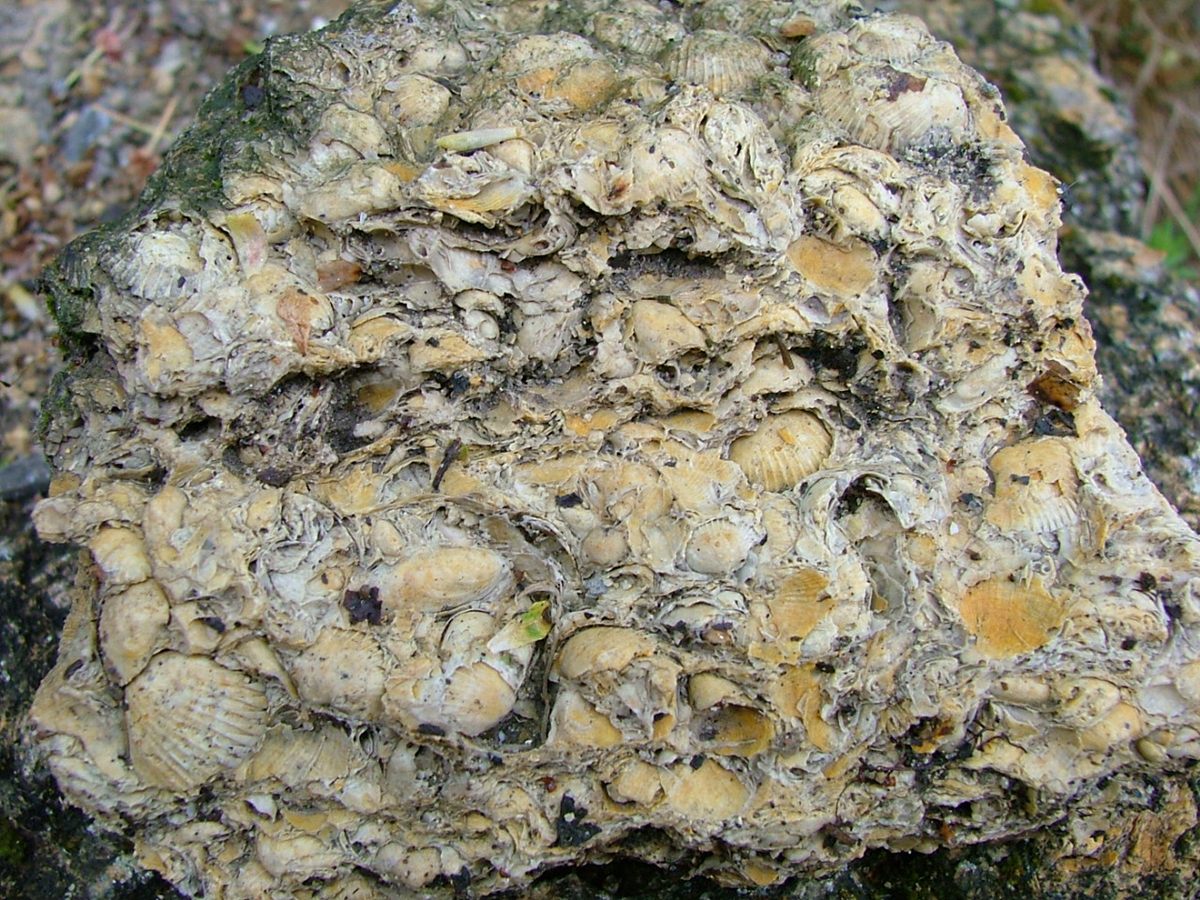
Coquina is a porous, poorly cemented limestone made almost entirely of broken shells of mollusks and other marine organisms. The word is Spanish for 'shellfish' or 'cockle.'
Coquina is a porous, poorly cemented limestone made almost entirely of broken shells of mollusks and other marine organisms. The word is Spanish for "shellfish" or "cockle."
🪨 Geology Guide Specimen: Open Coquina in the CRV Science Rock & Mineral ID Guide to log the specimen, compare it with the other 6 subgroups of Sedimentary, and test your eye in LithoClade.
Shell Hash: How Does Coquina Form?
Waves and currents break shells into fragments and winnow away the mud, leaving a loose pile of shell hash on a beach or shoal. Calcite cement then forms at the contact points between fragments, binding them while leaving many open pores.
Florida Coquina: Why Did It Build a Fort?
Coquina of the Anastasia Formation along Florida's Atlantic coast was quarried to build the Castillo de San Marcos at St. Augustine in the late 1600s. Its porous structure absorbs the impact of cannonballs rather than shattering, so shots tended to embed in the walls.
Relatives: How Does Coquina Differ from Other Limestones?
Unlike a typical fossiliferous limestone, in which whole fossils sit in fine mud, coquina is nearly all fragments and has little matrix. It is a high-energy deposit, and it is less strongly lithified than chalk or oolitic limestones.
Coquina at a Glance
| Property | Value |
|---|---|
| Type / variety | Porous Mollusk-Fragment Biocalcarenite |
| Composition | 100% Loosely Cemented Bivalve & Gastropod Shell Fragments (CaCO₃) |
| Geology Guide group | Sedimentary Rocks (Clastic, Chemical & Biogenic) |
| Rock Classification | Carbonates (Limestones & Dolostone) |
| Mohs hardness | Mohs 3 |
| Texture / habit | Coarse, porous open-framework of wave-broken shells |
| Density | 1.80–2.30 g/cm³ (highly porous) |
| Lustre and cleavage | Cream-to-buff shell hash with very little fine matrix |
| Geological setting | Wave-washed tropical/subtropical barrier bars and beaches (e.g., Florida) |
| Diagnostic feature (Geology Guide) | Porous, cream-colored rock resembling a solidified granola bar of broken clam and snail shells cemented together at their contact points after waves winnowed away all fine mud. |
| Name origin | Spanish coquina, "shellfish" |
| Famous use | Castillo de San Marcos, Florida |
See Also
- Fossiliferous Limestone — a limestone with fossils in a finer matrix
- Chalk — a fine-grained carbonate
- Great Scallop — a modern shell-forming bivalve