Great Scallop
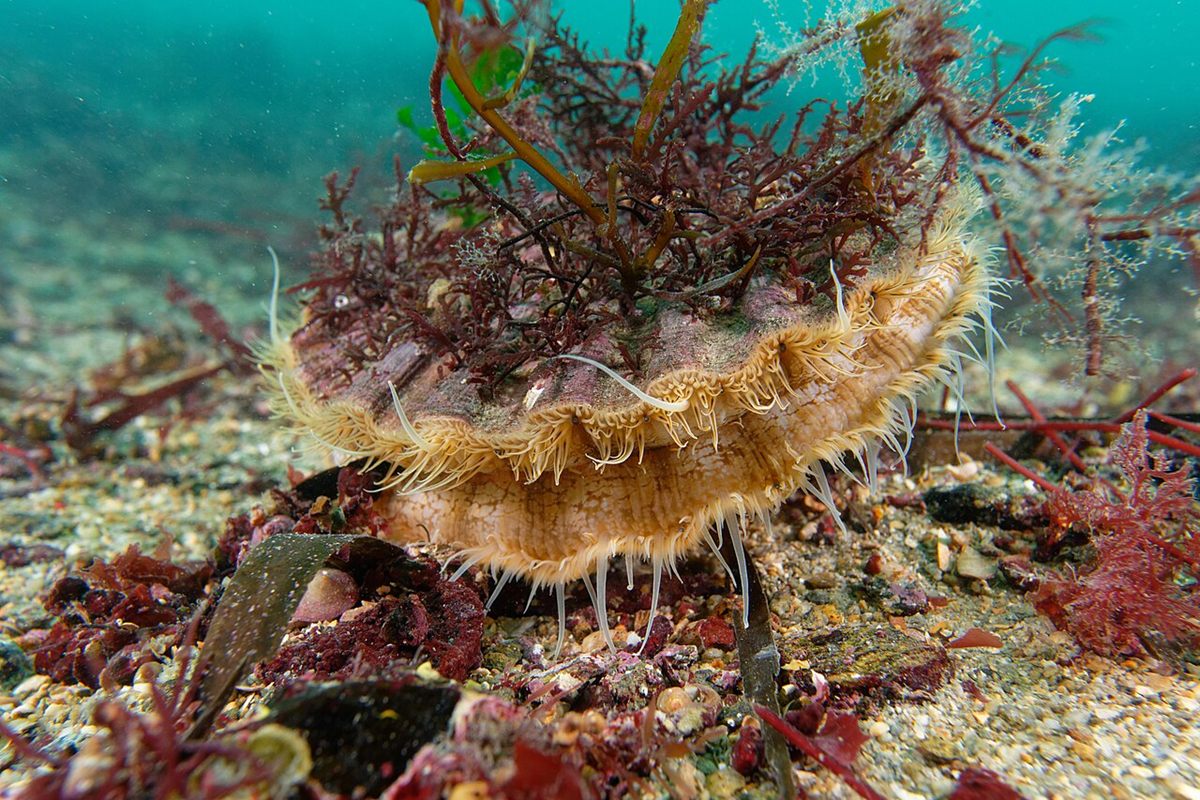
The great scallop (Pecten maximus) is a large bivalve of the northeastern Atlantic with a fan-shaped shell. Unlike most bivalves it can swim, and its mantle edge is lined with up to about a hundred tiny blue eyes.
The great scallop (Pecten maximus) is a large bivalve of the northeastern Atlantic with a fan-shaped shell. Unlike most bivalves it can swim, and its mantle edge is lined with up to about a hundred tiny blue eyes.
🧬 Field Guide Specimen: Open Great Scallop in the CRV Science Field Guide to log the specimen, see its place among the Lophotrochozoa lineages in the Cladogram Explorer, and test your recall in the Red List conservation game.
Eyes With Mirrors
Each eye has a lens and a mirror at the back made of layers of square guanine crystals, which reflects light onto the retina. The scallop uses the eyes to detect shadows and movement of predators such as starfish, closing its shell or swimming away.
Swimming by Clapping
The scallop snaps its two shells together, forcing out jets of water. It can dart away from a starfish with a series of claps. A single large muscle (the "meat" that is eaten) powers the shell.
Fisheries and the Shell Symbol
Scallop fisheries use dredges that can damage the seabed. The shell has been a symbol since antiquity, from Botticelli's Venus to the pilgrim badge of Saint James. See Blue Mussel.
Great Scallop at a Glance
| Property | Value |
|---|---|
| Scientific name | Pecten maximus |
| Kingdom | Animalia |
| Phylum | Mollusca |
| Class | Bivalvia |
| Order | Pectinida |
| Family | Pectinidae |
| Field Guide group | Lophotrochozoa: Mollusca (Mollusks) |
| Diagnostic feature (Field Guide) | Fan-shaped ribbed shell with one flat and one cupped half; claps them shut to swim and watches with up to 200 tiny mirror eyes. |
| Class | Bivalvia |
| Eyes | Up to about 100 along the mantle |
See Also
- Blue Mussel — another bivalve
- Common Starfish — a scallop predator