Pacific Geoduck
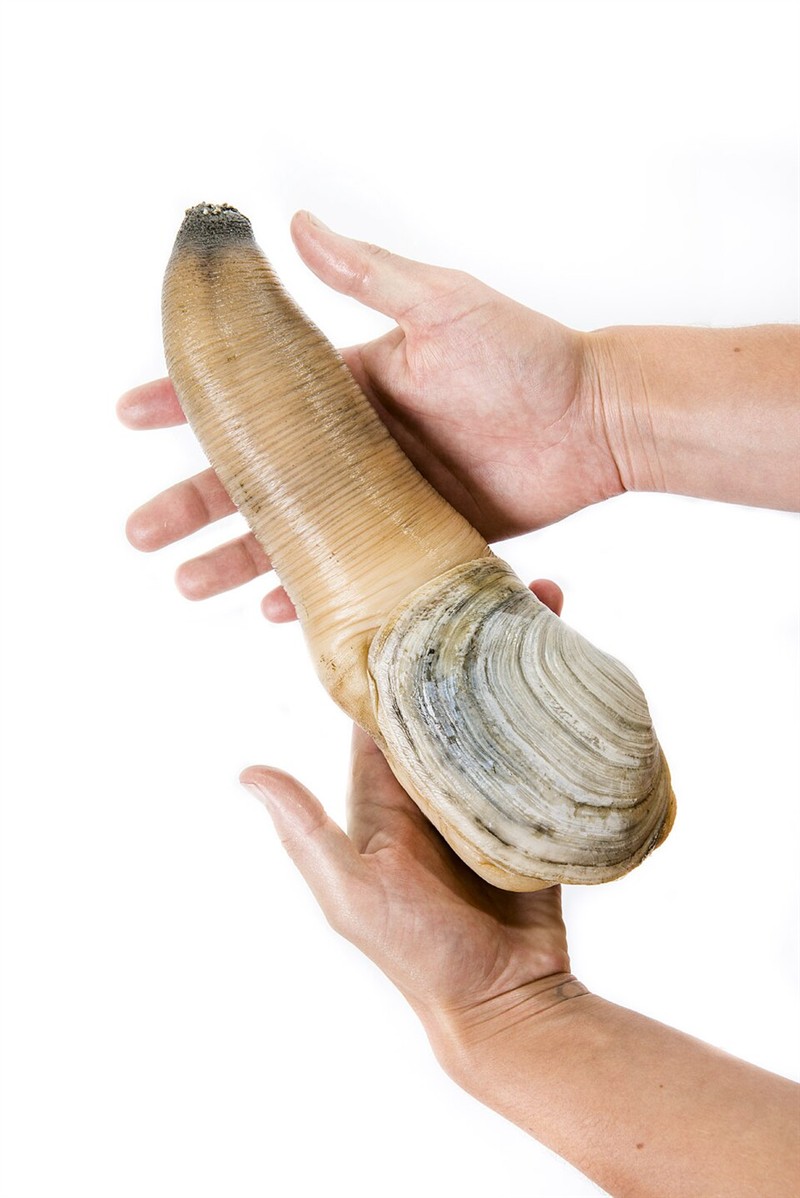
The Pacific geoduck (Panopea generosa) is the world's largest burrowing clam, with a shell about 20 centimeters long and a neck-like siphon that can reach a meter. It lives buried deep in the sandy seabed of the Pacific Northwest.
The Pacific geoduck (Panopea generosa) is the world's largest burrowing clam, with a shell about 20 centimeters long and a neck-like siphon that can reach a meter. It lives buried deep in the sandy seabed of the Pacific Northwest.
🧬 Field Guide Specimen: Open Pacific Geoduck in the CRV Science Field Guide to log the specimen, see its place among the Lophotrochozoa lineages in the Cladogram Explorer, and test your recall in the Red List conservation game.
A Very Long Siphon
The clam lives up to a meter below the surface and extends its siphon to the surface to draw in and expel water. The siphon is too large for the shell to enclose. The name is from a Lushootseed word, gʷidəq.
Over a Century Old
Geoducks grow quickly at first, then slowly, and may live more than 150 years. Growth rings in the shell record past ocean conditions.
Harvest and Farming
Geoducks are harvested by divers using water jets, and farmed in Puget Sound, a high-value export to Asia. See Giant Clam.
Pacific Geoduck at a Glance
| Property | Value |
|---|---|
| Scientific name | Panopea generosa |
| Kingdom | Animalia |
| Phylum | Mollusca |
| Class | Bivalvia |
| Order | Adapedonta |
| Family | Hiatellidae |
| Field Guide group | Lophotrochozoa: Mollusca (Mollusks) |
| Diagnostic feature (Field Guide) | Large deep-burrowing Northeast Pacific marine mollusk with a rectangular gaping calcareous shell up to 20 cm long that cannot fully enclose its massive, fused muscular siphon, which can extend over 1 meter and live for more than 140 years. |
| Class | Bivalvia |
| Possible lifespan | More than 150 years |
See Also
- Giant Clam — a giant bivalve
- Great Scallop — a swimming bivalve