Giant Clam
The giant clam (Tridacna gigas) is the largest living bivalve, with a shell up to about 1.2 meters across and a mass of more than 200 kilograms. It lives on Indo-Pacific coral reefs and was uplisted to Critically Endangered by the IUCN in 2024.
The giant clam (Tridacna gigas) is the largest living bivalve, with a shell up to about 1.2 meters across and a mass of more than 200 kilograms. It lives on Indo-Pacific coral reefs and was uplisted to Critically Endangered by the IUCN in 2024.
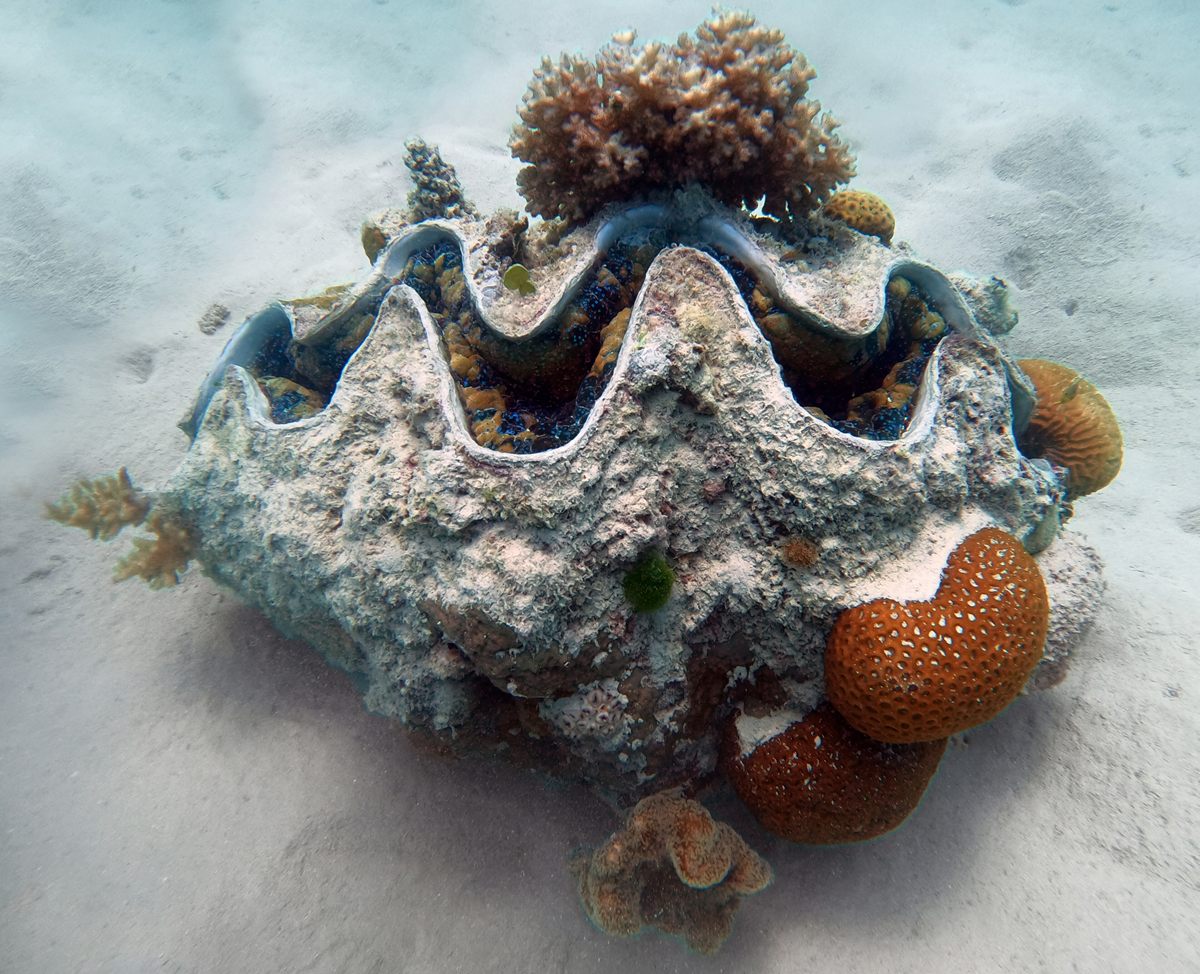
🧬 Field Guide Specimen: Open Giant Clam in the CRV Science Field Guide to log the specimen, see its place among the Lophotrochozoa lineages in the Cladogram Explorer, and test your recall in the Red List conservation game.
Farming Algae in the Mantle
The brightly colored mantle tissue exposed at the shell opening houses symbiotic algae (zooxanthellae), which provide much of the clam's food through photosynthesis. Reflective cells in the mantle scatter light so that algae deep in the tissue receive an even dose, an arrangement akin to a solar panel.
Overharvest
The clams are collected for meat and shells, and international trade is restricted under CITES Appendix II. The 2024 assessment found steep declines across the range. Because they grow slowly and must live near each other to reproduce, local populations recover poorly.
Life Span and Reproduction
Giant clams may live for a century. Each is a hermaphrodite that releases sperm and eggs into the water, and larvae settle on the reef after drifting for days. See Coral bleaching for the threat that heat poses to symbioses like this.
Giant Clam at a Glance
| Property | Value |
|---|---|
| Scientific name | Tridacna gigas |
| Kingdom | Animalia |
| Phylum | Mollusca |
| Class | Bivalvia |
| Order | Cardiida |
| Family | Cardiidae |
| Field Guide group | Lophotrochozoa: Mollusca (Mollusks) |
| Diagnostic feature (Field Guide) | Fluted shell valves with 4-5 folds, iridescent mantle harboring symbiotic zooxanthellae, loss of radula. |
| IUCN Red List status | Critically Endangered (CR), assessed 2024 |
| Maximum shell width | About 1.2 meters |