Phycomyces
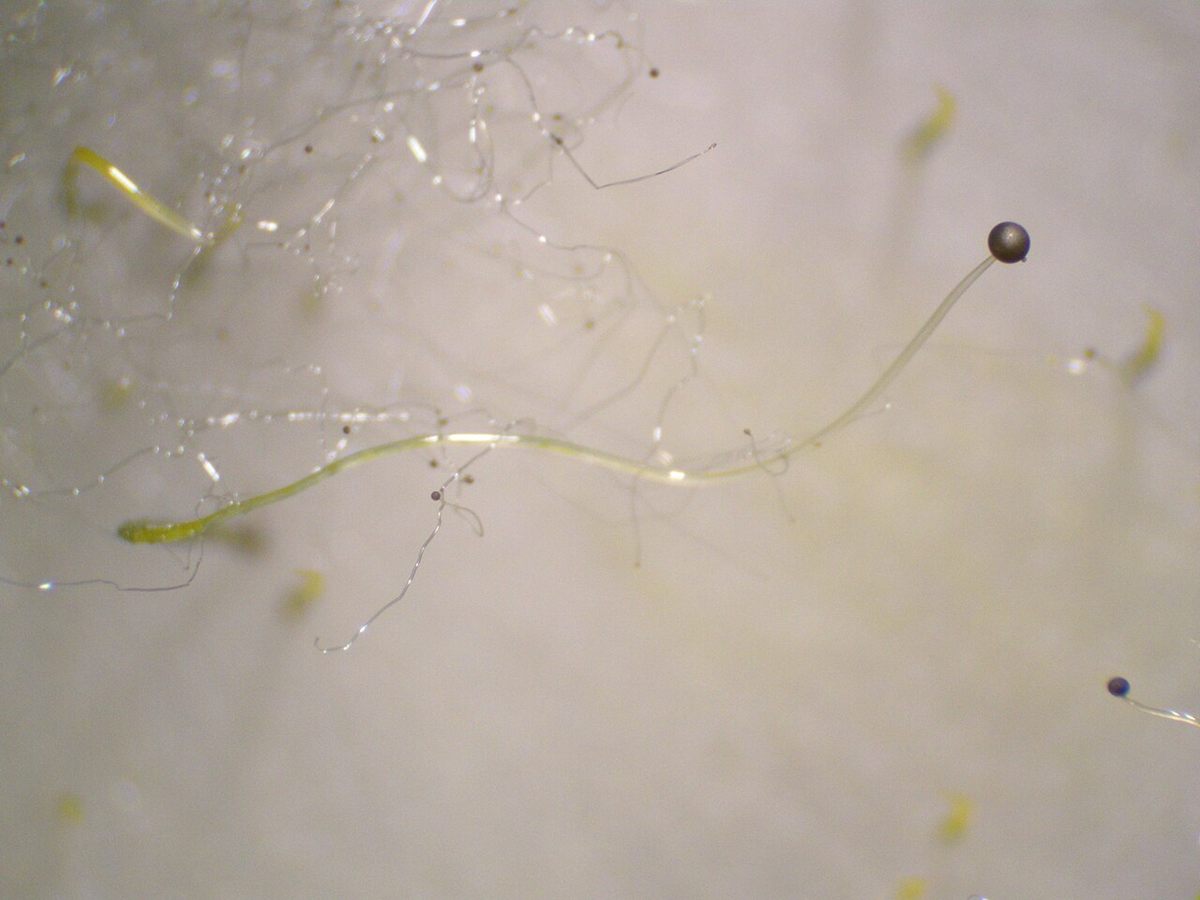
Phycomyces blakesleeanus is a mold whose tall, single-celled stalks can sense light, gravity, touch and even nearby objects. It is a classic organism for studying sensory physiology.
Phycomyces blakesleeanus is a mold whose tall, single-celled stalks can sense light, gravity, touch and even nearby objects. It is a classic organism for studying sensory physiology.
🧬 Field Guide Specimen: Open Phycomyces in the CRV Science Field Guide to log the specimen, see its place among the Opisthokonta lineages in the Cladogram Explorer, and test your recall in the Red List conservation game.
A Fungus That Sees: Extraordinary Light Sensitivity
The sporangiophores bend toward light and can adapt over a range of light intensity of more than a billion-fold, a larger range than most eyes. Max Delbrück and his colleagues used it to study how a single cell senses and responds to stimuli.
Growth by Stretch
The stalk is a giant cell that elongates quickly in a growth zone just under the sporangium. It spirals as it grows, and avoids obstacles by sensing air currents they change.
Relative of Black Bread Mold
Phycomyces belongs to Mucorales. See Black Bread Mold.
Phycomyces at a Glance
| Property | Value |
|---|---|
| Scientific name | Phycomyces blakesleeanus |
| Kingdom | Fungi |
| Phylum | Mucoromycota |
| Class | Mucoromycetes |
| Order | Mucorales |
| Family | Phycomycetaceae |
| Field Guide group | Opisthokonta: Fungi (True Fungi & Lichens) |
| Diagnostic feature (Field Guide) | Giant single-celled stalks several centimeters tall topped with black spore balls; the stalks bend toward light, a classic model for how fungi sense light. |
| Order | Mucorales |
| Sensitivity | Light, gravity, touch and wind |
See Also
- Black Bread Mold — a related mold
- Common Pinmold — a phototropic mold