Red Velvet Mite
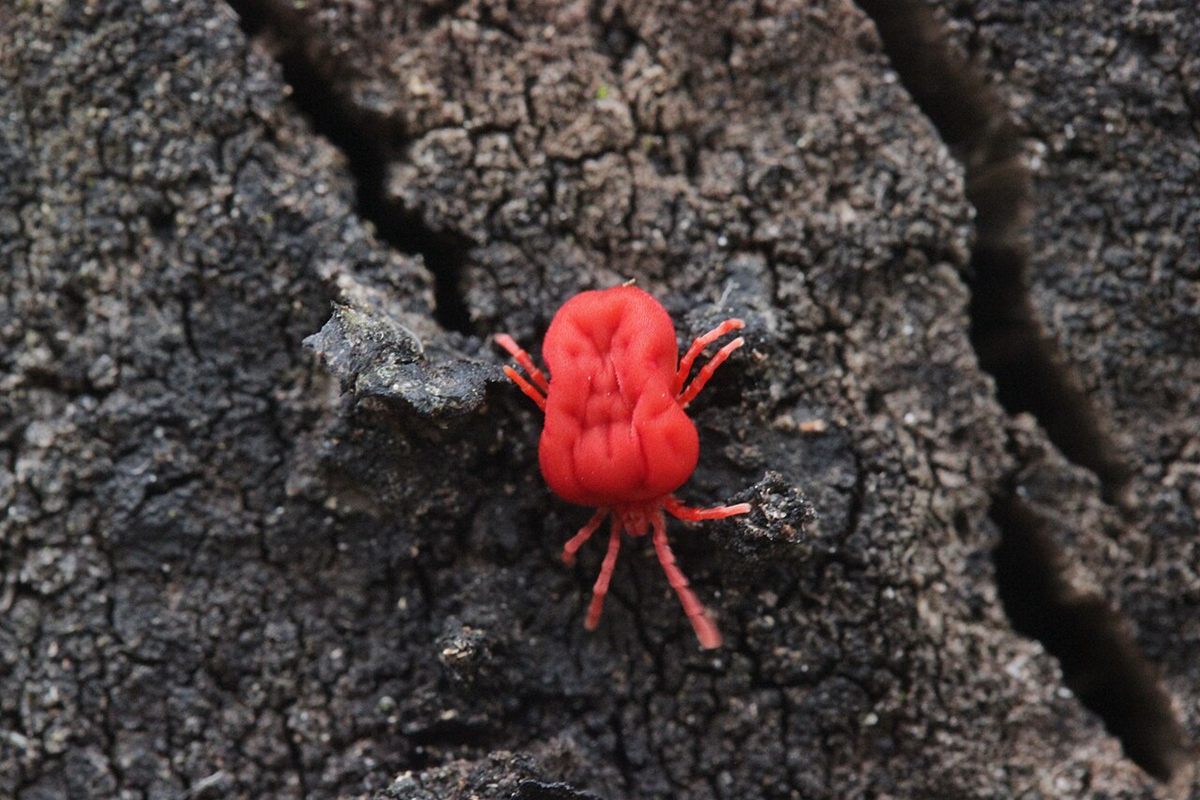
The red velvet mite (Trombidium holosericeum) is a bright red, velvety mite a few millimeters long that appears on the ground after rain in Europe. It is harmless to people.
The red velvet mite (Trombidium holosericeum) is a bright red, velvety mite a few millimeters long that appears on the ground after rain in Europe. It is harmless to people.
🧬 Field Guide Specimen: Open Red Velvet Mite in the CRV Science Field Guide to log the specimen, see its place among the Ecdysozoa lineages in the Cladogram Explorer, and test your recall in the Red List conservation game.
Red Velvet Mite at a Glance
| Property | Value |
|---|---|
| Scientific name | Trombidium holosericeum |
| Kingdom | Animalia |
| Phylum | Arthropoda |
| Class | Arachnida |
| Order | Trombidiformes |
| Family | Trombidiidae |
| Field Guide group | Ecdysozoa: Arachnida (Spiders, Scorpions & Allies) |
| Diagnostic feature (Field Guide) | Bright red, velvety, oval body with no visible division between front and rear; larvae parasitize other arthropods. |
| Order | Trombidiformes |
| Larval stage | Parasitic on arthropods |
Evolutionary Systematics and Comparative Anatomy
Trombidium holosericeum, described by Carl Linnaeus in 1758, serves as the type species of the genus Trombidium and the family Trombidiidae within the suborder Prostigmata (Order Trombidiformes, Superorder Acariformes). Within the cohort Parasitengona—a radiation that unites terrestrial velvet mites, chiggers (Trombiculidae), and secondary freshwater mites (Hydrachnidia)—T. holosericeum exemplifies the heteromorphic developmental architecture of the clade. Distributed across the Palearctic realm from western Europe through central Siberia, it is among the largest terrestrial mites in temperate ecosystems, with post-larval adults reaching 3.0 to 5.0 mm in body length.
Like other acariform arachnids, the body of T. holosericeum is divided functionally into an anterior gnathosoma, which bears the trophic appendages, and a posterior idiosoma, which houses the locomotor, digestive, excretory, and reproductive systems. Externally, no transverse suture separates the prosoma from the opisthosoma, giving the idiosoma a subrectangular, pillow-like profile with a slight posterior indentation and rounded humeral shoulders. The cuticular surface is clothed in a dense pelage of plumose, papillate setae measuring 30 to 60 μm in length. Along the anteromedian dorsal region of the idiosoma lies the crista metopica, a sclerotized longitudinal rod bearing a rounded sensory area (the areola) with two fine trichobothria that detect low-frequency substrate vibrations and air currents.
Flanking the crista metopica are paired, stalked double eyes (pedunculate ocelli), each containing two biconvex cuticular lenses positioned above pigmented retinular cells. The gnathosoma incorporates two-segmented chelicerae in which the distal movable digit is modified into a curved, serrated blade used for piercing prey cuticle, flanked by five-segmented pedipalps. The fourth segment of each pedipalp (the palpal tibia) bears a stout terminal odontus (claw), while the fifth segment (the palpal tarsus) articulates ventrolaterally at the base of the tibia to create a subchelate "thumb-claw" complex used for grasping and manipulating small arthropods and insect eggs.
Physiology, Cuticular Biochemistry, and Water Balance
The scarlet coloration of T. holosericeum results from high concentrations of keto-carotenoids—predominantly astaxanthin, canthaxanthin, and beta-carotene derivatives—dissolved within lipid droplets in the subcuticular epidermis and hemolymph. These carotenoids serve a dual physiological role: they scavenge reactive oxygen species generated by solar ultraviolet radiation during diurnal surface foraging, and they act as an aposematic visual warning to visual predators such as insectivorous birds, lizards, and carabid beetles. Bioassays demonstrate that vertebrate and invertebrate predators reject T. holosericeum upon contact with secretome compounds released from dermal glands along the idiosoma.
Because terrestrial mites possess a high surface-area-to-volume ratio, evaporative water loss across the flexible, unsclerotized idiosomal cuticle represents a primary physiological constraint. The dense coat of plumose dorsal setae traps a stagnant boundary layer of air next to the epicuticle, reducing convective moisture loss in dry microhabitats while simultaneously creating a superhydrophobic outer surface (a Cassie-Baxter wetting state). When heavy rainfall floods soil burrows, this trapped air film prevents liquid water from occluding the paired stigmata located at the base of the chelicerae, allowing gas exchange to continue into the internal network of unbranched tracheae.
Respiration and locomotion rely on a combination of intrinsic muscles and hydrostatic hemolymph pressure. Dorso-ventral muscle bundles traversing the idiosoma contract to pressurize the hemocoel, extending the eight seven-segmented walking legs, each of which terminates in paired tarsal claws and a central empodium. Digestion is largely extra-oral: after piercing an insect egg or soft-bodied soil collembolan with its cheliceral blades, the mite injects proteolytic and lipolytic enzymes from prosomal salivary glands, then aspirates the liquefied contents via a muscular pharyngeal pump into a blind midgut (ventriculus) that lacks a functional connection to the hindgut. Nitrogenous wastes, primarily guanine, are concentrated in a median excretory organ (the uropore) and voided as crystalline pellets.
Trophic Ecology, Heteromorphic Life Cycle, and Reproduction
Trombidium holosericeum undergoes a complex, seven-stage life cycle characteristic of the Parasitengona, alternating between active and quiescent (calyptostase) instars: egg, prelarva (deutovum), hexapod larva, protonymph (nymphochrysalis), octopod deutonymph, tritonymph (imagochrysalis), and octopod adult. This ontogeny partitions ecological niches between developmental stages, preventing intraspecific competition between juveniles and adults while enabling long-distance dispersal via winged hosts.
In spring, females deposit clusters of 100 to 400 spherical, orange-red eggs in moist soil crevices at depths of 2 to 10 cm. After passing through an inactive prelarval stage within the chorion, six-legged larvae measuring roughly 250 to 300 μm hatch and climb onto herbaceous vegetation. Unlike the larvae of trombiculid chiggers, which feed on vertebrate skin tissues, T. holosericeum larvae are ectoparasites of terrestrial arthropods, attaching to Orthoptera (grasshoppers), Coleoptera, Lepidoptera, Diptera, and Arachnida (harvestmen and spiders). The larva inserts its chelicerae through the host's intersegmental membrane and secretes a proteinaceous feeding tube (stylostome) to draw hemolymph over several days. Once engorged, the larva drops to the soil, enters the quiescent protonymphal stage, and reorganizes its internal tissues before emerging as a free-living, eight-legged predatory deutonymph.
Both deutonymphs and adults are edaphic predators that regulate populations of agricultural and silvicultural pests. Foraging on the soil surface after spring and summer rains, they consume the eggs of locusts, Colorado potato beetles (Leptinotarsa decemlineata), aphids, and dipterans, as well as nematodes and springtails. Sperm transfer is indirect: during courtship, the male performs an encircling walk around the female, lays down silken signaling threads on the substrate, and deposits a stalked spermatophore crowned with a viscous sperm droplet, which the female takes up into her genital opening.
Frequently Asked Questions
Do red velvet mites bite humans or transmit vector-borne diseases?
No, Trombidium holosericeum is harmless to humans and domestic mammals. Its chelicerae are adapted for puncturing insect eggs in the adult and deutonymphal stages, while its six-legged larvae parasitize insects and spiders rather than vertebrates. People sometimes confuse them with chiggers (family Trombiculidae), which are microscopic larval mites of a separate family that cause skin irritation.
Why do red velvet mites emerge in large numbers right after spring rainstorms?
During dry periods, adult velvet mites remain buried several centimeters deep in soil crevices to prevent desiccation across their soft cuticle. When spring rain saturates the topsoil and raises surface relative humidity near 100%, the mites emerge simultaneously to mate, deposit spermatophores without them drying out, and hunt freshly laid insect eggs on the damp litter layer.
How can an observer distinguish a red velvet mite from a clover mite or a tick?
Unlike hard ticks (Ixodidae) or soft ticks (Argasidae), Trombidium holosericeum possesses a bright scarlet coat of velvety hairs, a thumb-claw complex on its pedipalps, and a body constriction behind the second pair of legs. Compared to the much smaller plant-feeding clover mite (Bryobia praetiosa), the red velvet mite is five to ten times larger and has front legs of normal length.
References
- Mąkol, J., & Wohltmann, A. (2012). An annotated checklist of terrestrial Parasitengona (Actinotrichida: Prostigmata) of the world, excluding Trombiculidae and Walchiidae. Annales Zoologici, 62(3), 359–562. https://doi.org/10.3161/000345412X656671
- Shatrov, A. B. (2009). Stylostome formation in trombiculid mites (Acariformes: Trombiculidae). Experimental and Applied Acarology, 49(4), 261–280. https://doi.org/10.1007/s10493-009-9264-0
- Witte, H. (1991). Indirect sperm transfer in prostigmatic mites from a phylogenetic viewpoint. In R. Schuster & P. W. Murphy (Eds.), The Acari: Reproduction, Development and Life-History Strategies (pp. 137–176). Springer. https://doi.org/10.1007/978-94-011-3102-5_8
- Wohltmann, A. (2000). The evolution of life histories in Parasitengona (Acari: Prostigmata). Acarologia, 41(1–2), 145–204. https://doi.org/10.1051/acarologia/20101958