Castor Bean Tick
The castor bean tick or sheep tick (Ixodes ricinus) is the main tick in Europe and the chief vector of Lyme disease and tick-borne encephalitis there. It waits in damp vegetation and clings to passing animals.
The castor bean tick or sheep tick (Ixodes ricinus) is the main tick in Europe and the chief vector of Lyme disease and tick-borne encephalitis there. It waits in damp vegetation and clings to passing animals, parasitizing more than 300 species of terrestrial vertebrates across deciduous woodlands, heathlands, and humid pastures from Ireland and Iberia to the Ural Mountains and North Africa. As a three-host hard tick (family Ixodidae) whose engorged adult female swells to the size and mottled blue-gray appearance of a castor oil seed (Ricinus communis), Ixodes ricinus relies on foreleg Haller's organs to detect host kairomones during questing, anchors into host dermis with a recurved hypostome and cement cone, modulates host hemostasis and immunity through pharmacological saliva, and transmits a diverse guild of bacterial, viral, and protozoan pathogens across the western Palearctic.
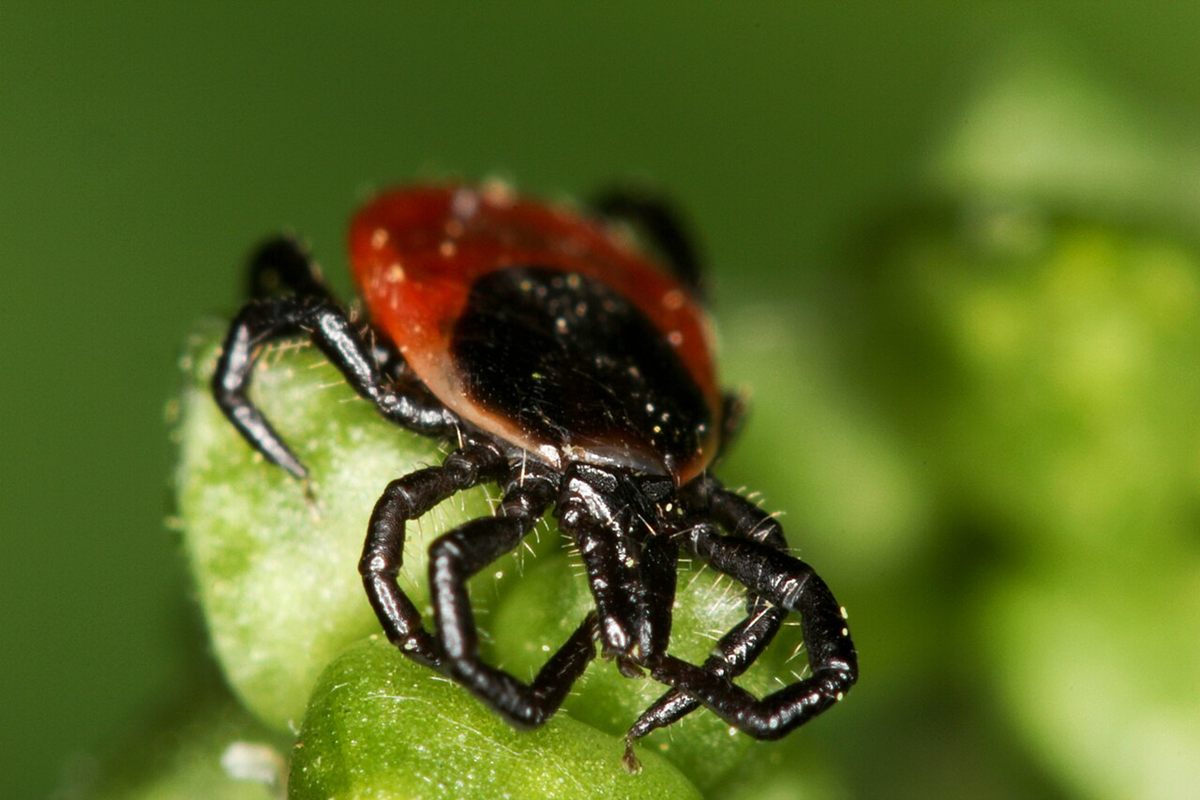
🧬 Field Guide Specimen: Open Castor Bean Tick in the CRV Science Field Guide to log the specimen, see its place among the Ecdysozoa lineages in the Cladogram Explorer, and test your recall in the Red List conservation game.
Castor Bean Tick at a Glance
| Property | Value |
|---|---|
| Scientific name | Ixodes ricinus |
| Kingdom | Animalia |
| Phylum | Arthropoda |
| Class | Arachnida |
| Order | Ixodida |
| Family | Ixodidae |
| Field Guide group | Ecdysozoa: Arachnida (Spiders, Scorpions & Allies) |
| Diagnostic feature (Field Guide) | Eight-legged blood-feeder that swells like a bean when full; barbed hypostome anchors it into skin; spreads Lyme disease in Europe. |
| Order | Ixodida |
| Diseases | Lyme disease and tick-borne encephalitis |
Taxonomy, Phylogenetics, and the Ixodes ricinus Species Complex
Systematics Within the Prostriate Hard Ticks (Ixodidae)
Formally named Acarus ricinus by Carl Linnaeus in his 1758 Systema Naturae and transferred to the genus Ixodes by Pierre André Latreille in 1795, Ixodes ricinus belongs to the order Ixodida (superorder Parasitiformes, subclass Acari) and the family Ixodidae (hard ticks, characterized by a sclerotized dorsal scutum and an anteriorly projecting capitulum or gnathosoma). Within Ixodidae, the subfamily Ixodinae (the Prostriata, comprising the single genus Ixodes with ~250 species) forms the basal sister clade to all other hard ticks (the Metastriata: Amblyomma, Dermacentor, Haemaphysalis, Hyalomma, and Rhipicephalus). Prostriate ticks are anatomically distinguished by an anal groove that arches anteriorly around the anus rather than posteriorly, the absence of eyes and festoons along the posterior idiosomal margin, and strong sexual dimorphism in which only males possess a full dorsal scutum and functional mouthparts that rarely engorge.
Phylogenetically, Ixodes ricinus is the nominal member of the holarctic Ixodes ricinus species complex (subgenus Ixodes), which includes the western Palearctic I. ricinus, the eastern Palearctic taiga tick (Ixodes persulcatus), the North African sibling species Ixodes inopinatus (described in 2014), the eastern North American Blacklegged Tick (Ixodes scapularis), and the western North American western blacklegged tick (Ixodes pacificus). All four major temperate species occupy homologous ecological niches in humid forest leaf litter and serve as the primary bridge vectors of Borrelia burgdorferi sensu lato spirochetes to humans across the Northern Hemisphere.
Functional Anatomy, Questing Neurobiology, and Blood-Feeding Physiology
Haller's Organ, Water Balance, and Three-Host Questing
Ixodes ricinus completes a three-host life cycle requiring two to four years (up to six years at subarctic latitudes), passing through egg, six-legged larva, eight-legged nymph, and eight-legged adult stages. Each post-embryonic instar feeds only once for 3 to 10 days before detaching and dropping into the leaf litter to molt (or, in adult females, to oviposit 1,500 to 2,500 eggs coated in protective waterproofing lipids from Gené's organ before dying). Still, ticks spend more than 98% of their lifespan off-host inside the humid microclimate of the forest floor.
When searching for a vertebrate host (questing), the tick climbs herbaceous stems or bracken to a height stratified by developmental stage—larvae at 0–15 cm (targeting wood mice Apodemus sylvaticus, bank voles Myodes glareolus, and ground-foraging songbirds), nymphs at 15–50 cm (targeting medium-sized mammals, birds, and humans), and adults at 50–100 cm (targeting roe deer Capreolus capreolus, red deer Cervus elaphus, sheep, and cattle). With its first pair of walking legs extended anteriorly like insect antennae, the tick scans the air using Haller's organ, a complex sensory capsule on the dorsal surface of tarsus I containing an anterior pit and posterior capsule. Bipolar olfactory and thermoreceptive neurons inside Haller's organ respond to host-emitted CO2 plumes, butyric acid, ammonia, lactic acid, 800–1,000 nm infrared thermal radiation, and substrate vibrations. Because questing exposes the tick to desiccating air when relative humidity drops below its critical equilibrium activity threshold (~80%–85% RH), I. ricinus periodically descends into damp moss to actively absorb water vapor from unsaturated air by secreting a hygroscopic, deliquescent salt solution from its type I salivary acini onto the hypostome and drinking the rehydrated droplet.
| Anatomical / Biochemical System | Structural or Molecular Mechanism | Role in Parasitism and Pathogen Transmission |
|---|---|---|
| Haller's organ (tarsus I) | Capsule and anterior pit with chemosensory/thermosensory sensilla | Detects host CO2, ammonia, butyric acid, and infrared body heat during questing |
| Chelicerae & barbed hypostome | Telescoping cutting digits + ventral denticulate harpoon + cement cone | Lacerates host dermis and anchors gnathosoma for multi-day blood meal |
| Type I–III salivary acini | Hygroscopic salt secretion (off-host) + osmoregulatory fluid return (on-host) | Absorbs atmospheric water vapor in litter; excretes excess Na+ and H2O back into host |
| Salivary sialome (Salp15, ixolaris) | Tissue-factor pathway inhibitors, anticomplement proteins, histamine-binding lipocalins | Blocks coagulation, suppresses pain/itch, and shields Borrelia from host antibodies |
| Alloscutum cuticular unfolding | Unhardened pleated opisthosomal cuticle with plasticization during slow phase | Allows adult female body mass to increase 80- to 120-fold during final rapid engorgement |
Gnathosomal Anchoring, Cuticular Plasticization, and Saliva-Assisted Transmission
Once aboard a host, Ixodes ricinus crawls to a thin-skinned, sheltered site and inserts its mouthparts. Paired telescoping chelicerae armed with lateral cutting teeth saw through the stratum corneum and epidermis, allowing the median ventral hypostome—covered in transverse rows of backward-pointing recurved denticles—to slide into the dermis alongside a secreted proteinaceous cement cone that glues the mouthparts in place. Over a 4- to 7-day slow feeding phase, the female synthesizes new endocuticle while ingesting small volumes of blood from a hemorrhagic pool created in the dermis; during the final 12 to 24 hours (rapid engorgement phase), neuroendocrine plasticization stretches the extensible posterior alloscutum, expanding the female from ~2 mg unfed mass to 200–250 mg (an 80- to 120-fold increase). To concentrate the blood meal, the midgut epithelium absorbs water and electrolytes into the hemolymph, and type II and III salivary acini pump approximately 70% of ingested H2O and Na+ ions back into the host circulation.
Simultaneously, the salivary glands secrete hundreds of bioactive proteins (the sialome) that disarm host defenses: ixolaris and penthalaris inhibit coagulation Factor Xa/VIIa tissue factor complexes; apyrases degrade pro-aggregatory ADP to block platelet plug formation; lipocalins sequester histamine and serotonin to eliminate host itching and pain; and immunosuppressive proteins such as Salp15 inhibit CD4+ T-cell activation and complement-mediated lysis. This localized immunomodulation creates a privileged cutaneous microenvironment (saliva-assisted transmission, SAT) that enhances the survival and dissemination of tick-borne microbes.
Vector Competence, Pathobiology, and Climate-Driven Range Expansion
Ixodes ricinus is the preeminent arthropod disease vector in Europe, transmitting pathogens across four major taxonomic groups:
- Lyme Borreliosis (Borrelia burgdorferi sensu lato): Unlike North America, where B. burgdorferi sensu stricto predominates, European I. ricinus transmits multiple genospecies with distinct clinical tropisms: Borrelia afzelii (maintained in rodent reservoirs and causing cutaneous erythema migrans and acrodermatitis chronica atrophicans), Borrelia garinii and Borrelia bavariensis (associated with avian and rodent reservoirs and causing neuroborreliosis), and B. burgdorferi sensu stricto (associated with Lyme arthritis). During an blood meal, spirochetes residing in the tick midgut sense incoming blood temperature and pH, downregulate outer surface protein A (OspA, which tethers them to the midgut receptor TROSPA), upregulate OspC, migrate through the hemocoel to the salivary glands, and enter the host dermis after 24 to 48 hours of attachment.
- Tick-Borne Encephalitis Virus (TBEV): An orthoflavivirus (Flaviviridae) comprising European, Siberian, and Far Eastern subtypes. Because TBEV already resides within the salivary glands of unfed infected ticks, viral transmission occurs within minutes of bite initiation, and amplifies horizontally between co-feeding nymphs and larvae on non-viremic forest rodents.
- Intracellular Bacteria and Piroplasms: Ixodes ricinus also transmits Anaplasma phagocytophilum (granulocytic anaplasmosis in sheep, cattle, and humans), Borrelia miyamotoi (hard-tick relapsing fever), Neoehrlichia mikurensis, and the intraerythrocytic apicomplexan parasites Babesia divergens (bovine redwater fever and fatal human babesiosis in splenectomized patients) and Babesia microti.
Long-term field monitoring across Sweden, Norway, and the Alps demonstrates that anthropogenic Climate change, milder winters, extended autumn growing seasons, and expanding roe deer populations have enabled Ixodes ricinus to shift its distribution northward past 66° N latitude in Fennoscandia and upward from historical 600–800 m ceilings to 1,500–1,800 meters above sea level in Central European mountain ranges.
Frequently Asked Questions
Why does tick-borne encephalitis (TBE) transmit immediately upon a bite while Lyme disease usually takes 24 to 48 hours?
In an unfed Ixodes ricinus nymph or adult, Borrelia spirochetes lie dormant anchored to the inner wall of the midgut via the outer surface protein OspA; only after warm host blood enters the gut do the bacteria switch surface proteins from OspA to OspC, penetrate the gut wall, migrate to the salivary glands, and enter the bite wound—a physiological journey taking 16 to 48 hours. By contrast, tick-borne encephalitis virus (TBEV) replicates directly inside the tick's salivary acinar cells prior to feeding, meaning infectious virions are injected with the very first droplets of cement and anticoagulant saliva within minutes of skin penetration.
How does the castor bean tick survive for years between blood meals without drying out?
Between its three brief blood meals, Ixodes ricinus spends over 98% of its two- to four-year life cycle resting beneath damp leaf litter where relative humidity stays above 80%–85%. Whenever the tick loses body water while questing on dry grass tips, it climbs back down into the humid litter layer, secretes a concentrated, hygroscopic salt droplet from its type I salivary glands onto its mouthparts, allows water vapor from the air to condense into the salt droplet, and swallows the rehydrated fluid to restore its hemolymph volume.
Which Lyme disease bacteria are transmitted by Ixodes ricinus in Europe compared to North America?
Whereas the North American blacklegged tick (Ixodes scapularis) primarily transmits Borrelia burgdorferi sensu stricto (which frequently causes migratory large-joint arthritis), European Ixodes ricinus transmits a diverse species complex dominated by Borrelia afzelii (acquired from small rodents and associated with skin manifestations such as erythema migrans and acrodermatitis chronica atrophicans) and Borrelia garinii (acquired from ground-foraging birds and strongly linked to European Lyme neuroborreliosis, including facial nerve palsy and lymphocytic meningoradiculitis).
References
- Gray, J. S., Dautel, H., Estrada-Peña, A., Kahl, O., & Lindgren, E. (2009). Effects of climate change on ticks and tick-borne diseases in Europe. Interdisciplinary Perspectives on Infectious Diseases, 2009, 593232. https://doi.org/10.1155/2009/593232
- Medlock, J. M., Hansford, K. M., Bormane, A., Derdakova, M., Estrada-Peña, A., George, J.-C., Golovljova, I., Jaenson, T. G. T., Jensen, J.-K., Jensen, P. M., Kazimirova, M., Oteo, J. A., Papa, A., Pfister, K., Plantard, O., Randolph, S. E., Rizzoli, A., Santos-Silva, M. M., Sprong, H., Vial, L., Hendrickx, G., Zeller, H., & Van Bortel, W. (2013). Driving forces for changes in geographical distribution of Ixodes ricinus ticks in Europe. Parasites & Vectors, 6, 1. https://doi.org/10.1186/1756-3305-6-1
- Stanek, G., Wormser, G. P., Gray, J., & Strle, F. (2012). Lyme borreliosis. The Lancet, 379(9814), 461–473. https://doi.org/10.1016/S0140-6736(11)60103-760103-7)
- Nuttall, P. A. (2019). Wonders of tick saliva. Ticks and Tick-borne Diseases, 10(2), 470–481. https://doi.org/10.1016/j.ttbdis.2018.11.005