Ring-tailed Lemur
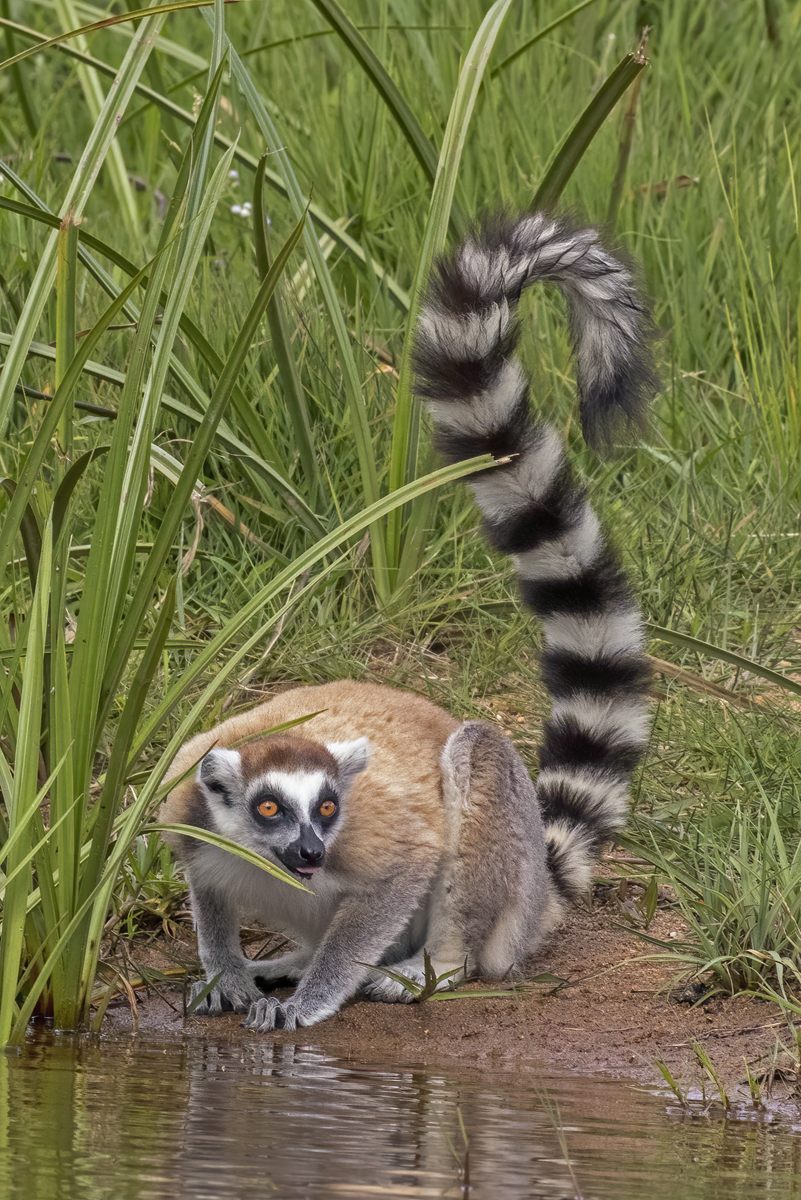
The ring-tailed lemur (Lemur catta) is a primate endemic to southern Madagascar, recognizable by its black-and-white banded tail.
The ring-tailed lemur (Lemur catta) is a primate endemic to southern Madagascar, recognizable by its black-and-white banded tail. It is listed as Endangered, with a shrinking population threatened by habitat loss, charcoal production, hunting and the pet trade.
🧬 Field Guide Specimen: Open Ring-tailed Lemur in the CRV Science Field Guide to log the specimen, see its place among the Mammals lineages in the Cladogram Explorer, and test your recall in the Red List conservation game.
Female-Led Troops and Scent Wars
Troops of about a dozen to thirty animals are led by dominant females. Males compete in "stink fights," waving their tails over scent glands on the wrists and forearms to waft odor toward rivals. Unlike most lemurs, ring-tails spend much of their time on the ground and sunbathe upright in the morning.
Island Evolution: How Did Lemurs Reach Madagascar?
Lemurs descend from ancestors that crossed the Mozambique Channel, probably by rafting on floating vegetation, roughly 50 to 60 million years ago. Isolation allowed them to radiate into more than a hundred species, which makes Madagascar a hot spot for primate diversity.
Conservation
Most of Madagascar's natural forest has been cleared, and ring-tailed lemurs depend on dry spiny forest and gallery forest in the south. Protected areas and community programs support the species, but its decline has been steep.
Ring-tailed Lemur at a Glance
| Property | Value |
|---|---|
| Scientific name | Lemur catta |
| Kingdom | Animalia |
| Phylum | Chordata |
| Class | Mammalia |
| Order | Primates |
| Suborder | Strepsirrhini |
| Field Guide group | Mammals: Eutheria (Placentals) |
| Diagnostic feature (Field Guide) | Black-and-white ringed tail, wet rhinarium nose, specialized dental grooming comb, opposable hallux. |
| IUCN Red List status | Endangered (EN) |
| Range | Southern Madagascar (endemic) |