Tokay Gecko
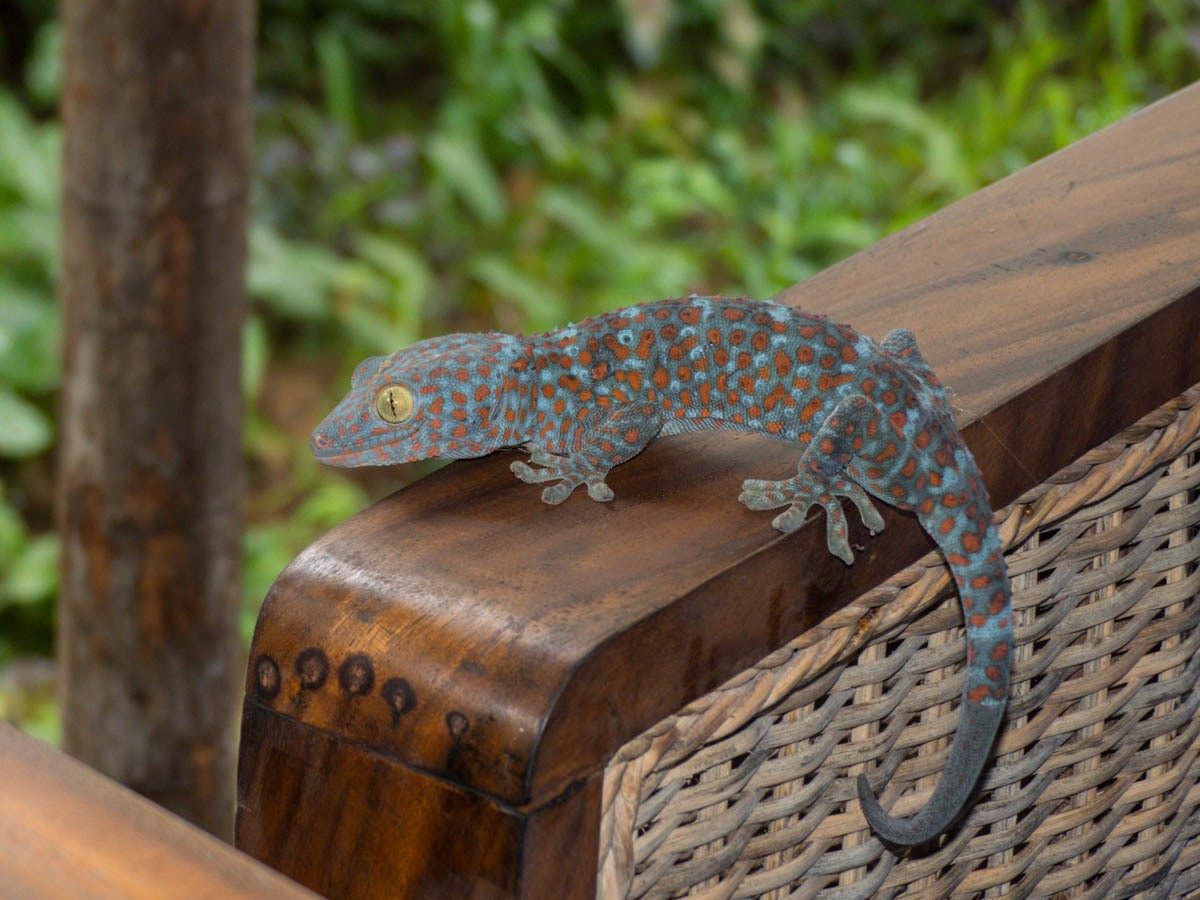
The tokay gecko (Gekko gecko) is a large, loudly vocal gecko of South and Southeast Asia, named for its call, a series of sharp 'to-kay' notes. It is a model system for the physics of adhesion.
The tokay gecko (Gekko gecko) is a large, loudly vocal gecko of South and Southeast Asia, named for its call, a series of sharp "to-kay" notes. It is a model system for the physics of adhesion.
🧬 Field Guide Specimen: Open Tokay Gecko in the CRV Science Field Guide to log the specimen, see its place among the Reptilia lineages in the Cladogram Explorer, and test your recall in the Red List conservation game.
Sticky Without Glue: How Do Gecko Toes Work?
Each toe pad carries millions of fine hairs (setae) that split into nanoscale tips (spatulae). The tips make such close contact with a surface that weak van der Waals forces, summed over billions of tips, hold the animal's weight. The adhesion works on glass and releases when the toe is peeled at an angle.
Defense and Calls
Tokays bite hard when handled and can drop their tail to escape a predator, regrowing it later. Males call loudly in the breeding season to defend territory.
Trade and Conservation
Large numbers are collected for the pet trade and traditional medicine, and the species was listed in CITES Appendix II in 2019 to regulate trade. It has also been introduced to Florida.
Tokay Gecko at a Glance
| Property | Value |
|---|---|
| Scientific name | Gekko gecko |
| Kingdom | Animalia |
| Phylum | Chordata |
| Class | Reptilia |
| Order | Squamata |
| Infraorder | Gekkota |
| Field Guide group | Reptilia (Reptiles) |
| Diagnostic feature (Field Guide) | Microscopic adhesive setae on toe lamellae utilizing intermolecular van der Waals forces, vocal barking. |
| IUCN Red List status | Least Concern (LC), assessed 2019 |
| Adhesion mechanism | Setae and van der Waals forces |
| Trade status | CITES Appendix II (2019) |
See Also
- Hydrogen bond — other weak intermolecular forces
- Biodiversity — wildlife trade