Water Flea
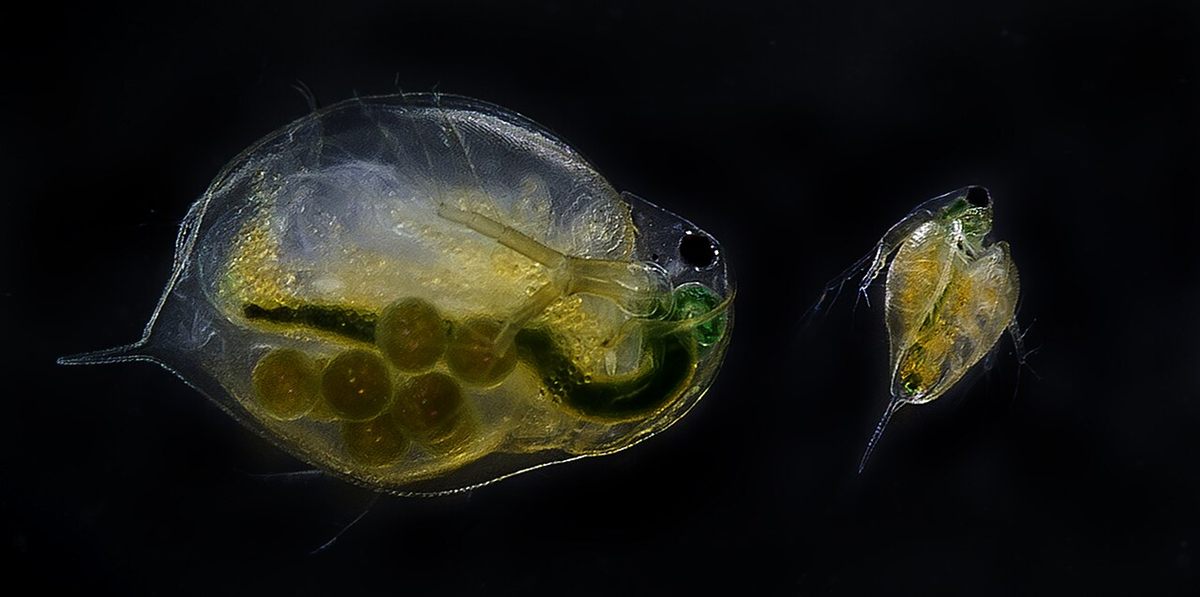
The water flea (Daphnia magna) is a small, transparent freshwater crustacean, a few millimeters long, that swims by beating its branched antennae. It is a key grazer in lakes and a standard model animal in ecology and toxicology.
The water flea (Daphnia magna) is a small, transparent freshwater crustacean, a few millimeters long, that swims by beating its branched antennae. It is a key grazer in lakes and a standard model animal in ecology and toxicology.
🧬 Field Guide Specimen: Open Water Flea in the CRV Science Field Guide to log the specimen, see its place among the Ecdysozoa lineages in the Cladogram Explorer, and test your recall in the Red List conservation game.
Clones and Sex: Cyclical Parthenogenesis
In good conditions, females produce eggs that develop without fertilization into more females. When food is scarce or the pond is drying, they produce males and sexual eggs enclosed in a tough case (ephippium) that survives winter. See Alleles and population genetics.
Shape-Shifting Defenses
When Daphnia detect chemicals released by predators, their offspring may grow helmets, spines or tail spikes. This inducible defense is a textbook example of phenotypic plasticity.
Genomes and Pollution
A relative, Daphnia pulex, was the first crustacean to have its genome sequenced in 2011. The animals are sensitive to chemicals, and are used in standard tests of water toxicity.
Water Flea at a Glance
| Property | Value |
|---|---|
| Scientific name | Daphnia magna |
| Kingdom | Animalia |
| Phylum | Arthropoda |
| Class | Branchiopoda |
| Order | Anomopoda |
| Family | Daphniidae |
| Field Guide group | Ecdysozoa: Mandibulata (Mandibulates) |
| Diagnostic feature (Field Guide) | Millimeter-scale transparent carapace enclosing the body, single compound eye, large forked antennae used for jerky 'hopping' swimming, visible beating heart. |
| Reproduction | Cyclical parthenogenesis |
| Use | Ecotoxicology tests |