American Paddlefish
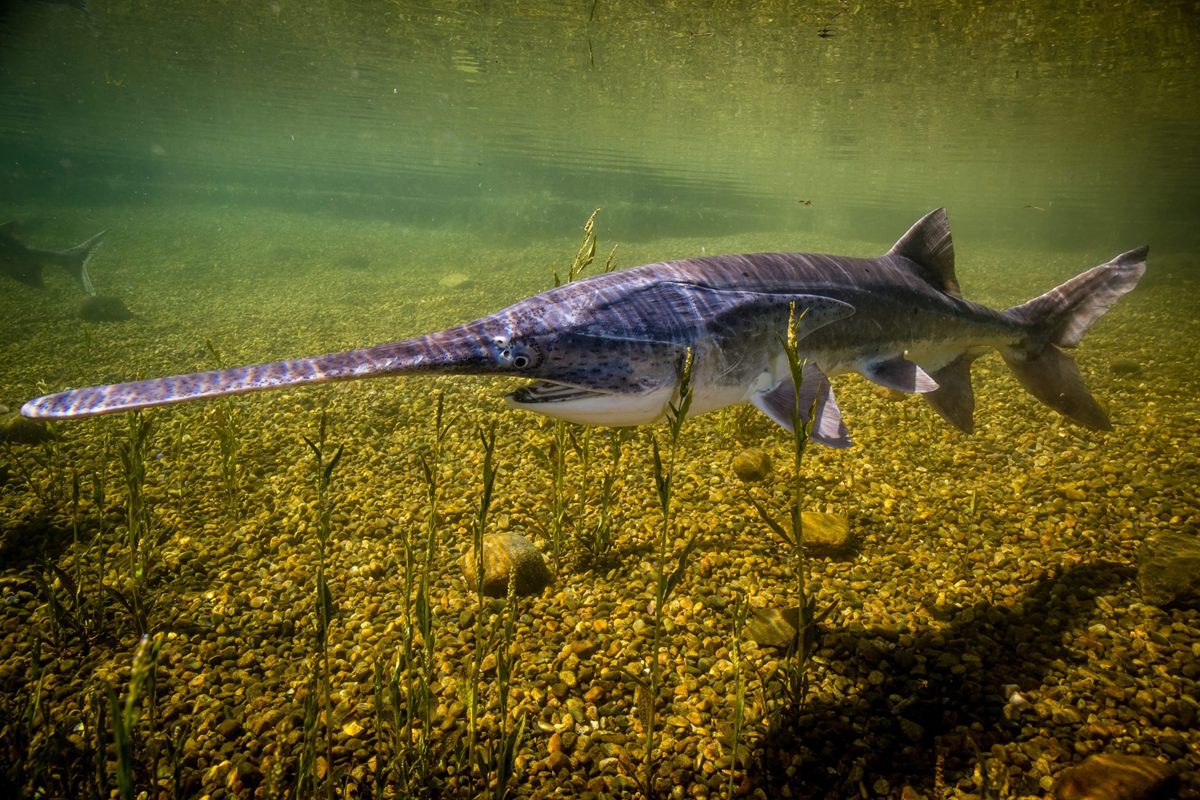
The American paddlefish (Polyodon spathula) is a large, scaleless freshwater fish of the Mississippi River basin, named for the long paddle-shaped snout (rostrum) that extends in front of its eyes.
The American paddlefish (Polyodon spathula) is a large, scaleless freshwater fish of the Mississippi River basin, named for the long paddle-shaped snout (rostrum) that extends in front of its eyes. It is listed as Vulnerable. A close relative, the Chinese paddlefish, was declared extinct in 2022.
🧬 Field Guide Specimen: Open American Paddlefish in the CRV Science Field Guide to log the specimen, see its place among the Vertebrates lineages in the Cladogram Explorer, and test your recall in the Red List conservation game.
A Paddle That Senses Prey: What Is the Rostrum For?
The rostrum is covered with thousands of electroreceptors that detect the faint electric fields of the tiny zooplankton the fish eats. The paddlefish swims with its huge mouth open and filters plankton with long gill rakers, a feeding style more like a baleen whale than a typical predatory fish.
Why Is It Declining?
Dams block the upriver spawning migrations and change river flows, and the fish has been overharvested for its roe, sold as caviar. Fish can live for several decades and mature late, so populations recover slowly.
An Old Lineage
Paddlefish belong to Acipenseriformes with sturgeons, an ancient lineage with a largely cartilaginous skeleton. Fossil paddlefish are known from the Cretaceous.
American Paddlefish at a Glance
| Property | Value |
|---|---|
| Scientific name | Polyodon spathula |
| Kingdom | Animalia |
| Phylum | Chordata |
| Class | Actinopterygii |
| Subclass | Chondrostei |
| Field Guide group | Marine and Freshwater Fish |
| Diagnostic feature (Field Guide) | Ancient freshwater chondrostean with an elongated paddle-like rostrum packed with electroreceptors and a heterocercal tail. |
| IUCN Red List status | Vulnerable (VU), assessed 2022 |
| Feeding | Filter feeding on zooplankton |