Coelacanth
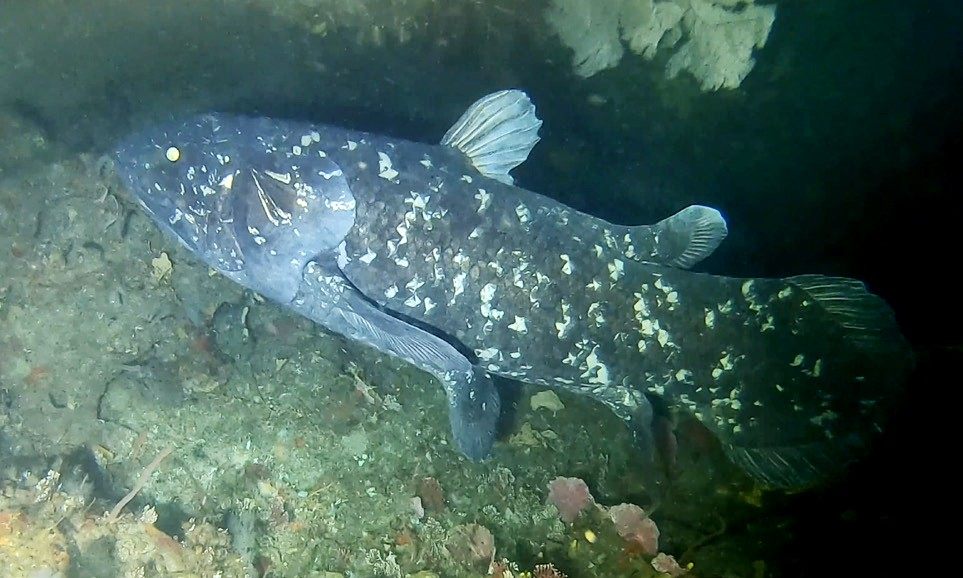
The West Indian Ocean coelacanth (Latimeria chalumnae) is a large, lobe-finned fish once thought to have died out with the dinosaurs.
The West Indian Ocean coelacanth (Latimeria chalumnae) is a large, lobe-finned fish once thought to have died out with the dinosaurs. A living specimen was caught off South Africa in December 1938, one of the great zoological discoveries of the twentieth century. It is listed as Critically Endangered.
🧬 Field Guide Specimen: Open West Indian Ocean Coelacanth in the CRV Science Field Guide to log the specimen, see its place among the Evolutionary lineages in the Cladogram Explorer, and test your recall in the Red List conservation game.
A Fish Back From the Dead: The 1938 Discovery
Marjorie Courtenay-Latimer, a museum curator in East London, South Africa, noticed an odd blue fish in a trawler's catch. The ichthyologist J. L. B. Smith identified it as a coelacanth, a group known from fossils up to about 66 million years old. A second species was found in Indonesia in 1997.
Lobed Fins: Why Do They Matter?
The paired fins sit on fleshy stalks with bones and muscles, and they move in an alternating pattern similar to the gait of four-legged animals. Coelacanths are lobe-finned fishes (Sarcopterygii), like lungfish and tetrapods, although lungfish are closer to land vertebrates than coelacanths are.
Deep, Slow and Rare
Coelacanths drift in caves at depths of 150 to 250 meters near the Comoro Islands and are thought to number in the hundreds. They have an unusual hinge in the skull and an electrosensory organ in the snout, and give birth to live young.
Coelacanth at a Glance
| Property | Value |
|---|---|
| Scientific name | Latimeria chalumnae |
| Kingdom | Animalia |
| Phylum | Chordata |
| Class | Sarcopterygii |
| Subclass | Actinistia |
| Field Guide group | Evolutionary Oddities (Unique & Disputed Lineages) |
| Diagnostic feature (Field Guide) | Renowned deep-sea 'Lazarus taxon' displaying fleshy paired lobe-fins supported by internal limb-like bones and a three-lobed diphycercal tail. |
| IUCN Red List status | Critically Endangered (CR), assessed 2000 |
| Discovered alive | December 1938 |