White Sturgeon
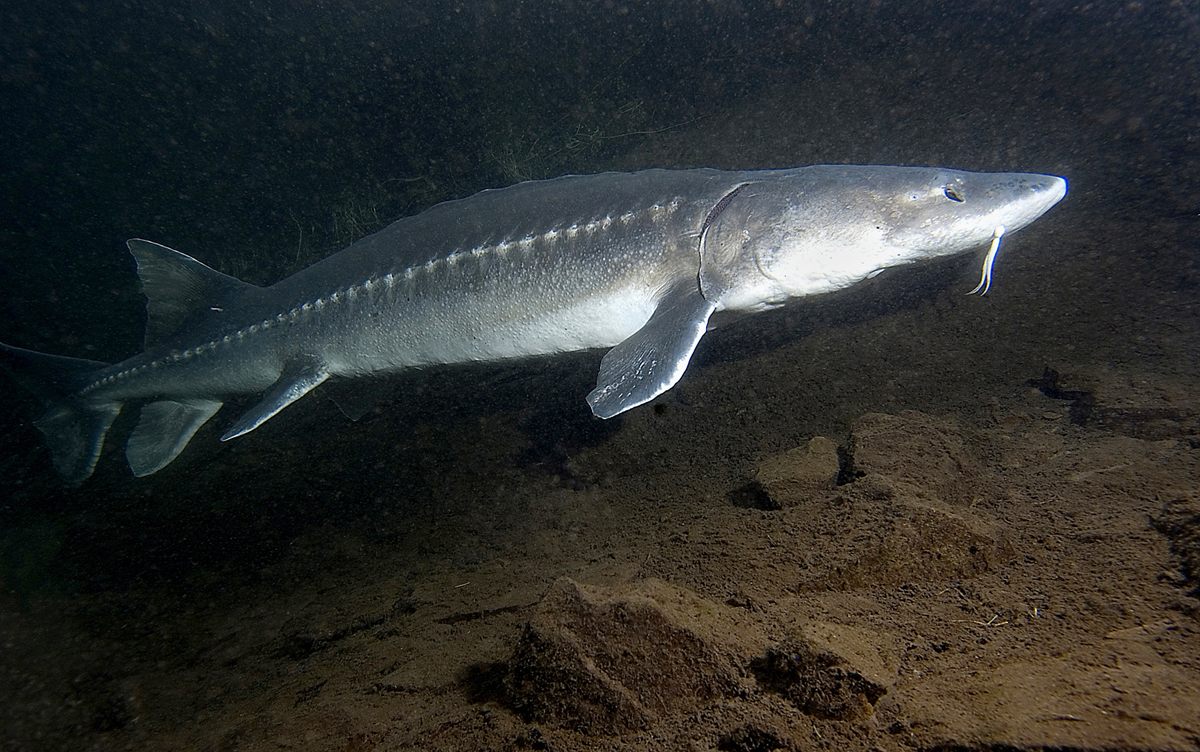
The white sturgeon (Acipenser transmontanus) is the largest freshwater fish in North America, living in rivers of the Pacific coast and reaching about 6 meters in length. It can live for a century or more, and it belongs to an ancient group of armored fishes.
The white sturgeon (Acipenser transmontanus) is the largest freshwater fish in North America, living in rivers of the Pacific coast and reaching about 6 meters in length. It can live for a century or more, and it belongs to an ancient group of armored fishes.
🧬 Field Guide Specimen: Open White Sturgeon in the CRV Science Field Guide to log the specimen, see its place among the Vertebrates lineages in the Cladogram Explorer, and test your recall in the Red List conservation game.
Armored and Slow: A Prehistoric Design
Sturgeons have rows of bony plates (scutes) instead of overlapping scales, a cartilaginous skeleton, sensory barbels near the mouth and an upper tail lobe longer than the lower. They suck up crustaceans, mollusks and fish from river bottoms.
Why Is Recovery So Slow?
Females do not spawn until they are fifteen to twenty-five years old, and then only every few years. Dams block spawning migrations and alter flows, and heavy harvest for meat and caviar has depleted stocks. Some populations, such as the Kootenai River group, are listed as endangered.
Conservation and Farming
Fishing is tightly regulated, and fish farms now supply most caviar. Hatchery programs help rebuild populations in some rivers.
White Sturgeon at a Glance
| Property | Value |
|---|---|
| Scientific name | Acipenser transmontanus |
| Kingdom | Animalia |
| Phylum | Chordata |
| Class | Actinopterygii |
| Subclass | Chondrostei |
| Field Guide group | Marine and Freshwater Fish |
| Diagnostic feature (Field Guide) | North America's largest freshwater fish, with five rows of bony plates (scutes), a shark-like upturned tail, four sensory barbels, and a toothless sucking mouth. |
| IUCN Red List status | Vulnerable (VU), assessed 2022 |
| Maximum length | About 6 meters |
| Female maturity | About 15 to 25 years |