Beadlet Anemone
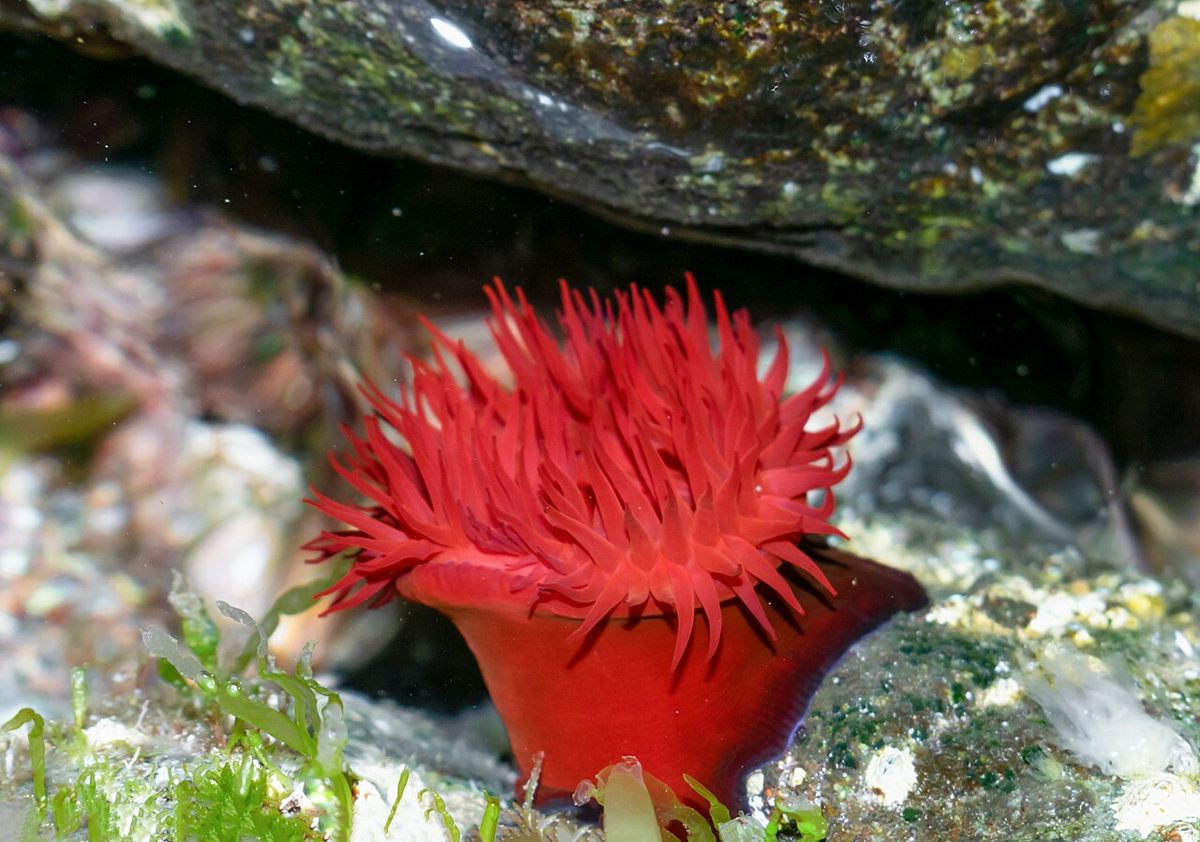
The beadlet anemone (Actinia equina) is a red or green sea anemone of rocky shores in the northeastern Atlantic and Mediterranean. At low tide it draws in its tentacles and looks like a blob of jelly.
The beadlet anemone (Actinia equina) is a red or green sea anemone of rocky shores in the northeastern Atlantic and Mediterranean. At low tide it draws in its tentacles and looks like a blob of jelly.
🧬 Field Guide Specimen: Open Beadlet Anemone in the CRV Science Field Guide to log the specimen, see its place among the Cnidaria+Ctenophora lineages in the Cladogram Explorer, and test your recall in the Red List conservation game.
Beadlet Anemone at a Glance
| Property | Value |
|---|---|
| Scientific name | Actinia equina |
| Kingdom | Animalia |
| Phylum | Cnidaria |
| Class | Anthozoa |
| Order | Actiniaria |
| Family | Actiniidae |
| Field Guide group | Cnidaria + Ctenophora (Radiata & Jellies) |
| Diagnostic feature (Field Guide) | Red jelly-like blob at low tide; ring of blue beads below its tentacles carries stinging cells used to fight neighbors. |
| IUCN Red List status | Least Concern (LC), assessed 2015 |
| Class | Anthozoa |
| Weapons | Acrorhagi with stinging cells |
Taxonomy, Phylogenetics, and Evolutionary History
Actinia equina (described by Carl Linnaeus in 1758 as Priapus equinus) is a solitary hexacorallian sea anemone in the family Actiniidae, order Actiniaria, and class Anthozoa. Unlike medusozoan cnidarians that alternate between polyps and medusae, anthozoans exist only in the polyp phase, possessing a muscular actinopharynx and a gastrovascular cavity subdivided radially by paired mesenteries. Within Hexacorallia, Actiniaria diverged from stony corals (Scleractinia) during the early Paleozoic, retaining an unmineralized, hydrostatically supported column anchored by a pedal disc. While burrowing anemones such as the Starlet Sea Anemone (Nematostella vectensis) belong to Anenthemonae, A. equina belongs to the superfamily Actinioidea within Enthemonae.
Allozyme, mitochondrial DNA, and microsatellite studies show that nominal Actinia equina across the northeastern Atlantic and Mediterranean is a cryptic species complex displaying ecological divergence across intertidal zones. On European shores, the high- and mid-shore crimson-red morph retains the name Actinia equina, whereas the larger lower-shore morph is separated as the strawberry anemone (Actinia fragacea), the green-columned morph as Actinia prasina, and Mediterranean populations as Actinia schmidti.
Comparative Anatomy, Physiology, and Biomechanics
Acrorhagial Cnidocyte Combat and Allorecognition
The common name "beadlet anemone" refers to a circle of 24 to 48 blue, turquoise, or white spherical tubercles—termed acrorhagi—arranged inside a collar-like groove (the fosse) below the outer ring of 192 feeding tentacles. Unlike the feeding tentacles, which carry spirocysts and basitrichous isorhizas to entangle crustacean and molluscan prey, the acrorhagi are agonistic weapons packed with holotrichous isorhiza nematocysts 50 to 70 micrometers long.
When two Actinia equina polyps make tentacular contact, surface glycoprotein receptors mediate allorecognition. If the neighbor is a genetically identical clone mate produced via asexual brooding, both polyps withdraw peacefully. If the neighbor is a non-clone, one or both anemones initiate an acrorhagial contest: gastrovascular hydrostatic pressure inflates the marginal collar and blue acrorhagi, and the attacking polyp bends its column to press the swollen acrorhagi onto the opponent's body wall. Thousands of holotrichous nematocysts discharge, leaving behind strips of blue acrorhagial ectoderm (an "acrorhagial peel") adhered to the victim's column that continue firing toxins and inducing tissue necrosis until the losing anemone detaches its pedal disc and retreats.
| Anatomical System | Structural Feature | Biomechanical or Physiological Function | Quantitative Parameter |
|---|---|---|---|
| Acrorhagi (blue beads) | 24–48 inflatable tubercles with holotrichous isorhizas | Territorial combat against non-clonal conspecifics | Discharge acceleration >40,000 × g |
| Equinatoxins (EqTx) | 19.8 kDa actinoporin pore-forming proteins (179 residues) | Binds sphingomyelin in membranes to form cation pores | Pore radius ~1.1 nm; causes cytolysis |
| Endodermal sphincter | Circular muscle ring at the top of the column | Seals tentacles and oral disc inside column at low tide | Retains ~5–15 mL water for >6–12 hours |
| Carotenoid-proteins | Actinioerythrin (violaxanthin-derived nor-carotenoid) | Photoprotection and coloration in red/green morphs | Absorption shifted via protein binding |
Pore-Forming Equinatoxins and Intertidal Desiccation Tolerance
The venom of Actinia equina contains 19.8-kilodalton cytolytic proteins called equinatoxins (EqTx I–III), prototypes for the actinoporin family of cnidarian pore-forming toxins. Folded into a beta-sandwich core flanked by two alpha-helices, Equinatoxin II binds to sphingomyelin in eukaryotic membranes while its N-terminal amphipathic alpha-helix inserts across the lipid bilayer, assembling into a 2-nanometer toroidal pore. The resulting influx of Ca2+ and Na+ and efflux of K+ triggers osmotic cell lysis.
Inhabiting rocky shores up to the high-water neap tide mark, A. equina endures 6 to 12 hours of aerial emersion per tide. As the tide recedes, the anemone retracts its 192 tentacles and contracts an endodermal sphincter muscle at the top of the column, forming a smooth dome that reduces evaporative surface area by over 60% and traps oxygenated water inside the gastrovascular cavity.
Trophic Ecology, Reproductive Life History, and Conservation
When submerged, Actinia equina expands six hexamerous cycles of tentacles to capture wave-dislodged mussels (Mytilus edulis), barnacles, isopods, amphipods, and shore crabs (Carcinus maenas). Unlike tropical anemones that host the Ocellaris Clownfish, A. equina lacks intracellular zooxanthellae (Symbiodiniaceae) and feeds heterotrophically.
Actinia equina combines sexual gametogenesis with internal viviparous brooding inside the gastrovascular cavity of male, female, and hermaphroditic adults. Microsatellite markers show that brooded juveniles are genetically identical clones of the parent—even when that parent is functionally male with ripe testes—arising via apomictic parthenogenesis or somatic budding. Expelled through the mouth, juveniles adhere to adjacent crevices, forming clonal aggregations. The IUCN lists A. equina as Least Concern (LC).
Frequently Asked Questions
What are the bright blue beads inside the rim of a beadlet anemone?
The ring of 24 to 48 blue or turquoise spheres located in the groove beneath the outer tentacles are called acrorhagi. Unlike the tentacles, which capture food, acrorhagi are combat organs packed with penetrating nematocysts. When a beadlet anemone touches a neighboring anemone that is not a genetic clone of itself, it inflates these blue beads and wipes them against the rival's column, leaving behind stinging tissue peels that force the intruder to move away.
How does the beadlet anemone survive out of water for hours at low tide?
When the tide drops, Actinia equina pulls all 192 of its tentacles inward and tightens a ring-shaped sphincter muscle around the top of its body column. This turns the anemone into a compact, hemispherical jelly-like dome that minimizes exposed surface area and seals a pocket of seawater inside its digestive cavity, keeping its internal tissues moist and cool until the tide returns.
How do male beadlet anemones give birth to live young through their mouths?
Both male and female Actinia equina brood miniature, fully formed juvenile anemones inside their gastrovascular cavities and release them through the mouth. Genetic testing shows that these internally brooded young are genetic clones of the parent produced via asexual parthenogenesis or internal budding, allowing even sperm-producing males to brood and release clonal offspring right next to their own rocky perch.
References
- Brace, R. C., Pavey, J., & Quicke, D. L. J. (1979). Intraspecific aggression in the colour morphs of the anemone Actinia equina: the 'convention' governing dominance ranking. Animal Behaviour, 27, 553–561. https://doi.org/10.1016/0003-3472(79)90190-890190-8)
- Anderluh, G., & Maček, P. (2002). Cytolytic peptide and protein toxins from sea anemones (Anthozoa: Actiniaria). Toxicon, 40(2), 111–124. https://doi.org/10.1016/S0041-0101(01)00191-X00191-X)
- Orr, J., Thorpe, J. P., & Carter, M. A. (1982). Biochemical genetic confirmation of the asexual reproduction of brooded offspring in the sea anemone Actinia equina. Marine Ecology Progress Series, 7, 227–229. https://doi.org/10.3354/meps007227
- Perrin, M. C., Thorpe, J. P., & Solé-Cava, A. M. (1999). Population structuring, gene dispersal and reproduction in the Actinia equina species group. Oceanography and Marine Biology: An Annual Review, 37, 129–152. https://doi.org/10.1201/9781482298550-6