Beryl
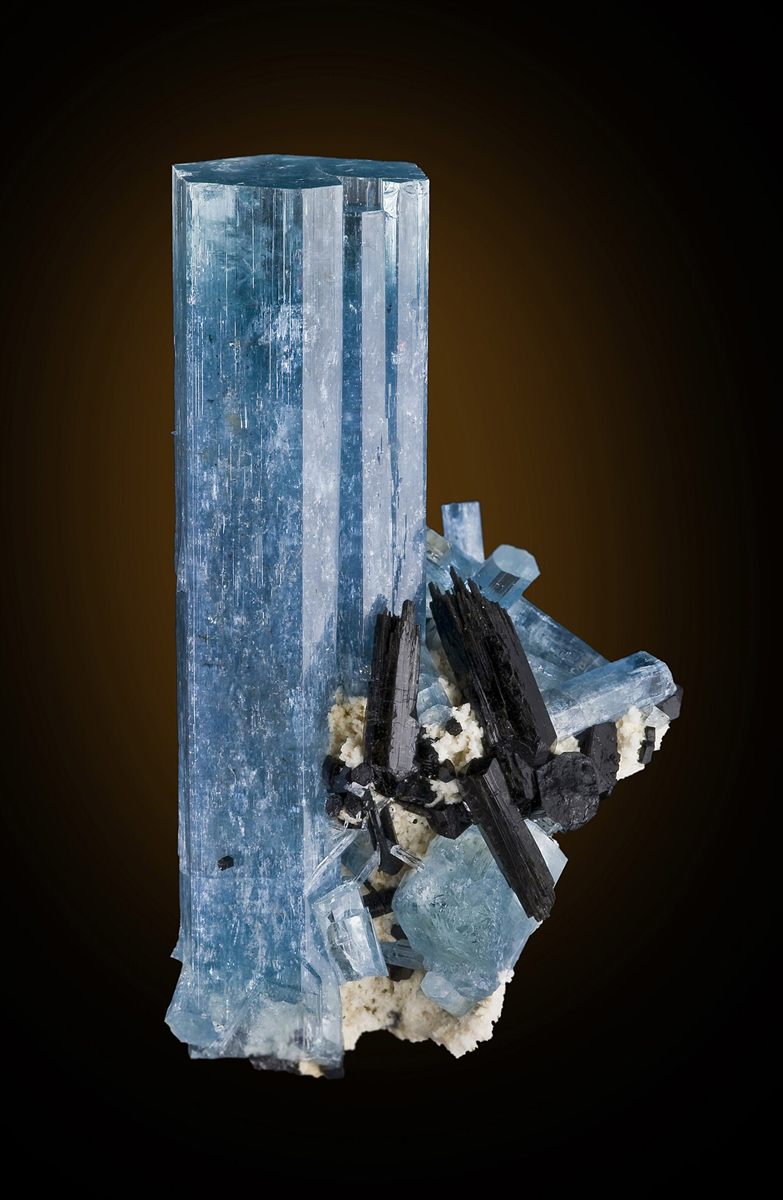
Beryl is a beryllium aluminum ring silicate, Be₃Al₂Si₆O₁₈, with hexagonal crystals and a hardness of 7.5 to 8. Pure beryl is colorless, and its colored varieties include green emerald and blue aquamarine.
Beryl is a beryllium aluminum ring silicate, Be₃Al₂Si₆O₁₈, with hexagonal crystals and a hardness of 7.5 to 8. Pure beryl is colorless, and its colored varieties include green emerald and blue aquamarine.
🪨 Geology Guide Specimen: Open Beryl (Aquamarine / Emerald) in the CRV Science Rock & Mineral ID Guide to log the specimen, compare it with the other 8 mineral classes of Dana / Strunz Classes, and test your eye in LithoClade.
Gem Varieties: What Colors Beryl?
Trace elements make the colors. Chromium and sometimes vanadium give emerald its green, iron gives the pale blue of aquamarine, manganese gives pink morganite and iron in another state makes yellow heliodor. Colorless beryl is goshenite. Emeralds usually have many inclusions, which gem cutters accept as part of the stone's character.
Pegmatites and Hydrothermal Veins: Where Does Beryl Form?
Beryl forms in pegmatites, where beryllium is concentrated in the last melt, sometimes in giant crystals many meters long. Some emeralds form in a different setting, in hydrothermal veins in black shales, as in Colombia, where fluids bring beryllium and chromium together.
Beryllium Source: Why Does It Matter?
Beryl is a source of beryllium, a light, stiff metal used in aerospace parts, X-ray windows and alloys. The element is also toxic, so processing beryllium minerals has strict safety rules.
Beryl at a Glance
| Property | Value |
|---|---|
| Type / variety | Be₃Al₂Si₆O₁₈ • Hexagonal Cyclosilicate |
| Composition | Be₃Al₂Si₆O₁₈ (Colored blue by Fe²⁺ in Aquamarine, green by Cr³⁺/V³⁺ in Emerald) |
| Geology Guide group | Minerals (8 Major Chemical Groups) |
| Mineral Group | Silicates |
| Mohs hardness | Mohs 7.5–8 |
| Texture / habit | Sharp, flat-topped 6-sided hexagonal prism columns |
| Density | 2.68–2.80 g/cm³ |
| Lustre and cleavage | Vitreous sea-blue or emerald-green prisms with indistinct basal parting |
| Geological setting | Granitic pegmatites and hydrothermal veins in black shales/schists |
| Diagnostic feature (Geology Guide) | Very hard (Mohs 7.5–8), sea-blue or emerald-green crystal forming textbook six-sided hexagonal columns with flat pinacoidal tops and vertical prism striations. |
| Formula | Be₃Al₂Si₆O₁₈ |
| Varieties | Emerald, aquamarine, morganite, heliodor |