Tourmaline
Tourmaline is a group of complex boron silicate minerals with trigonal crystals, a hardness of 7 to 7.5 and an extraordinary range of colors. Black schorl, lithium-rich elbaite in pink and green, and brown dravite are its common members.
Tourmaline is a group of complex boron silicate minerals with trigonal crystals, a hardness of 7 to 7.5 and an extraordinary range of colors. Black schorl, lithium-rich elbaite in pink and green, and brown dravite are its common members.
🪨 Geology Guide Specimen: Open Tourmaline (Elbaite / Schorl) in the CRV Science Rock & Mineral ID Guide to log the specimen, compare it with the other 8 mineral classes of Dana / Strunz Classes, and test your eye in LithoClade.
Crystal Habit: Why Is It Triangular?
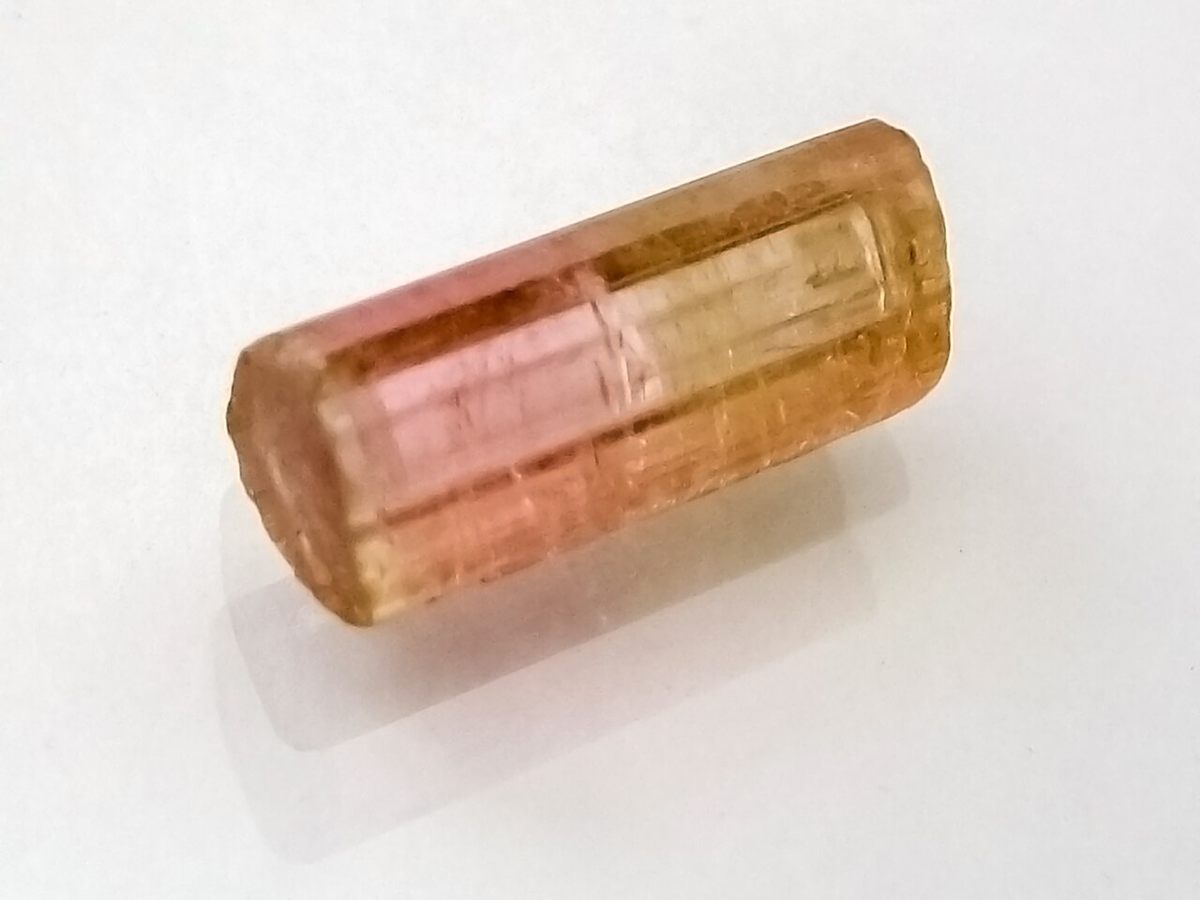
Tourmaline grows as long, striated prisms whose cross-section is a rounded triangle. The crystals are pyroelectric and piezoelectric, so they develop an electric charge when heated or squeezed, which is why they can attract dust.
Colors and Zoning: What Is a Watermelon Tourmaline?
Elbaite crystals often change color along their length or from core to rim as the chemistry of the fluid changed during growth. A pink core wrapped in a green rim is nicknamed watermelon tourmaline. Iron makes the black of schorl, and manganese and lithium give pinks and greens.
Boron Indicator: What Does Tourmaline Record?
Tourmaline is the main common mineral that contains boron, so it forms in boron-rich settings such as pegmatites and hydrothermal veins and in some metamorphic rocks. Its chemistry records the fluids it formed from, and it is hard and weather-resistant enough to survive as a detrital grain.
Tourmaline at a Glance
| Property | Value |
|---|---|
| Type / variety | Na(Li,Fe,Al)₃Al₆(BO₃)₃Si₆O₁₈(OH)₄ • Cyclosilicate |
| Composition | Complex Boron-Bearing 6-Membered Ring Lattice (Schorl = Fe-rich, Elbaite = Li-rich) |
| Geology Guide group | Minerals (8 Major Chemical Groups) |
| Mineral Group | Silicates |
| Mohs hardness | Mohs 7–7.5 |
| Texture / habit | Elongated, vertically striated prisms with a rounded triangular cross-section |
| Density | 3.00–3.25 g/cm³ |
| Lustre and cleavage | Vitreous jet-black or zoned pink-and-green ('watermelon') prisms; pyroelectric |
| Geological setting | Boron-rich granitic pegmatites, hydrothermal veins, and metamorphic schists |
| Diagnostic feature (Geology Guide) | Vertically striated prismatic crystal (Mohs 7–7.5) with a distinctive rounded-triangle cross-section (like a rotary engine rotor), often displaying concentric pink-and-green color zoning. |
| Main members | Schorl, elbaite, dravite |
| Special properties | Pyroelectric and piezoelectric |