Pegmatite
Pegmatite is an igneous rock with exceptionally large crystals, often several centimeters and sometimes meters long, most commonly of granitic composition.
Pegmatite is an igneous rock with exceptionally large crystals, often several centimeters and sometimes meters long, most commonly of granitic composition. It forms from the water-rich last portions of a crystallizing magma, where crystals can grow far larger than in the surrounding granite.
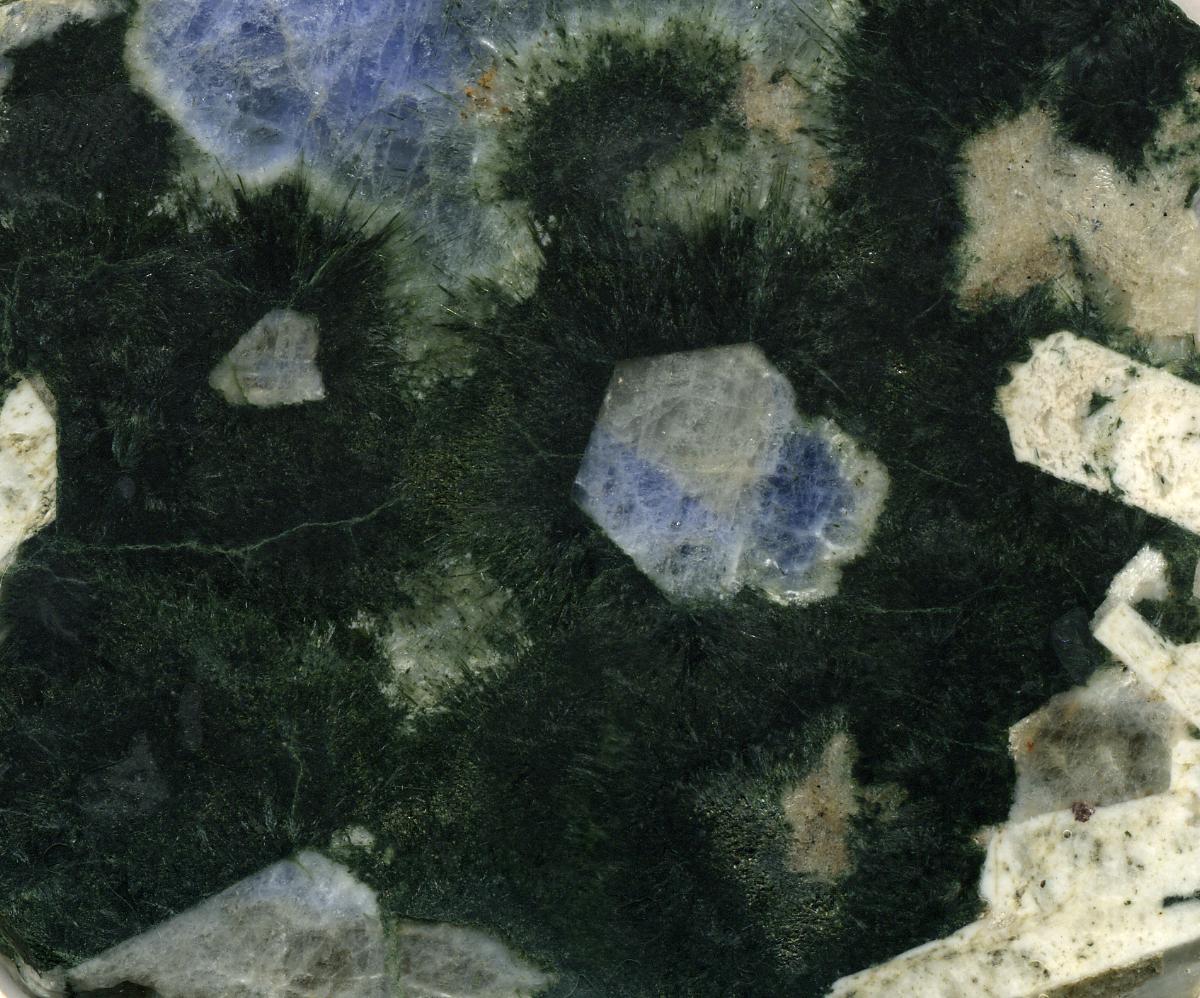
🪨 Geology Guide Specimen: Open Granitic Pegmatite in the CRV Science Rock & Mineral ID Guide to log the specimen, compare it with the other 7 subgroups of Igneous, and test your eye in LithoClade.
Giant Crystals: Why Do Pegmatites Grow So Large?
The leftover melt in a cooling granite becomes enriched in water and in fluxing elements such as boron, phosphorus, fluorine and lithium. These lower the melt's viscosity and the number of crystal seeds, so a few crystals grow very large. Researchers still debate whether growth is slow in a fluid-rich melt or fast from a strongly undercooled one, but both models give water and fluxes the central role.
Contents: What Do Pegmatites Host?
Simple pegmatites are blocky potassium feldspar, quartz and books of silvery muscovite. Rare-element pegmatites add tourmaline, beryl, topaz, spodumene and lepidolite. They are mined for lithium, tantalum, cesium and beryllium, and for gem crystals, and they are the classic source of mineral specimens.
Occurrence: Where Are They Found?
Pegmatites form dikes and pods in and around granite plutons, often within mountain belts, and many are zoned from a fine-grained wall zone inward to a quartz core. They frequently occur alongside aplite in composite dikes, the two textures recording different stages of the same residual melt.
Pegmatite at a Glance
| Property | Value |
|---|---|
| Type / variety | Quartz–Microcline Pegmatite |
| Composition | Giant Microcline + Quartz + Muscovite + Accessory Tourmaline/Beryl |
| Geology Guide group | Igneous Rocks (Plutonic & Volcanic) |
| Rock Classification | Felsic Plutonic (Granitoids) |
| Mohs hardness | Mohs 6–7.5 |
| Texture / habit | Extremely coarse crystals (>2 cm to meters) |
| Density | 2.60–2.70 g/cm³ |
| Lustre and cleavage | Blocky feldspar cleavage & books of silvery mica |
| Geological setting | Water- and boron-rich residual pockets of cooling batholiths |
| Diagnostic feature (Geology Guide) | Exceptionally huge interlocking crystals (>2 cm across) of blocky potassium feldspar, smoky quartz, and books of muscovite crystallized from water-rich residual magma. |
| Crystal size | More than about 2 cm, up to meters |
| Economic importance | Lithium, tantalum, cesium and gem minerals |