Native Bismuth
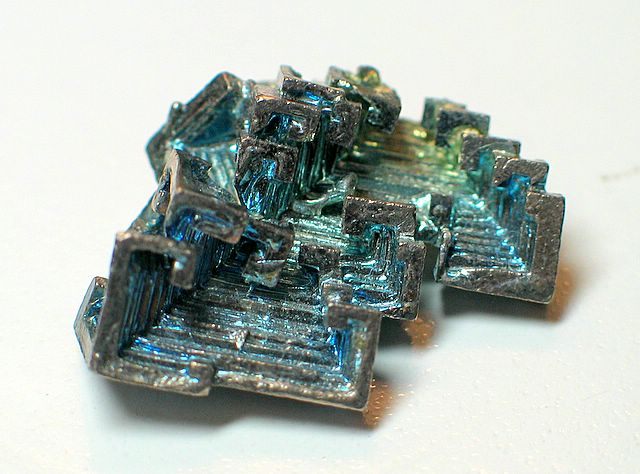
Native bismuth is the element bismuth, Bi, found in nature as silvery-pink metallic crystals and masses. It is a brittle, heavy semimetal that grows into striking stair-stepped crystals when it solidifies slowly.
Native bismuth is the element bismuth, Bi, found in nature as silvery-pink metallic crystals and masses. It is a brittle, heavy semimetal that grows into striking stair-stepped crystals when it solidifies slowly.
🪨 Geology Guide Specimen: Open Native Bismuth in the CRV Science Rock & Mineral ID Guide to log the specimen, compare it with the other 8 mineral classes of Dana / Strunz Classes, and test your eye in LithoClade.
Hopper Crystals and Rainbow Tarnish: What Does It Look Like?
Bismuth has a hardness of 2 to 2.5 and a density near 9.8 grams per cubic centimeter. Slowly cooled bismuth forms geometric "hopper" crystals with stepped edges, and a thin oxide film gives them rainbow colors, so the brightly colored crystals sold in shops are usually lab-grown.
Odd Properties: Why Is Bismuth Unusual?
Bismuth is the most strongly diamagnetic of the metals, which means it is weakly repelled by magnets. It also expands slightly as it freezes, like water, and has a low melting point, so it is used in fusible alloys.
Occurrence and Uses: Where Is It Found?
Native bismuth forms in hydrothermal veins with cobalt, nickel and silver minerals and in pegmatites. Bismuth compounds are used in medicines such as stomach remedies and in cosmetics, and the metal replaces lead in some products because it is much less toxic. See bismuth.
Native Bismuth at a Glance
| Property | Value |
|---|---|
| Type / variety | Bi • Trigonal Hopper-Crystal Semimetal |
| Composition | Bi (Element 83 • Heaviest stable/quasi-stable pnictogen semimetal) |
| Geology Guide group | Minerals (8 Major Chemical Groups) |
| Mineral Group | Native Elements |
| Mohs hardness | Mohs 2–2.5 |
| Texture / habit | Geometric stair-stepped 'hopper' pseudo-cubes or foliated metallic masses |
| Density | 9.70–9.83 g/cm³ (very heavy; expands upon freezing like water!) |
| Lustre and cleavage | Silvery-pink metallic lustre tarnished with rainbow oxide interference colors |
| Geological setting | Hydrothermal cobalt-nickel-silver-tin veins and granitic pegmatites |
| Diagnostic feature (Geology Guide) | Heavy (density 9.8 g/cm³), brittle silvery-pink metallic crystal famous for growing intricate geometric staircase 'hopper' labyrinths coated in rainbow interference tarnish and strongly repelling magnetic fields. |
| Formula | Bi |
| Density | About 9.8 g/cm³ |
See Also
- Bismuth — the element
- Native Gold — another native metal
- Native Copper — another native metal