Native Gold
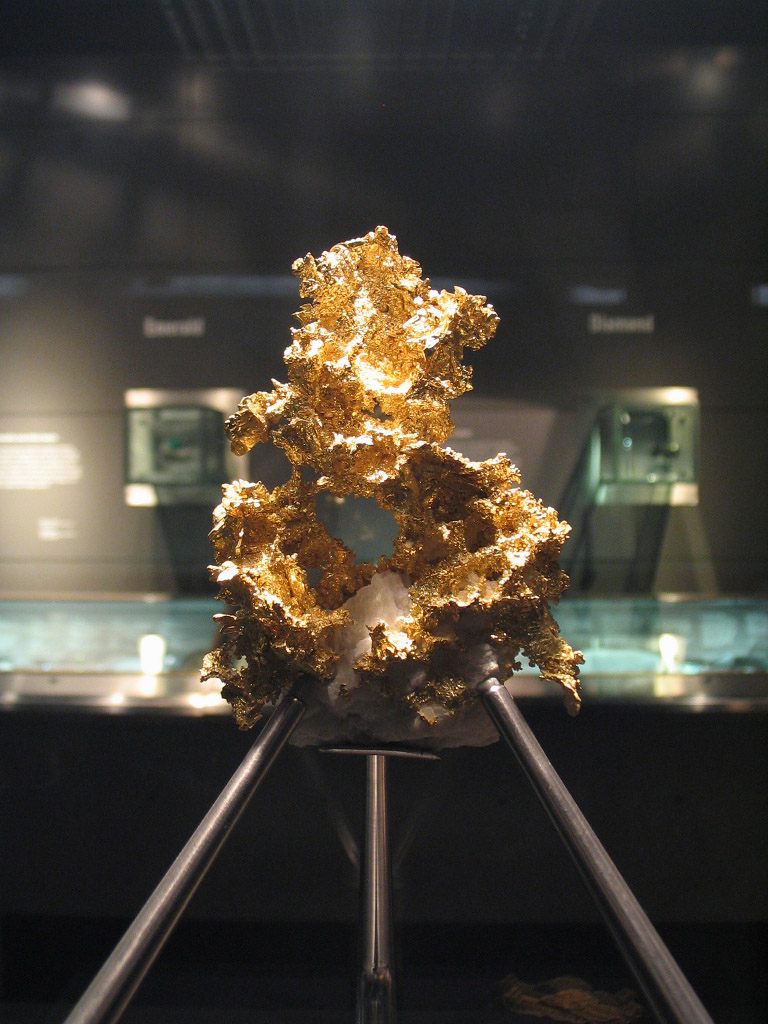
Native gold is the element gold, Au, found in nature as a metal, usually alloyed with some silver. It is soft, heavy, bright yellow and does not tarnish, and it has been prized as a metal since prehistory.
Native gold is the element gold, Au, found in nature as a metal, usually alloyed with some silver. It is soft, heavy, bright yellow and does not tarnish, and it has been prized as a metal since prehistory.
🪨 Geology Guide Specimen: Open Native Gold in the CRV Science Rock & Mineral ID Guide to log the specimen, compare it with the other 8 mineral classes of Dana / Strunz Classes, and test your eye in LithoClade.
Heavy and Malleable: How Do You Recognize It?
Gold has a hardness of 2.5 to 3 and is extremely dense, 19.3 grams per cubic centimeter when pure. It flattens under a hammer and can be drawn out into wire instead of breaking, and it leaves a golden streak. Natural gold usually contains 5 to 15 percent silver, and the pale alloy is called electrum.
Veins and Placers: Where Is It Found?
Gold crystallizes from hydrothermal fluids in quartz veins, often with pyrite. Because it is heavy and does not corrode, weathering carries it into streams, where it is concentrated as placer gold, as in the California Gold Rush. The huge Witwatersrand gold fields of South Africa are in ancient conglomerates.
Value and Uses: Why Is Gold So Prized?
Its resistance to tarnish, workability and color made gold a store of value and a material for jewelry and coins. It also conducts electricity and does not corrode, so it is used in electronics. See gold.
Native Gold at a Glance
| Property | Value |
|---|---|
| Type / variety | Au • Isometric Native Noble Metal |
| Composition | Au (Often alloyed naturally with 5–15% Silver as Electrum) |
| Geology Guide group | Minerals (8 Major Chemical Groups) |
| Mineral Group | Native Elements |
| Mohs hardness | Mohs 2.5–3 |
| Texture / habit | Dendritic fern-like leaves, wires, octahedral crystals, or water-worn nuggets |
| Density | 19.3 g/cm³ when pure (15–19 g/cm³ in natural nuggets; extraordinarily heavy!) |
| Lustre and cleavage | Rich buttery-yellow metallic lustre that NEVER tarnishes; golden-yellow streak; malleable & ductile |
| Geological setting | Hydrothermal quartz-carbonate veins and high-energy alluvial river placers |
| Diagnostic feature (Geology Guide) | Buttery-yellow metallic mineral of extraordinary density (19.3 g/cm³) and Mohs 2.5–3 hardness that leaves a shining yellow streak, never tarnishes in air or acid, and flattens under a hammer instead of shattering. |
| Formula | Au |
| Density | 19.3 g/cm³ when pure |