Aplite
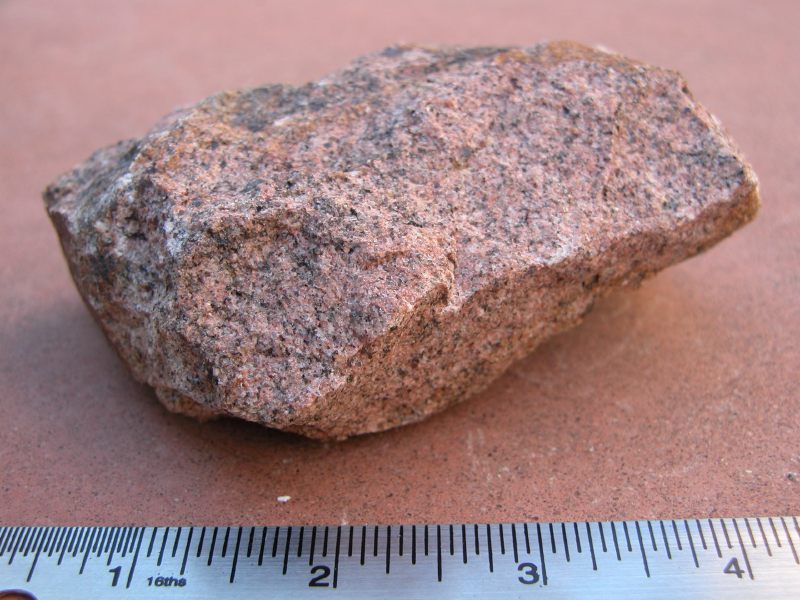
Aplite is a fine-grained, sugary rock of quartz and feldspar that fills fractures and dikes in granite. Because it has almost no dark minerals it is usually pale pink or cream, and its even, saccharoidal texture explains the name, from the Greek for 'simple.'
Aplite is a fine-grained, sugary rock of quartz and feldspar that fills fractures and dikes in granite. Because it has almost no dark minerals it is usually pale pink or cream, and its even, saccharoidal texture explains the name, from the Greek for "simple."
🪨 Geology Guide Specimen: Open Aplite in the CRV Science Rock & Mineral ID Guide to log the specimen, compare it with the other 7 subgroups of Igneous, and test your eye in LithoClade.
Aplite at a Glance
| Property | Value |
|---|---|
| Type / variety | Saccharoidal Quartz–Feldspar Aplite |
| Composition | Equigranular Quartz + Alkali Feldspar (devoid of dark mafic minerals) |
| Geology Guide group | Igneous Rocks (Plutonic & Volcanic) |
| Rock Classification | Felsic Plutonic (Granitoids) |
| Mohs hardness | Mohs 6.5–7 |
| Texture / habit | Sugary (saccharoidal) fine equigranular (<1 mm) |
| Density | 2.60–2.65 g/cm³ |
| Lustre and cleavage | Uniform pale cream/pink sugary appearance |
| Geological setting | Late-stage cross-cutting dikes and veins inside batholiths |
| Diagnostic feature (Geology Guide) | Pale, sugary-textured intrusive dike rock composed almost entirely of uniform sub-millimeter quartz and alkali feldspar grains with virtually zero dark ferromagnesian minerals. |
| Texture name | Saccharoidal (sugary) |
| Typical form | Dikes and veins in granite |
Petrography, QAPF Modal Composition, and Allotriomorphic-Granular Texture
Leucocratic Minimum-Melt Mineralogy and IUGS Classification
Aplite (coined by A. J. Retzius and Karl Caesar von Leonhard from the Greek haploos, "simple," referring to its uniform mineral assemblage) is a fine-grained, holocrystalline, leucocratic hypabyssal/plutonic igneous rock occurring as planar cross-cutting dikes and veins within or adjacent to granitic batholiths. When used without a prefix, aplite refers to granitic aplite, plotting near the thermal minimum of the IUGS QAPF diagram within the monzogranite, syenogranite, or alkali-feldspar granite fields (Q = 25–35%, A = 35–50%, P = 20–35%).
Chemically, granitic aplite represents an evolved, high-silica residual liquid (73 to 77 wt% SiO2, 12.5 to 14.0 wt% Al2O3, 4.0 to 5.5 wt% K2O, 3.0 to 4.5 wt% Na2O, and <0.5 wt% CaO + FeO + MgO). Because iron, magnesium, and calcium were exhausted during earlier crystallization of hornblende, biotite, and calcic plagioclase in the host batholith, aplite has a color index (M) below 5%—and commonly <1 to 2%. Its modal composition consists of ~30–35 vol% quartz, ~35–45 vol% potassium feldspar (microcline or orthoclase microperthite), and ~25–30 vol% sodic plagioclase (albite to sodic oligoclase, An0–15).
Saccharoidal Microstructure and Accessory Phases
In hand specimen and thin section, aplite is defined by its allotriomorphic-granular (xenomorphic-granular) or saccharoidal (sugary) texture:
- Equigranular Sub-Millimeter Intergrowth: Average grain size is 0.1 to 1.0 mm—finer than phaneritic granite (2–10 mm), yet completely crystalline and coarser than the cryptocrystalline or glassy matrix of volcanic rhyolite. Because quartz, microcline, and albite nucleated and grew simultaneously at the ternary eutectic without any phase crystallizing early, grains lack crystal faces and meet along polygonal boundaries resembling cane sugar.
- Aluminous Accessory Minerals: Because residual melts are weakly peraluminous and enriched in incompatible volatiles, sparse dark specks scattered through an aplite dike usually consist of euhedral red-brown spessartine–almandine garnets ((Mn,Fe)3Al2(SiO4)3), black schorl tourmaline needles, or silvery flakes of muscovite.
| Felsic Igneous Rock | Typical Grain Size | Texture & Fabric | Mafic Color Index (M) | Emplacement Mechanism |
|---|---|---|---|---|
| Aplite | 0.1–1.0 mm | Equigranular, allotriomorphic saccharoidal | <1–5% (Leucocratic; trace garnet/tourmaline) | Rapid pressure-quench nucleation in fractures inside cooling plutons |
| Pegmatite | 2 cm to >10 m | Coarse, skeletal, graphic quartz-feldspar intergrowths | 1–10% (Biotite blades, tourmaline, beryl) | Low-nucleation, rapid-diffusion growth from fluxed boundary melt |
| Granite | 1–20 mm | Phaneritic, hypidiomorphic-granular or porphyritic | 5–20% (Biotite + hornblende + magnetite) | Slow conductive cooling of main-stage batholith chambers |
| Rhyolite | <0.05 mm + glass | Aphanitic, vitrophyric, or flow-banded | 2–10% (Biotite, sanidine, quartz phenocrysts) | Extrusive surface lava flows, domes, and ignimbrites |
Petrogenesis: The Jahns–Burnham Model and Decompression Pressure Quenching
Why do aplite (<1 mm grain size) and pegmatite (10 cm to meter-scale crystals) share nearly identical bulk granitic chemistries within the same cross-cutting dike? Because aplite dikes intrude deep inside hot, slowly cooling batholiths, aplite is not produced by thermal chilling. Experimental petrology in the albite–orthoclase–quartz–H2O system (Jahns & Burnham, 1969; London, 2008) shows that aplite forms via isothermal pressure quenching (decompression degassing):
- Second Boiling and Hydrofracturing: At 85–95% batholith crystallization (2–5 kbar), residual melt saturates with 5–10 wt% dissolved H2O, overpressurizing and fracturing the solidified granite carapace.
- Sudden Pressure Drop Raises the Solidus: Dissolved H2O depolymerizes Si–O–Si bridges (Si–O–Si + H2O ⇌ 2 Si–OH) and lowers the granite solidus to ~650 °C at 4 kbar. When melt injects into an opening fracture and pressure drops, H2O exsolves as steam, repolymerizing the melt and raising the equilibrium solidus temperature by 50 to 100 °C.
- Undercooling (ΔT) and Nucleation Burst: Sitting 50 to 100 °C below its new drier freezing point (~740 °C), the melt experiences a sharp nucleation burst while ionic diffusion slows, precipitating millions of sub-millimeter quartz, albite, and microcline grains simultaneously. Where volatiles and fluxes (F, B, Li) remain trapped in a boundary layer, nucleation is suppressed and giant pegmatite crystals grow in zoned composite dikes or banded "line rock."
Field Relationships, Geomorphic Expression, and Industrial Ceramic Uses
Because aplite lacks biotite and calcic plagioclase, aplite dikes weather more slowly than host biotite granite, standing in positive relief as pale ridges across batholiths like the Sierra Nevada. Industrially, low-iron aplites (<0.2 wt% Fe2O3) serve as low-melting feldspathic fluxes in container glass, fiberglass, and porcelain ceramics, and as crushed aggregate.
Frequently Asked Questions
How can you distinguish aplite from quartzite and fine-grained sandstone in hand specimen?
Aplite forms sharp-walled igneous dikes cutting plutonic rocks, whereas sandstone and quartzite form stratified beds. Under a 10× hand lens, quartzite consists of >90% glassy cleavage-free quartz grains, whereas aplite contains 60–70% opaque cream or pink feldspar grains with flat cleavage flashes plus 30% grey quartz in a non-porous interlocking mesh.
Why is aplite so fine-grained when it cooled deep underground inside hot granite?
Aplite is fine-grained because of rapid pressure quenching, not temperature chilling. When a fracture opens in a deep granite pluton, pressure drops and dissolved water escapes as steam, raising the freezing point of the silicate melt by 50–100 °C and triggering simultaneous nucleation of sub-millimeter quartz and feldspar grains.
Why do fine-grained aplite and giant-crystalled pegmatite occur together in the same dike?
Both crystallize from late volatile-rich residual granitic magma. Decompression degassing triggers high nucleation density to form sugary aplite, whereas trapped water, boron, fluorine, and lithium in adjacent zones depolymerize the melt, suppress new nuclei, and accelerate ion diffusion to grow giant pegmatite crystals.
References
- Jahns, R. H., & Burnham, C. W. (1969). Experimental studies of pegmatite genesis: I. A model for the derivation and crystallization of granitic pegmatites. Economic Geology, 64(8), 843–864. https://doi.org/10.2113/gsecongeo.64.8.843
- London, D. (2008). Pegmatites. The Canadian Mineralogist Special Publication 10. https://www.mineralogicalassociation.ca/wordpress/index.php/publications/special-publications/sp-10-pegmatites/
- Webber, K. L., Simmons, W. B., Falster, A. U., & Foord, E. E. (1999). Cooling rates and crystallization dynamics of shallow level pegmatite-aplite dikes, San Diego County, California. American Mineralogist, 84(5–6), 708–717. https://doi.org/10.2138/am-1999-5-602
- Glazner, A. F., Bartley, J. M., Coleman, D. S., & Lindley, I. D. (2020). Aplite diking and the transition from magmatic to hydrothermal processes in plutons. Geosphere, 16(6), 1473–1492. https://doi.org/10.1130/GES02255.1