Cassiterite
Cassiterite is tin dioxide, SnO₂, with tetragonal crystals, a hardness of 6 to 7 and a high density near 7 grams per cubic centimeter. It is the main ore of tin, the metal alloyed with copper to make bronze.
Cassiterite is tin dioxide, SnO₂, with tetragonal crystals, a hardness of 6 to 7 and a high density near 7 grams per cubic centimeter. It is the main ore of tin, the metal alloyed with copper to make bronze.
🪨 Geology Guide Specimen: Open Cassiterite in the CRV Science Rock & Mineral ID Guide to log the specimen, compare it with the other 8 mineral classes of Dana / Strunz Classes, and test your eye in LithoClade.
Heavy and Hard: How Do You Recognize It?
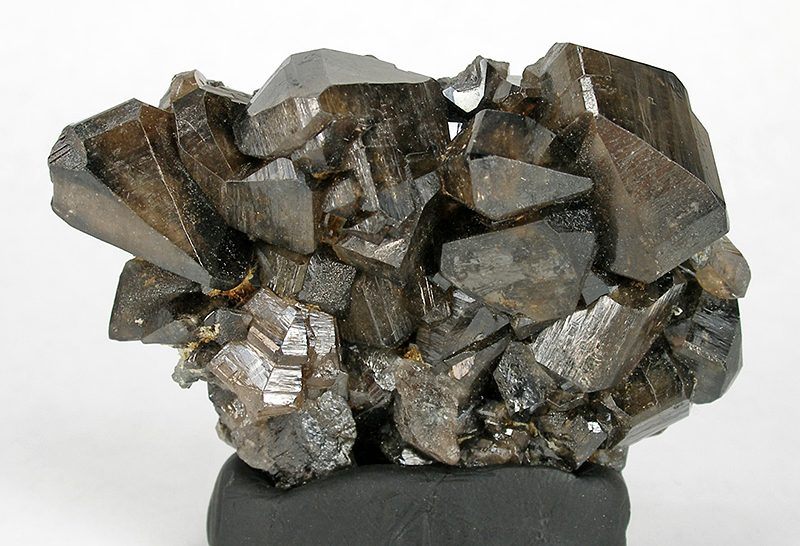
Cassiterite is dark brown to black with a bright, adamantine luster, yet leaves a white to pale streak. Its high density makes it feel surprisingly heavy, and it has the same structure as rutile, with characteristic knee-shaped twins.
Granite Veins and Placers: Where Is It Found?
Cassiterite forms in veins and altered zones in and around tin-rich granite, and in pegmatites. Because it is heavy and resists weathering, it accumulates in river gravels as stream tin, the type of deposit worked in Southeast Asia and in historic Cornwall.
Bronze Age: Why Did Tin Matter?
Cassiterite at a Glance
| Property | Value |
|---|---|
| Type / variety | SnO₂ • Tetragonal Tin Oxide |
| Composition | SnO₂ (78.6 wt% Tin • Isostructural with Rutile) |
| Geology Guide group | Minerals (8 Major Chemical Groups) |
| Mineral Group | Oxides & Hydroxides |
| Mohs hardness | Mohs 6–7 |
| Texture / habit | Short stubby tetragonal prisms with knee-shaped ('visor') contact twins |
| Density | 6.98–7.01 g/cm³ (startlingly heavy in the hand!) |
| Lustre and cleavage | Mirror-like adamantine dark brown-to-black crystal faces; white/pale-tan streak |
| Geological setting | High-temperature granitic greisen veins, pegmatites, and alluvial 'stream-tin' placers |
| Diagnostic feature (Geology Guide) | Dark coffee-brown to jet-black stubby crystal (Mohs 6–7) with mirror-like adamantine faces and knee-shaped 'visor twins' that feels startlingly heavy in the hand (specific gravity ~7.0!) yet leaves a pale white streak. |
| Formula | SnO₂ |
| Density | About 7 g/cm³ |