Rutile
Rutile is titanium dioxide, TiO₂, with tetragonal crystals, a hardness of 6 to 6.5 and a brilliant, almost metallic luster. It forms reddish-brown to golden needles and is one of the main ores of titanium.
Rutile is titanium dioxide, TiO₂, with tetragonal crystals, a hardness of 6 to 6.5 and a brilliant, almost metallic luster. It forms reddish-brown to golden needles and is one of the main ores of titanium.
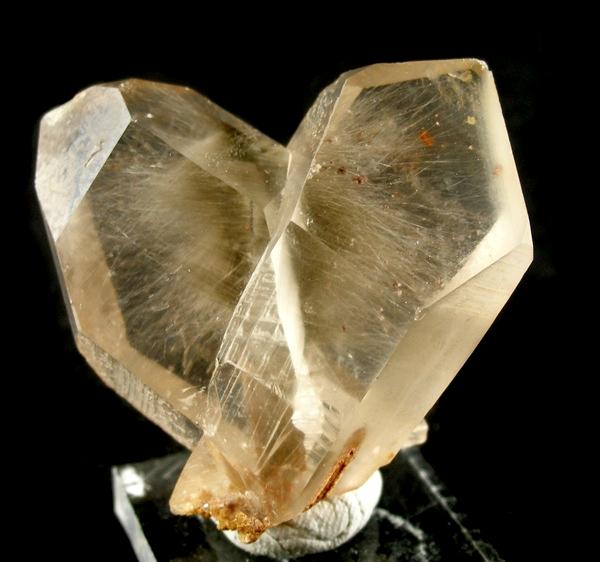
🪨 Geology Guide Specimen: Open Rutile in the CRV Science Rock & Mineral ID Guide to log the specimen, compare it with the other 8 mineral classes of Dana / Strunz Classes, and test your eye in LithoClade.
Needles in Quartz: What Is Rutilated Quartz?
Rutile often grows as fine golden needles that are enclosed in clear quartz, a combination prized as a gemstone. It also forms elbow-shaped twins, with the crystals joined at 60 or 90 degrees.
Optical Properties: Why Does It Sparkle?
Rutile has an extremely high refractive index, higher than diamond, and strong dispersion, so it flashes in light. Natural crystals are usually dark but can be translucent, and synthetic rutile was once made as a diamond imitation.
Titanium Ore and Sands: Where Is It Mined?
Rutile at a Glance
| Property | Value |
|---|---|
| Type / variety | TiO₂ • Tetragonal Titanium Oxide |
| Composition | TiO₂ (59.9 wt% Titanium) |
| Geology Guide group | Minerals (8 Major Chemical Groups) |
| Mineral Group | Oxides & Hydroxides |
| Mohs hardness | Mohs 6–6.5 |
| Texture / habit | Golden hair-like acicular needles (often enclosed in quartz) or 60° 'elbow' twins |
| Density | 4.23 g/cm³ |
| Lustre and cleavage | Brilliant metallic-adamantine deep red-to-golden lustre; pale brown streak |
| Geological setting | High-pressure eclogites, granitic pegmatites, alpine veins, and heavy-mineral beach sands |
| Diagnostic feature (Geology Guide) | Deep crimson-red to golden-straw tetragonal needles and 60° 'elbow-twinned' prisms (Mohs 6–6.5) with a brilliant adamantine-submetallic flash, often seen as golden hairs shooting through clear quartz. |
| Formula | TiO₂ |
| Crystal system | Tetragonal |