Eclogite
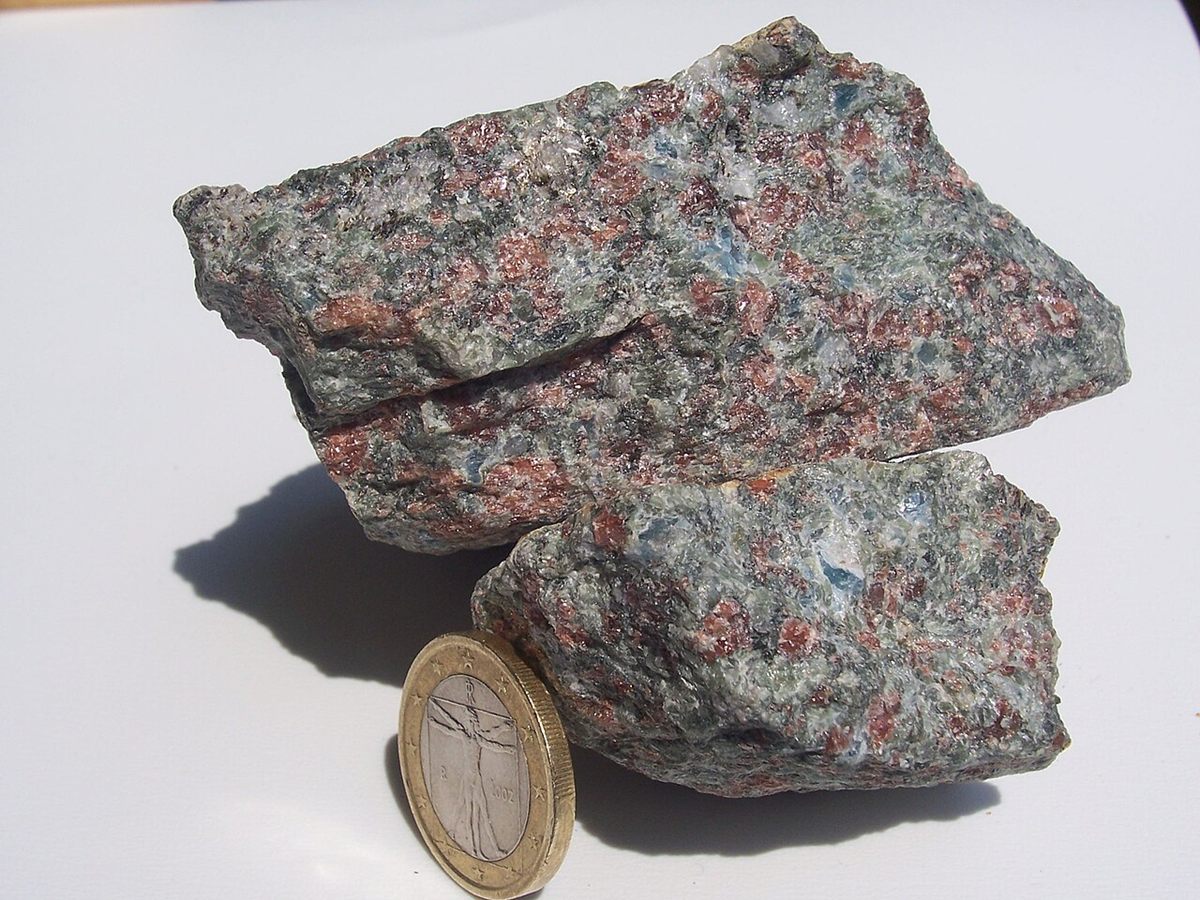
Eclogite is a dense, striking red-and-green metamorphic rock made of garnet and a sodium-rich green pyroxene called omphacite, with no plagioclase. It forms from basalt buried deep in subduction zones, at depths of about 45 kilometers or more.
Eclogite is a dense, striking red-and-green metamorphic rock made of garnet and a sodium-rich green pyroxene called omphacite, with no plagioclase. It forms from basalt buried deep in subduction zones, at depths of about 45 kilometers or more.
🪨 Geology Guide Specimen: Open Eclogite in the CRV Science Rock & Mineral ID Guide to log the specimen, compare it with the other 6 subgroups of Metamorphic, and test your eye in LithoClade.
Deep Burial: How Does Basalt Become Eclogite?
When oceanic crust sinks to depths of 45 kilometers or more, plagioclase becomes unstable at the high pressure and recrystallizes into denser minerals, producing red pyrope-almandine garnet and green omphacite. The conversion is complete at pressures above about 1.2 gigapascals and temperatures of roughly 500 to 800 degrees Celsius.
A Sinking Rock: Why Does Eclogite Matter?
Eclogite is denser than the mantle peridotite around it, about 3.4 to 3.6 grams per cubic centimeter. The change from basalt to eclogite makes a subducting slab heavier, which adds to the pull that drives plate motion, as described in plate tectonics.
Rare Exposures: How Do We See It?
Eclogites reach the surface in a few places where slabs were rapidly returned to the surface, as in the Western Alps and Norway, and as inclusions in kimberlite. Some contain microscopic diamond and coesite, evidence of formation at even greater depths. Compare the colder blueschist.
Eclogite at a Glance
| Property | Value |
|---|---|
| Type / variety | Omphacite–Pyrope Subduction-Zone Eclogite |
| Composition | Apple-Green Omphacite (Na-Clinopyroxene) + Red Pyrope–Almandine Garnet (Zero Plagioclase!) |
| Geology Guide group | Metamorphic Rocks (Foliated, Granoblastic & High-P) |
| Rock Classification | High-Pressure Subduction |
| Mohs hardness | Mohs 6.5–7.5 |
| Texture / habit | Dense, coarse red-and-green granular mosaic |
| Density | 3.35–3.60 g/cm³ (denser than upper mantle peridotite!) |
| Lustre and cleavage | Striking 'Christmas-tree' contrast of crimson garnets in grass-green pyroxene |
| Geological setting | Subducted oceanic basalt crust at 45–100+ km depth (>1.2 GPa, 500–800 °C) |
| Diagnostic feature (Geology Guide) | Ultra-dense (3.5 g/cm³) red-and-green rock composed of crimson garnet crystals set in grass-green sodium clinopyroxene; burial below 45 km depth crushed all plagioclase feldspar out of existence. |
| Key minerals | Garnet and omphacite |
| Typical depth | About 45 km and below |
See Also
- Blueschist — a cooler high-pressure rock
- Kimberlite — a volcanic rock that carries up eclogite fragments
- Plate Tectonics — the subduction that makes eclogite