Almandine Garnet
Almandine is the iron-aluminum end member of the garnet group, Fe₃Al₂(SiO₄)₃, a deep wine-red, isometric silicate with a hardness of 7 to 7.5. It is the most common garnet and an important index mineral of regional metamorphism.
Almandine is the iron-aluminum end member of the garnet group, Fe₃Al₂(SiO₄)₃, a deep wine-red, isometric silicate with a hardness of 7 to 7.5. It is the most common garnet and an important index mineral of regional metamorphism.
🪨 Geology Guide Specimen: Open Almandine Garnet in the CRV Science Rock & Mineral ID Guide to log the specimen, compare it with the other 8 mineral classes of Dana / Strunz Classes, and test your eye in LithoClade.
Crystals: What Shape Does Garnet Take?
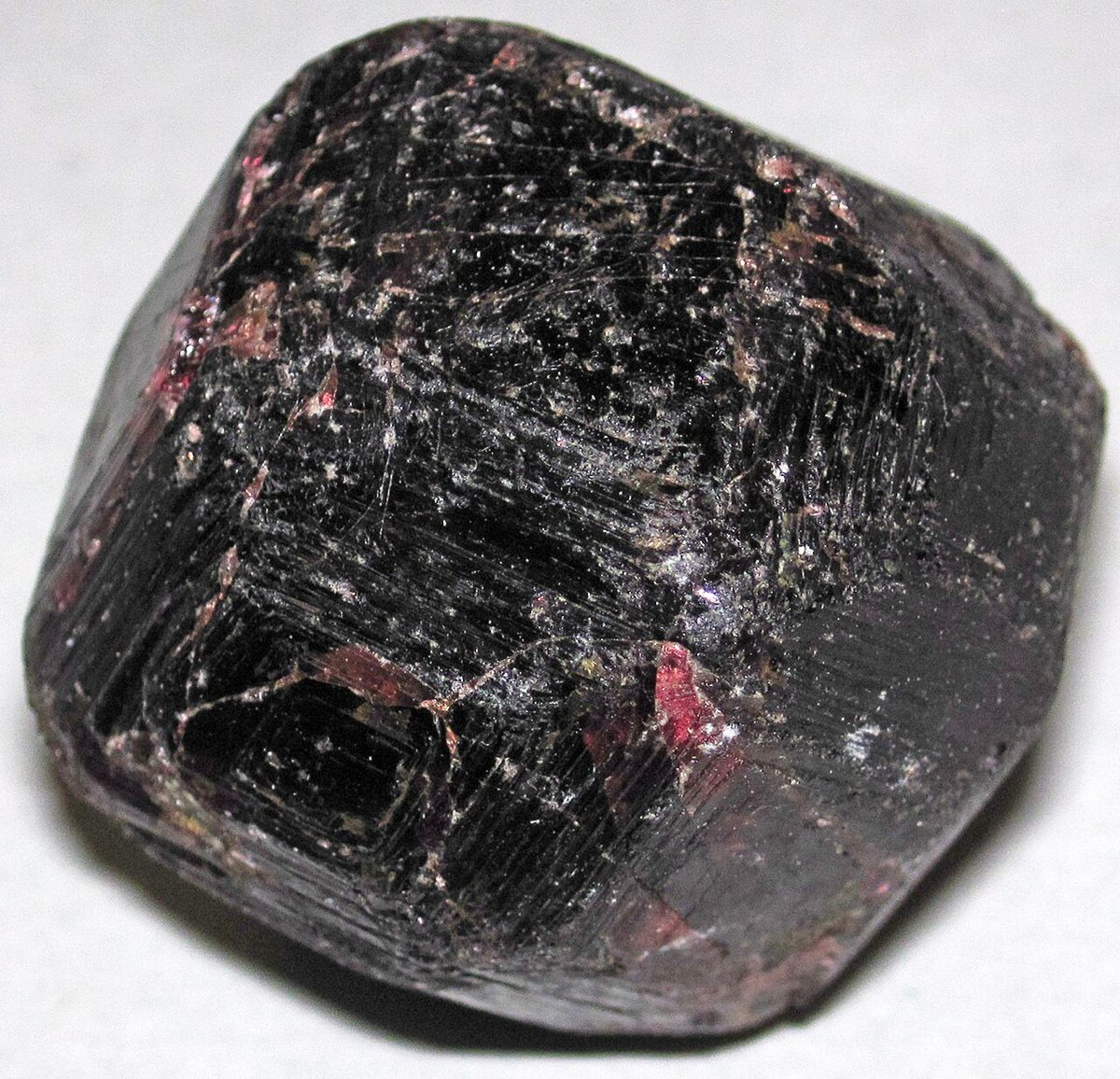
Garnet grows as rounded, many-sided crystals, twelve-sided rhombic dodecahedra or twenty-four-sided trapezohedra. Because it is built of isolated silicate tetrahedra linked by iron and aluminum, it has no cleavage and is dense, about 4.1 to 4.3 grams per cubic centimeter.
Metamorphic Mineral: What Does Almandine Record?
Almandine grows when mudstone is metamorphosed to medium grade, as in garnet muscovite schist, and its composition and zoning record the pressure and temperature it grew in. Almandine-pyrope garnet is also the red mineral in eclogite.
Names and Uses: Why "Garnet"?
The word garnet comes from the Latin for pomegranate, after the resemblance of the red crystals to the fruit's seeds. Almandine is used as a gem and, because it is hard, crushed for sandpaper and for waterjet cutting. Its deep color and its high density both come from iron, which makes up a large part of the formula.
Almandine Garnet at a Glance
| Property | Value |
|---|---|
| Type / variety | Fe₃Al₂(SiO₄)₃ • Isometric Nesosilicate |
| Composition | Fe₃Al₂(SiO₄)₃ (Iron Aluminum Island Lattice) |
| Geology Guide group | Minerals (8 Major Chemical Groups) |
| Mineral Group | Silicates |
| Mohs hardness | Mohs 7–7.5 |
| Texture / habit | Equant 12-sided rhombic dodecahedra or 24-sided trapezohedra |
| Density | 4.05–4.32 g/cm³ (very dense for a non-metallic mineral) |
| Lustre and cleavage | Deep wine-red vitreous-to-resinous lustre; no cleavage |
| Geological setting | Regional metamorphic mica schists, gneisses, and granitic pegmatites |
| Diagnostic feature (Geology Guide) | Deep wine-red, heavy (density ~4.2 g/cm³), high-hardness (Mohs 7.5) crystal that naturally grows into symmetrical 12-sided soccer-ball-like dodecahedra and 24-sided trapezohedra without cleavage. |
| Formula | Fe₃Al₂(SiO₄)₃ |
| Crystal system | Isometric |
See Also
- Garnet Muscovite Schist — the schist named for it
- Eclogite — a rock rich in red garnet
- Iron — the element in almandine