Garnet Muscovite Schist
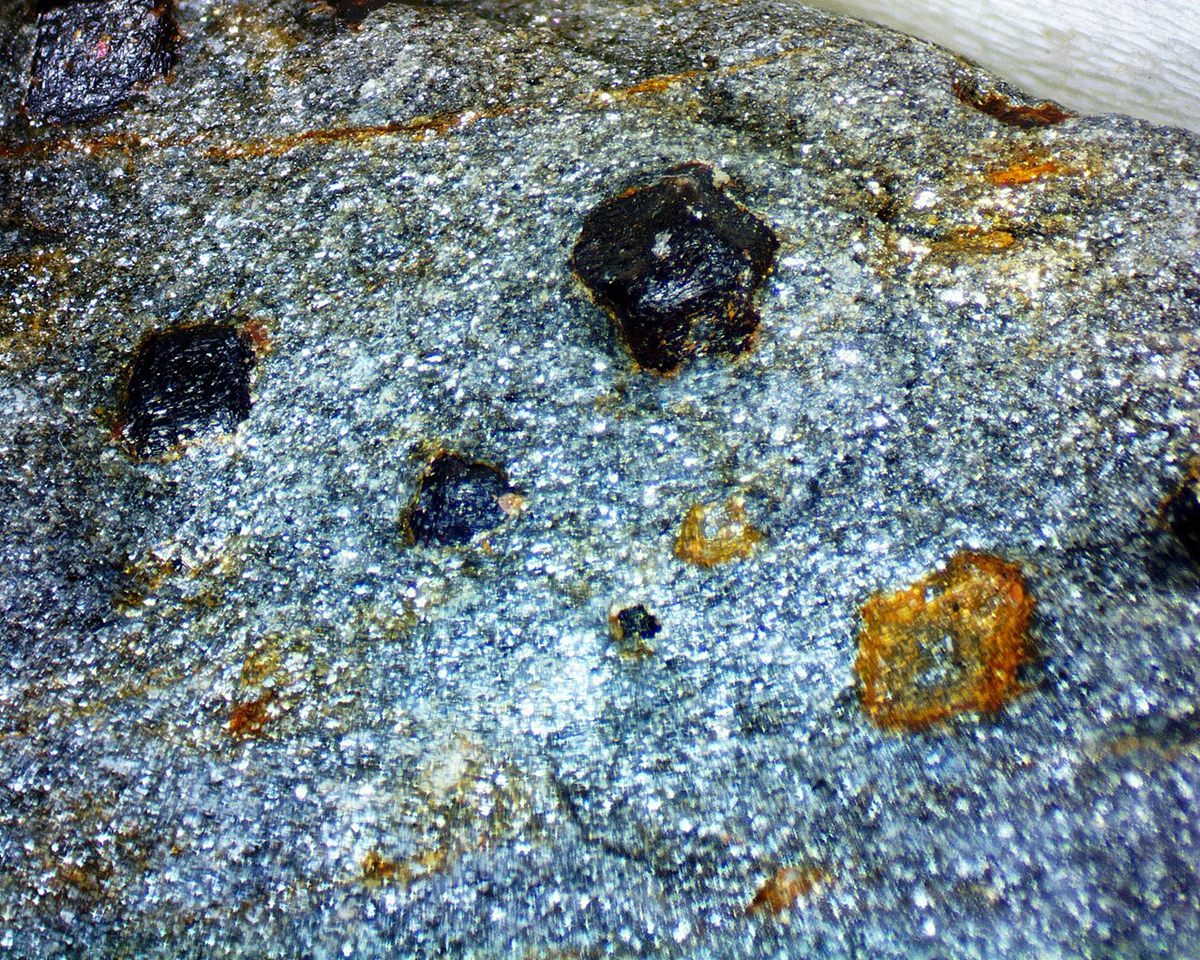
Garnet muscovite schist is a medium-grade metamorphic rock with coarse, glittering flakes of white mica wrapping around red garnet crystals. It forms by recrystallization of mudstone in the roots of mountain belts.
Garnet muscovite schist is a medium-grade metamorphic rock with coarse, glittering flakes of white mica wrapping around red garnet crystals. It forms by recrystallization of mudstone in the roots of mountain belts.
🪨 Geology Guide Specimen: Open Garnet Muscovite Schist in the CRV Science Rock & Mineral ID Guide to log the specimen, compare it with the other 6 subgroups of Metamorphic, and test your eye in LithoClade.
Barrovian Zones: What Does Garnet Mark?
In the 1890s George Barrow mapped the Scottish Highlands and found that metamorphosed mudstone changed through a series of zones named for index minerals: chlorite, biotite, garnet, staurolite, kyanite and sillimanite. Garnet marks the middle of the sequence, at roughly 450 to 600 degrees Celsius, and the pattern is still used worldwide.
Schistosity: Why Do the Micas Glitter?
At this grade, platy minerals grow large enough to see, and mica flakes align in a scaly foliation called schistosity. The foliation wraps around the equant red crystals of almandine garnet, which stand out like knots in wood. Muscovite, quartz, biotite and sometimes plagioclase make up the rest.
Mountain Roots: What Do Garnet Schists Record?
Garnet is a pressure-sensitive mineral, so its composition and growth zoning let geologists calculate how deeply and how hot the rock was buried and later exhumed. This turns schist into a depth gauge for collisions, linked to plate tectonics. Higher-grade versions include staurolite mica schist.
Garnet Muscovite Schist at a Glance
| Property | Value |
|---|---|
| Type / variety | Almandine–Muscovite Lepidoblastic Schist |
| Composition | Coarse Muscovite & Biotite Flakes + Quartz + Dodecahedral Almandine Garnets |
| Geology Guide group | Metamorphic Rocks (Foliated, Granoblastic & High-P) |
| Rock Classification | Medium-Grade Foliated (Schists) |
| Mohs hardness | Mohs 3–4 (mica matrix) to 7.5 (garnet crystals) |
| Texture / habit | Coarse lepidoblastic (scaly mica) foliation wrapping around 5–15 mm red crystals |
| Density | 2.80–3.05 g/cm³ |
| Lustre and cleavage | Glittering silvery-gold mica sheets studded with deep red 12-sided crystals |
| Geological setting | Collisional mountain roots at 450–600 °C and 5–8 kbar (Mudstone protolith) |
| Diagnostic feature (Geology Guide) | Glittering, silvery-grey rock composed of visible overlapping mica flakes that wrap around dark red, 12-sided almandine garnet crystals like knots in wood. |
| Index mineral | Garnet |
| Typical temperature | About 450-600 °C |
See Also
- Staurolite Mica Schist — the next zone up
- Almandine Garnet — the mineral that gives the red crystals
- Muscovite — the white mica