Biotite Quartz Schist
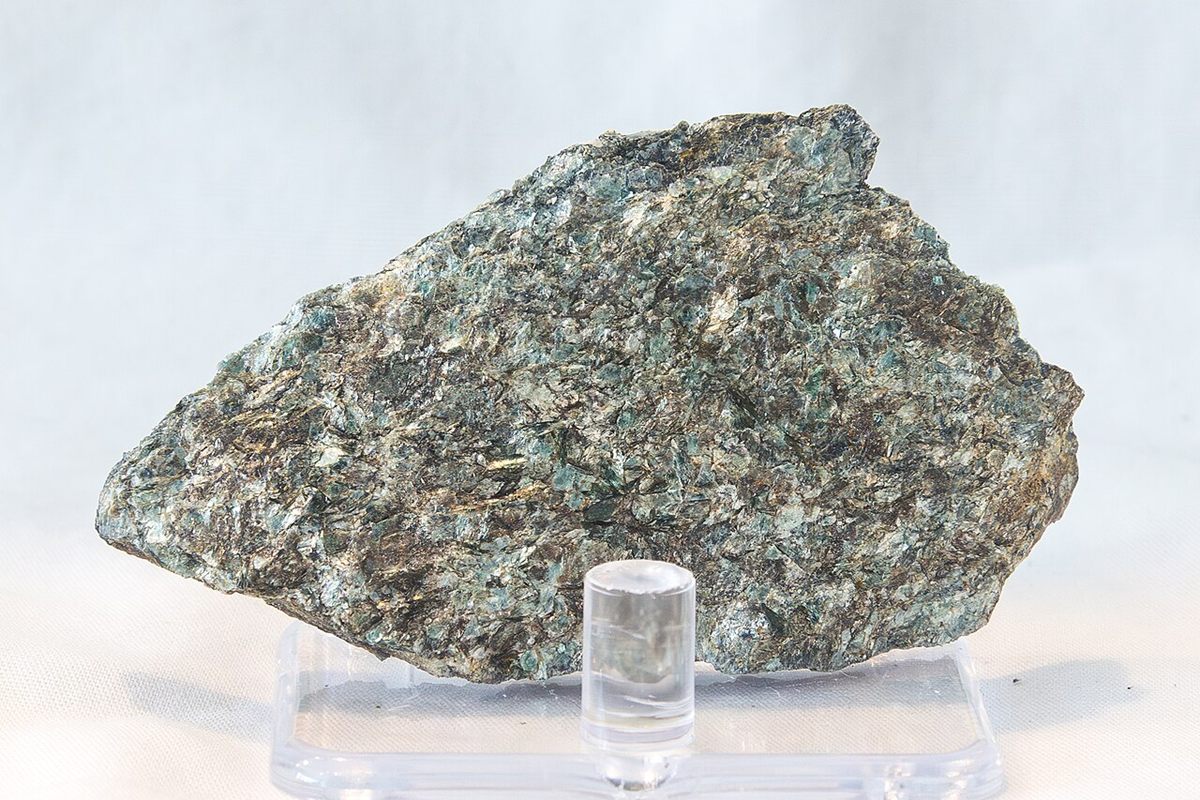
Biotite quartz schist is a dark, sparkling metamorphic rock dominated by visible, aligned flakes of black to bronze biotite mica, with thin lenses of quartz. It forms from muddy sediments at medium grade in the roots of mountain ranges.
Biotite quartz schist is a dark, sparkling metamorphic rock dominated by visible, aligned flakes of black to bronze biotite mica, with thin lenses of quartz. It forms from muddy sediments at medium grade in the roots of mountain ranges.
🪨 Geology Guide Specimen: Open Biotite Quartz Schist in the CRV Science Rock & Mineral ID Guide to log the specimen, compare it with the other 6 subgroups of Metamorphic, and test your eye in LithoClade.
Foliation: Why Does It Split Along Glittering Surfaces?
Biotite grows as platy crystals perpendicular to the squeezing, so the rock splits along undulating surfaces covered with mica. This makes it strongly anisotropic: it is weak along the foliation and much stronger across it, an important fact for tunnels and foundations.
Metapelite: What Was the Original Rock?
The protolith is mudstone, or shale, rich in clay and aluminum. At the biotite zone of the Barrovian sequence, clay reacts with potassium and iron to form biotite, and quartz recrystallizes into lenses. Higher in grade the rock may gain garnet and other minerals.
Famous Bedrock: Where Is It Found?
Mica schists are the bedrock of much of Manhattan, where the Manhattan Schist carries the foundations of its tall buildings, and of the Scottish Highlands and the Appalachians. The pattern shows the edges of ancient collisions.
Biotite Quartz Schist at a Glance
| Property | Value |
|---|---|
| Type / variety | Foliated Biotite–Quartz Pelitic Schist |
| Composition | Aligned Black/Bronze Biotite Flakes + Muscovite + Quartz + Plagioclase |
| Geology Guide group | Metamorphic Rocks (Foliated, Granoblastic & High-P) |
| Rock Classification | Medium-Grade Foliated (Schists) |
| Mohs hardness | Mohs 3–6 (anisotropic along vs. across foliation) |
| Texture / habit | Continuous wavy alignment of macroscopic (>1 mm) dark mica plates |
| Density | 2.75–2.90 g/cm³ |
| Lustre and cleavage | Sparkling bronze-black micaceous foliation planes |
| Geological setting | Continental collision belts (e.g., Manhattan Bedrock, Scottish Highlands) |
| Diagnostic feature (Geology Guide) | Dark, sparkling rock dominated by visible (>1 mm), parallel-aligned flakes of black-to-bronze biotite mica and thin quartz lenses that split along undulating, glittering surfaces. |
| Key mineral | Biotite |
| Protolith | Mudstone or shale |
See Also
- Garnet Muscovite Schist — a schist from slightly higher grade
- Muscovite — the white mica often found alongside
- Plate Tectonics — the source of schist belts