Quartz
Quartz is a silicon dioxide (SiO₂) mineral and the second most abundant mineral in the continental crust, after the feldspars.
Quartz is a silicon dioxide (SiO₂) mineral and the second most abundant mineral in the continental crust, after the feldspars. It is hard, chemically stable and found in nearly every environment. Amethyst is its purple variety, famous from crystal-lined cavities called geodes.
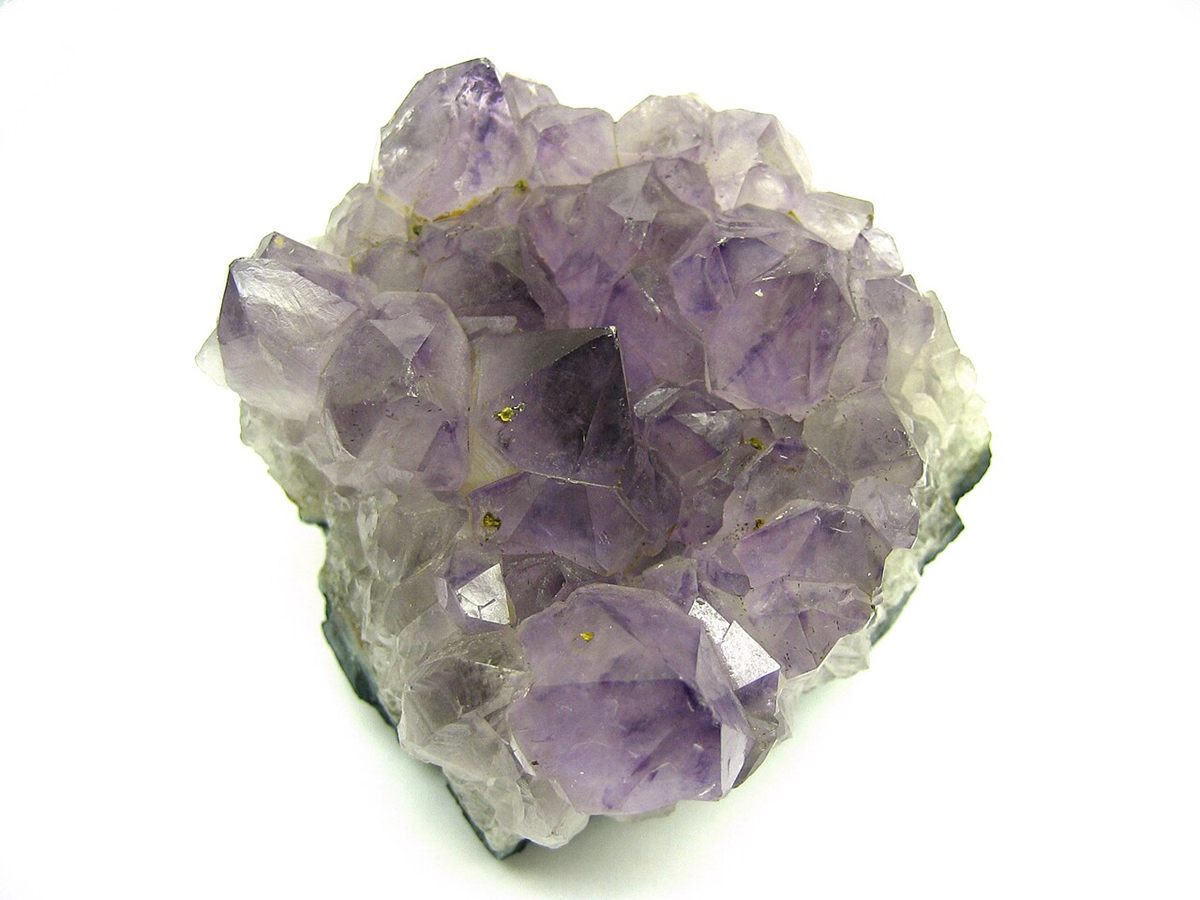
🪨 Geology Guide Specimen: Open Quartz (Amethyst) in the CRV Science Rock & Mineral ID Guide to log the specimen, compare it with the other 8 mineral classes of Dana / Strunz Classes, and test your eye in LithoClade.
Framework Structure: Why Is Quartz So Common and Durable?
Quartz is a framework silicate in which every silicon-oxygen tetrahedron shares all its corners with neighbors, forming a strong three-dimensional network. There are no weak planes, so it has no cleavage and breaks along curved, glassy surfaces, and its hardness of 7 is the standard for that number on the Mohs scale. Because it resists weathering, quartz survives as the sand of beaches and deserts.
Varieties: What Colors Quartz?
Clear quartz is colorless. Amethyst gets its violet from iron impurities altered by natural radiation, smoky quartz from radiation acting on aluminum, rose quartz from microscopic inclusions, and citrine from iron. Chalcedony, agate and chert are made of microscopic quartz crystals.
Piezoelectricity: Why Is Quartz in Watches?
Squeezing a quartz crystal produces an electric voltage, and applying a voltage makes it vibrate at a very steady frequency. This piezoelectric property is the basis of quartz clocks, watches and radio oscillators. Quartz is also the main ingredient of glass and of granite, quartzite and many sandstones.
Quartz at a Glance
| Property | Value |
|---|---|
| Type / variety | SiO₂ • Trigonal Tectosilicate |
| Composition | SiO₂ (with trace Fe³⁺/Fe⁴⁺ color centers in Amethyst) |
| Geology Guide group | Minerals (8 Major Chemical Groups) |
| Mineral Group | Silicates |
| Mohs hardness | Mohs 7 (reference standard for 7) |
| Texture / habit | 6-sided hexagonal prisms terminated by rhombohedral pyramids |
| Density | 2.65 g/cm³ |
| Lustre and cleavage | Vitreous lustre; zero cleavage—breaks with curved conchoidal fracture |
| Geological setting | Hydrothermal veins, volcanic geodes, pegmatites, and crustal rocks |
| Diagnostic feature (Geology Guide) | Six-sided prismatic crystals with pyramidal terminations (Mohs 7) that lack cleavage planes entirely, breaking along curved glass-like surfaces; trace iron irradiation produces rich violet hues inside volcanic geodes. |
| Crystal system | Trigonal (alpha-quartz) |
| Amethyst color | Iron impurities and natural radiation |