Corundum
Corundum is aluminum oxide, Al₂O₃, with trigonal crystals and a hardness of 9, the standard for that number on the Mohs scale and the hardest common mineral after diamond. Its gem varieties are red ruby and sapphire in every other color.
Corundum is aluminum oxide, Al₂O₃, with trigonal crystals and a hardness of 9, the standard for that number on the Mohs scale and the hardest common mineral after diamond. Its gem varieties are red ruby and sapphire in every other color.
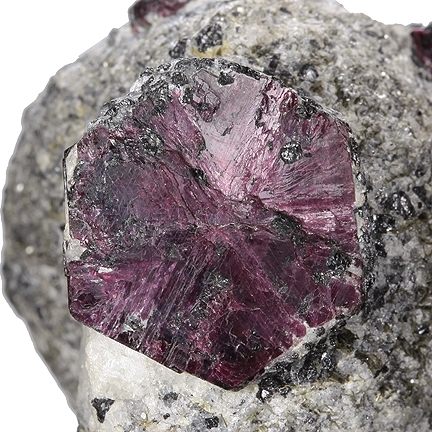
🪨 Geology Guide Specimen: Open Corundum (Ruby & Sapphire) in the CRV Science Rock & Mineral ID Guide to log the specimen, compare it with the other 8 mineral classes of Dana / Strunz Classes, and test your eye in LithoClade.
Extreme Hardness: Why Is Corundum So Hard?
Aluminum and oxygen are packed tightly and bonded strongly in corundum's lattice, giving it a hardness of 9. Impure, granular corundum mixed with magnetite and other minerals is called emery and has long been used as an abrasive.
Ruby and Sapphire: What Gives the Colors?
Pure corundum is colorless. A small amount of chromium turns it red, making ruby, and iron with titanium gives the classic blue of sapphire. The first working laser, built in 1960, used a synthetic ruby crystal.
Occurrence: Where Does It Form?
Corundum at a Glance
| Property | Value |
|---|---|
| Type / variety | Al₂O₃ • Trigonal Aluminum Oxide |
| Composition | Al₂O₃ (Trace Cr³⁺ yields red Ruby; Fe²⁺ + Ti⁴⁺ charge transfer yields blue Sapphire) |
| Geology Guide group | Minerals (8 Major Chemical Groups) |
| Mineral Group | Oxides & Hydroxides |
| Mohs hardness | Mohs 9 (reference standard for 9; second hardest common mineral after diamond) |
| Texture / habit | 6-sided barrel-shaped hexagonal prisms with flat ends and triangular growth lines |
| Density | 3.98–4.10 g/cm³ (exceptionally dense for an aluminum mineral) |
| Lustre and cleavage | Adamantine-to-vitreous crimson or royal blue; basal parting lines |
| Geological setting | Silica-undersaturated syenites, marbles, high-grade gneisses, and gem placers |
| Diagnostic feature (Geology Guide) | Barrel-shaped hexagonal crystal with flat ends and Mohs 9 hardness (scratches topaz and quartz easily, scratched only by diamond); trace chromium turns it pigeon-blood red, while iron-titanium turns it royal blue. |
| Formula | Al₂O₃ |
| Gem varieties | Ruby (chromium) and sapphire |