Kyanite
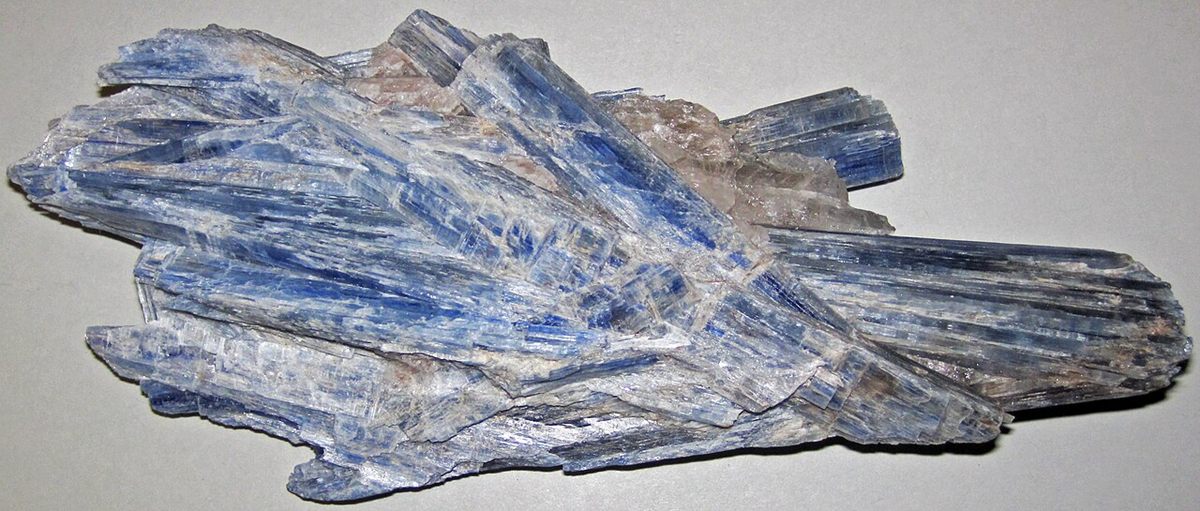
Kyanite is an aluminum silicate, Al₂SiO₅, that forms long, flat blue blades in high-pressure metamorphic rocks. It is one of three polymorphs of that formula, with andalusite and sillimanite, and its name comes from the Greek for 'dark blue.'
Kyanite is an aluminum silicate, Al₂SiO₅, that forms long, flat blue blades in high-pressure metamorphic rocks. It is one of three polymorphs of that formula, with andalusite and sillimanite, and its name comes from the Greek for "dark blue."
🪨 Geology Guide Specimen: Open Kyanite in the CRV Science Rock & Mineral ID Guide to log the specimen, compare it with the other 8 mineral classes of Dana / Strunz Classes, and test your eye in LithoClade.
Polymorphs: Why Does Pressure Matter?
Kyanite, andalusite and sillimanite have the same chemical formula but different crystal structures, each stable in a different pressure-temperature range. Kyanite is the high-pressure form, andalusite the low-pressure form and sillimanite the high-temperature form, so which one a rock contains tells geologists how deep and hot it was.
Anisotropy: Why Is Hardness Different in Two Directions?
A blade of kyanite has a hardness of about 4.5 to 5 along its length but 6.5 to 7 across its width, a rare property that makes it a favorite teaching example. Its blue color and bladed form make it easy to spot in schist and gneiss.
Occurrence and Use: Where Does It Occur?
Kyanite grows in aluminum-rich metamorphic rocks such as staurolite mica schist and whiteschist. Heated, it forms mullite, a heat-resistant ceramic, so kyanite is mined for refractories and spark plugs. See aluminum.
Kyanite at a Glance
| Property | Value |
|---|---|
| Type / variety | Al₂SiO₅ • Triclinic Bladed Nesosilicate |
| Composition | Al₂SiO₅ (High-pressure polymorph of Andalusite & Sillimanite) |
| Geology Guide group | Minerals (8 Major Chemical Groups) |
| Mineral Group | Silicates |
| Mohs hardness | Mohs 4.5–5 parallel to blade length, but Mohs 6.5–7 across the blade! |
| Texture / habit | Long, flat, Cornflower-blue bladed crystals in radiating sheaves |
| Density | 3.53–3.65 g/cm³ |
| Lustre and cleavage | Vitreous-to-pearly sky-blue blades with perfect pinacoidal cleavage |
| Geological setting | High-pressure regional metamorphic schists, gneisses, and eclogites |
| Diagnostic feature (Geology Guide) | Cornflower-blue, long bladed crystal famous for extreme hardness anisotropy: a steel pocketknife scratches it easily along the length of the blade (Mohs 4.5), but cannot scratch it across the width (Mohs 7)! |
| Formula | Al₂SiO₅ |
| Polymorphs | Andalusite and sillimanite |
See Also
- Staurolite Mica Schist — a schist where kyanite is the next index mineral
- Whiteschist — a high-pressure rock with kyanite
- Aluminum — the metal in kyanite