Cartwheel Galaxy
The Cartwheel Galaxy (ESO 350-40) is a collisional ring galaxy in Sculptor, about 500 million light-years away and some 145,000 light-years across.
The Cartwheel Galaxy (ESO 350-40) is a collisional ring galaxy in Sculptor, about 500 million light-years away and some 145,000 light-years across. Fritz Zwicky identified it in 1941, and its wheel shape resulted from a smaller galaxy plunging through its disk.
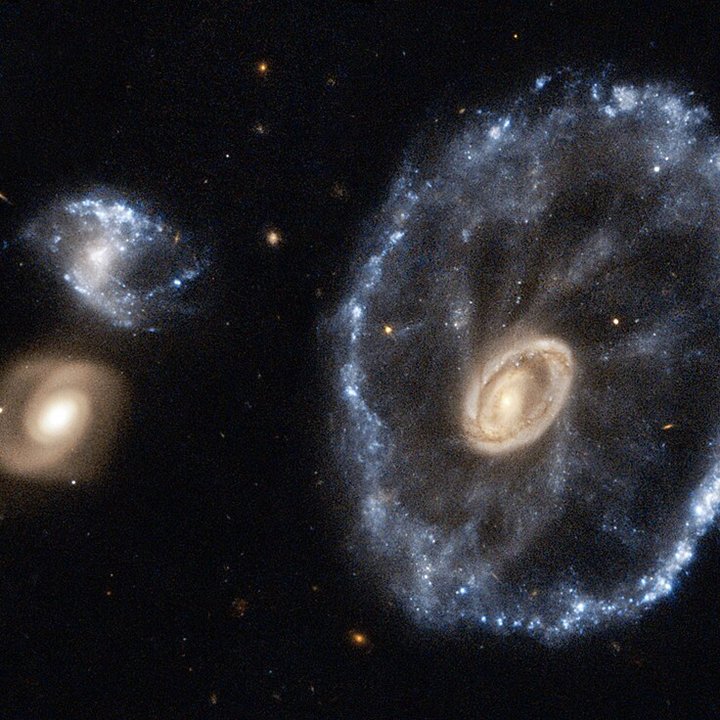
🔭 Galaxy Guide: Find Cartwheel Galaxy in the CRV Science Deep Sky Galaxy Guide to see its Hubble, JWST or ground-based image, the diagnostic clue used to classify it, and the Ring / Irregular class it belongs to. Test your eye in the Deep Sky Classification game.
How a Collision Makes a Ring
When a compact galaxy passes through a disk, its gravity pulls disk material inward, and the stars and gas then rebound outward as an expanding density wave. The ring seen today is that wave, sweeping through gas and triggering star formation as it goes. The collision is estimated to have happened a few hundred million years ago.
Rim and Spokes: Two Rings and a Core
The bright outer ring is dotted with young star clusters and supernova remnants, while an inner ring surrounds the yellowish nucleus. Faint spokes connecting them are remnants of the original disk's structure. Webb's infrared image in 2022 revealed dust and old stars that Hubble could not.
The Companions
Several smaller galaxies lie nearby, and one is likely the intruder that formed the ring. The system shows how interactions can transform a normal spiral into a markedly different structure.
Cartwheel Galaxy at a Glance
| Property | Value |
|---|---|
| Catalog designation | ESO 350-40 |
| Constellation | Sculptor |
| Distance | 500 million light-years |
| Hubble / morphological type | S pec (Collisional Ring) |
| Galaxy Guide class | Ring & Starburst Irregular Galaxy (Ring / Irr) |
| Discoverer | Fritz Zwicky, 1941 |
| Diameter | About 145,000 light-years |
| Image credit (Galaxy Guide) | NASA / ESA / CSA / STScI (JWST NIRCam & MIRI) |
Collisional Bullseye Mechanics & Expanding Epicyclic Density Waves
Lynds–Toomre Impulse Approximation and Caustic Ring Formation
Discovered by Fritz Zwicky in 1941 on wide-field Schmidt plates and dubbed by him "one of the most complicated structures awaiting its explanation on the basis of stellar dynamics," the Cartwheel Galaxy (ESO 350-40, AM 0035-335) is the archetype of a collisional ring galaxy formed by a nearly head-on, high-velocity galactic penetration. As formulated analytically by Roger Lynds and Alar Toomre (1976) and J. C. Theys and E. A. Spiegel (1976), when a compact intruder galaxy of mass Mint plunges nearly perpendicular to a target disk galaxy (within ~15°–30° of the rotation axis) at a small impact parameter (b < 0.15 Rdisk) and high relative velocity Vrel ≈ 300 to 600 km·s−1, disk stars experience a transient, inward radial gravitational impulse:
Δ*v*R(R) = −∫ [(G Mint R) / (R2 + Vrel2 t2 + a2)3/2] d*t* = −(2 G Mint R) / [Vrel (R2 + a2)]
where a is the softening scale length of the intruder. Following the intruder's passage, stars across the target disk begin coherent inward and outward radial epicyclic oscillations around their guiding-center radii R0 with epicyclic frequency κ(R0):
R(t) = R0 + (ΔvR / κ(R0)) sin[κ(R0) t]
Because the epicyclic frequency κ(R) = [2 Ω(R) (2 Ω(R) + R dΩ/d*R*)]1/2 decreases monotonically with galactocentric radius in a differentially rotating halo, inner stars complete their inward contraction and rebound outward earlier than outer stars. The outward-rebounding inner orbits overtake the still-contracting outer orbits, generating a high-density orbit-crowding caustic (where ∂*R*/∂*R*0 = 0) that propagates radially outward across the disk like a cylindrical wave.
Outer Ring Expansion Kinematics, Inner Ring, and Spiral Spokes
Fabry-Pérot Hα interferometry by Amram et al. (1998) and H I 21-cm synthesis imaging with the Very Large Array by Higdon (1996) establish that the Cartwheel's outer ring (radius Router ≈ 22 kpc, or diameter ~44 kpc / 145,000 light-years) combines circular rotation (Vrot ≈ 254 km·s−1) with a radial expansion velocity of Vexp ≈ 53 to 89 km·s−1. Dividing the current outer ring radius by the deceleration-corrected expansion speed dates the bullseye impact to ~200 to 300 million years ago. Behind the outer ring, stars that have completed a full epicyclic period (2π / κ) and rebounded a second time assemble the concentric inner ring (Rinner ≈ 4.5 kpc) surrounding the old lenticular nucleus. Connecting the inner and outer rings are radial-spiral "spokes"—composed of gas and stars sheared by differential rotation as material falls back inward from the expanding outer caustic—demonstrating that the pre-collision disk is beginning to re-establish spiral density arms via swing amplification.
Multi-Wavelength Diagnostics: JWST, Hubble, Chandra & Starburst Propagations
The Radial Age Gradient ("Snowplow" Starburst Effect)
Because the expanding outer ring wave sweeps supersonically into the ambient cold atomic gas of the outer disk, it drives a radiative shock that compresses neutral hydrogen above the Toomre threshold surface density for gravitational instability, igniting an azimuthal necklace of giant H II regions and Super Star Clusters (SSCs) totaling an integrated star formation rate of SFR ≈ 18 to 22 M☉·yr−1 (over 80% of which occurs in the outer ring). As measured by Marcum, Appleton, and Higdon (1992), the Cartwheel exhibits a clean radial color and stellar age gradient between the outer ring and inner ring:
- Leading Outer Ring (R ≈ 22 kpc): Dominated by zero-age O and B stars (t < 5–10 Myr) with blue optical-infrared colors (B − V ≈ 0.0, V − K ≈ 1.6), strong Balmer Hα and [O III] 500.7 nm nebular emission, and sub-solar oxygen metallicity (12 + log(O/H) ≈ 8.2, or ~0.3 Z☉). In November 2021, the Type II supernova SN 2021afdx exploded in the southwestern quadrant of this outer ring.
- Post-Ring Interior Disk (R ≈ 6–20 kpc): As the density wave advances outward, it leaves behind an aging wake of A- and F-type main-sequence stars and red supergiants (t ≈ 50–250 Myr) whose ionizing OB stars have expired.
- Inner Ring & Nucleus (R ≤ 5 kpc): Populated by older K and M giant stars (t > 1–5 Gyr, V − K > 3.0) warmed by dust, with modest ongoing star formation traced by warm molecular hydrogen (H2) shocks detected by Spitzer and JWST.
JWST NIRCam/MIRI Dust Geometry and the Ultra-Luminous X-Ray Source Crown
In August 2022, the James Webb Space Telescope observed the Cartwheel with NIRCam (0.9–4.4 μm) and MIRI (5–28 μm), resolving the galaxy's dust and stellar skeleton free of foreground extinction. MIRI mid-infrared imaging revealed that the spokes between the inner and outer rings are rich in silica and hydrocarbon (PAH) dust filaments (~7.7 and 11.3 μm), tracing the spiral skeleton along which gas flows back toward the inner ring. Simultaneously, Chandra and XMM-Newton observations by Wolter & Trinchieri (2004) discovered that the Cartwheel's outer ring hosts the richest known concentration of Ultraluminous X-ray Sources (ULXs) in any single galaxy: 15 to 20 point sources with LX(0.5–10 keV) > 1039 erg·s−1, headed by N10 (LX ≈ 1.3 × 1041 erg·s−1), powered by young high-mass X-ray binaries born in the low-metallicity outer ring starburst.
Identifying the Bullet Companion: G1, G2, or G3?
The Cartwheel resides in a compact four-galaxy group at redshift z = 0.0301 (vhel ≈ 9,050 km·s−1) accompanied by three smaller neighbors 25 to 90 kpc to the northeast and north: the late-type spiral G1 (ESO 350-G040 NED01), the gas-stripped S0 galaxy G2, and the spiral G3 (~88 kpc north). While early optical studies favored G1 or G2, VLA H I 21-cm synthesis mapping by Higdon (1996) discovered a continuous 88-kiloparsec plume of neutral hydrogen (~2 × 10⁹ M☉ of H I) linking the Cartwheel's disk directly to G3, confirming G3 as the high-velocity "bullet" intruder that pierced the Cartwheel ~250 Myr ago.
References
- Lynds, R., & Toomre, A. (1976). "On the interpretation of ring galaxies: The binary ring system II Hz 4." The Astrophysical Journal, 209, 382–388. doi:10.1086/154730
- Higdon, J. L. (1996). "Wheels of fire. II. Neutral hydrogen in the Cartwheel ring galaxy." The Astrophysical Journal, 467, 241–260. doi:10.1086/177599
- Appleton, P. N., & Struck-Marcell, C. (1996). "Collisional ring galaxies." Fundamentals of Cosmic Physics, 16, 111–220. doi:10.48550/arXiv.astro-ph/9601005
- Wolter, A., & Trinchieri, G. (2004). "Rings of fire: X-ray point sources in the Cartwheel galaxy." Astronomy & Astrophysics, 426(3), 787–801. doi:10.1051/0004-6361:20040537