Lindsay-Shapley Ring
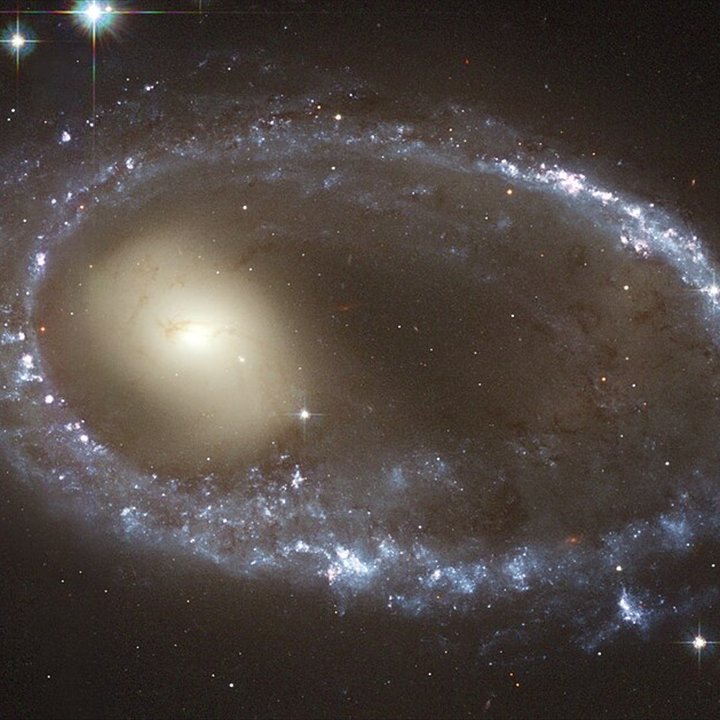
The Lindsay-Shapley Ring (AM 0644-741) is a collisional ring galaxy in Volans about 300 million light-years away, roughly 150,000 light-years across. It was found in 1960 on photographic plates by Eric Lindsay and Harlow Shapley.
The Lindsay-Shapley Ring (AM 0644-741) is a collisional ring galaxy in Volans about 300 million light-years away, roughly 150,000 light-years across. It was found in 1960 on photographic plates by Eric Lindsay and Harlow Shapley.
🔭 Galaxy Guide: Find Lindsay-Shapley Ring in the CRV Science Deep Sky Galaxy Guide to see its Hubble, JWST or ground-based image, the diagnostic clue used to classify it, and the Ring / Irregular class it belongs to. Test your eye in the Deep Sky Classification game.
An Expanding Wave of Star Formation
A smaller galaxy crossed the disk, launching a ring-shaped density wave that sweeps outward through gas, compressing it and triggering star formation. The result is a bright blue ring dotted with H II regions and hot high-mass stars.
An Off-Center Nucleus
The nucleus sits noticeably off-center within the ring, a signature of how the collision geometry distorted the disk. Hubble's image shows the ring clumped into bright knots of star formation.
Ring Galaxies in Context
Ring galaxies are rare because the collision must be nearly head-on. They are useful tests of models for how disks respond to impacts, and for tracing how star formation can be sparked by shocks.
Lindsay-Shapley Ring at a Glance
| Property | Value |
|---|---|
| Catalog designation | AM 0644-741 |
| Constellation | Volans |
| Distance | 300 million light-years |
| Hubble / morphological type | Ring Galaxy |
| Galaxy Guide class | Ring & Starburst Irregular Galaxy (Ring / Irr) |
| Discovery | Lindsay and Shapley, 1960 |
| Image credit (Galaxy Guide) | NASA / ESA & the Hubble Heritage Team (AURA/STScI) |
Off-Center Collisional Mechanics & Asymmetric Ring Kinematics
RE-Type Ring Morphology and Oblique Impact Trajectory
Discovered in 1960 by Eric Mervyn Lindsay and Harlow Shapley on photographic plates obtained with the 60-inch Rockefeller Reflector and ADH Baker-Schmidt telescope at Boyden Observatory in South Africa—and subsequently cataloged by Halton Arp and Barry Madore (1987) as AM 0644-741 (ESO 034-IG011)—the Lindsay-Shapley Ring is one of the largest and brightest southern collisional ring galaxies (z = 0.0220, vhel = 6,609 km·s−1, luminosity distance ~92 Mpc or ~300 million light-years). In the morphological classification scheme of Theys and Spiegel (1976), AM 0644-741 belongs to the RE class (elliptical, sharp-edged ring enclosing an empty interior) combined with an RN component (a prominent off-center nucleus displaced toward the southern rim of the ring).
While a zero-impact-parameter (b ≈ 0) vertical collision generates a concentric ring around a centered nucleus (as approximated in the Cartwheel Galaxy), N-body and hydrodynamical impact models by Antunes & Wallin (2007) and Appleton & Struck-Marcell (1996) demonstrate that the lopsided geometry of AM 0644-741 resulted from an off-center, inclined penetration:
- Impact Parameter and Inclination: Approximately 150 to 220 million years ago, a compact spheroidal intruder galaxy of mass Mint ≈ (0.3–0.5) Mtarget plunged through the southern-eastern quadrant of the target spiral disk at a galactocentric impact parameter of b ≈ 4 to 7 kpc (roughly 20–30% of the initial disk scale radius) and an inclination angle of 25° to 35° from the disk normal.
- Nuclear Recoil vs. Asymmetric Epicyclic Wave: During the passage, the target galaxy's bulge/nucleus and its surrounding disk stars received different radial velocity impulses Δ*v*R. Because the intruder passed closer to the nucleus than to the far (northern) edge of the disk, the nucleus recoiled southward while the radially expanding epicyclic density caustic propagated asymmetrically across the disk.
- Crescent Compression on the Northern Arc: On the northern and northwestern side of the ring, differential rotation and the off-center radial expansion wave converge, crowding stellar and gaseous streamlines together into a double-stranded, high-surface-brightness crescent spanning ~46 kiloparsecs (~150,000 light-years) along its principal axis (inclined at i ≈ 57° to the line of sight). Conversely, on the southern side nearest the off-center yellow nucleus, the ring splits into a fainter, lower-density arc where the shock front has already swept through the thinner inner disk gas.
Fabry-Pérot Velocity Fields and Expansion Speed
Two-dimensional Hα Fabry-Pérot interferometry by Few, Madore, and Arp (1982) and Higdon, Higdon, and Rand (2011) separates the kinematic velocity field of AM 0644-741 into circular rotation and radial expansion:
Vobs(R, θ) = Vsys + [Vrot(R) cos θ + Vexp(R) sin θ] sin i
where θ is the azimuthal angle in the plane of the galaxy. Across the 46-kpc ring, the deprojected circular rotation velocity reaches a flat plateau of Vrot ≈ 310 ± 15 km·s−1, indicating a dark matter halo with an enclosed dynamical mass of Mdyn(R < 23 kpc) ≈ 5.2 × 10¹¹ M☉. Simultaneously, the ring expands radially outward at Vexp ≈ 128 ± 12 km·s−1—nearly twice the expansion speed of the Cartwheel Galaxy—implying a dynamical expansion age of tdyn ≈ Rring / Vexp ≈ 175 Myr since pericentric impact.
Starburst Knots, Young Star Clusters & Multi-Wavelength Diagnostics
Hubble ACS Population Synthesis and Giant H II Complexes
High-angular-resolution imaging with the Hubble Space Telescope Advanced Camera for Surveys (ACS) in broadband B (F435W), V (F555W), I (F814W), and narrowband Hα (F658N) resolves the expanding ring of AM 0644-741 into more than 170 giant H II regions and hundreds of luminous Super Star Clusters (SSCs) with individual masses of 104 to 106 M☉. Because the radial expansion velocity (Vexp ≈ 128 km·s−1) is strongly supersonic relative to the sound speed of the pre-shock neutral interstellar medium (cs ≈ 8–10 km·s−1, Mach number ℳ > 12), the outward-propagating density wave drives a radiative shock into the outer H I disk (MH I ≈ 1.1 × 10¹⁰ M☉ mapped by the Australia Telescope Compact Array).
The post-shock gas layer fragments via gravitational instability into dense molecular cores along the northern and western arcs, sustaining a galaxy-wide star formation rate of SFR ≈ 11 to 15 M☉·yr−1 (traced by Hα, GALEX far-ultraviolet, and Spitzer 24 μm continuum). Across the width of the ring, HST photometry confirms the "snowplow" age sequence predicted by Appleton & Struck-Marcell:
- Outer Leading Edge: Populated by zero-age H II complexes (t < 5–8 Myr) ionized by early O-type stars emitting intense Hα (656.3 nm) and [O III] (500.7 nm) recombination/forbidden lines, traced by dark filamentary dust lanes on the outer shock boundary.
- Inner Trailing Edge of the Ring: Populated by continuum-bright, Hα-faint blue star clusters aged 15 to 60 Myr that are already drifting inward relative to the outward-advancing shock front.
- Interior Cavity and Displaced Nucleus: Depleted of cold gas and dominated by pre-collision old red giants (t > 3–8 Gyr) in the off-center bulge, which exhibits weak low-ionization nuclear emission-line region (LINER) activity.
Chandra X-Ray Binary Population
Observations with the Chandra X-ray Observatory and XMM-Newton detect 9 point-like Ultraluminous X-ray Sources (ULXs) (LX > 1039 erg·s−1) arrayed along the northern and western starburst segments of the Lindsay-Shapley Ring, confirming that the ring's supersonic shock wave forms high-mass stars that evolve into black hole and neutron star X-ray binaries.
The Bullet Companion & Future Ring Dissolution
Approximately 1.6 arcminutes (~45 kpc in projection) southeast of the Lindsay-Shapley Ring lies a compact elliptical/S0 galaxy (AM 0644-741B, vhel ≈ 6,750 km·s−1) stripped of its outer gas envelope, representing the bullet intruder that pierced AM 0644-741 ~175 Myr ago. Over the next 300 to 500 Myr, radial epicyclic phase mixing will disperse the blue ring back into a thickened spiral disk.
References
- Lindsay, E. M., & Shapley, H. (1960). "A ring galaxy in the constellation Volans." The Observatory, 80, 223–224. https://ui.adsabs.harvard.edu/abs/1960Obs....80..223L
- Few, J. M. A., Madore, B. F., & Arp, H. C. (1982). "Ring galaxies – I. Kinematics of the southern ring galaxy AM 0644-741." Monthly Notices of the Royal Astronomical Society, 199(3), 633–647. doi:10.1093/mnras/199.3.633
- Higdon, J. L., & Wallin, J. F. (1997). "Wheels of fire. III. Star formation in the 'Lindsay-Shapley' ring galaxy AM 0644-741." The Astrophysical Journal, 474(2), 686–700. doi:10.1086/303491
- Higdon, J. L., Higdon, S. J. U., & Rand, R. J. (2011). "Wheels of fire. IV. Neutral hydrogen and star formation in the Lindsay-Shapley ring galaxy AM 0644-741." The Astrophysical Journal, 739(1), 97. doi:10.1088/0004-637X/739/1/97