Hoag's Object
Hoag's Object (PGC 54559) is a rare ring galaxy in Serpens, about 600 million light-years away, with a nearly perfect blue ring of young stars around a round yellow core. Arthur Hoag discovered it in 1950.
Hoag's Object (PGC 54559) is a rare ring galaxy in Serpens, about 600 million light-years away, with a nearly perfect blue ring of young stars around a round yellow core. Arthur Hoag discovered it in 1950.
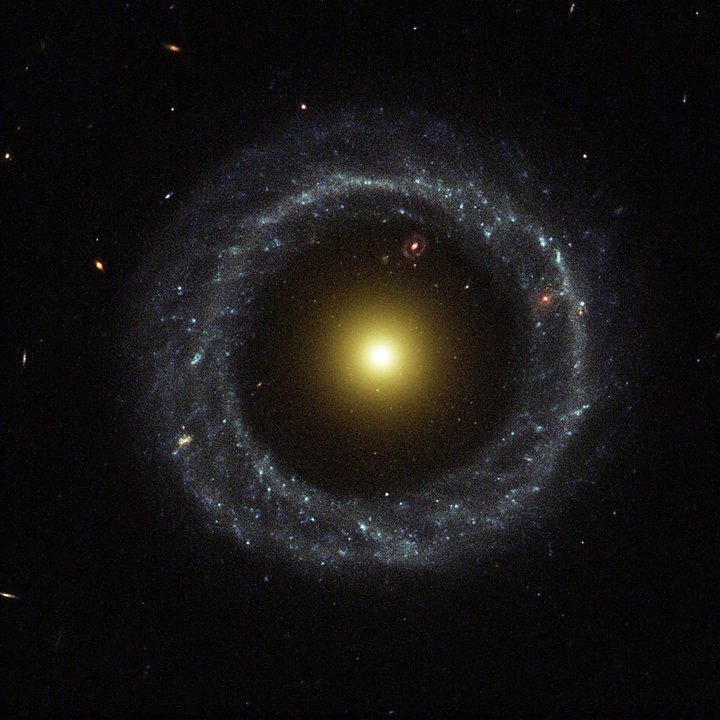
🔭 Galaxy Guide: Find Hoag's Object in the CRV Science Deep Sky Galaxy Guide to see its Hubble, JWST or ground-based image, the diagnostic clue used to classify it, and the Ring / Irregular class it belongs to. Test your eye in the Deep Sky Classification game.
A Ring With No Visible Intruder: How Did It Form?
Most ring galaxies are collisional, formed when a smaller galaxy punches through a disk. Hoag's Object has no obvious intruder and a very symmetric ring. Proposals include an old galactic collision, the accretion of gas from a companion, and a ring left behind by a bar that has since dissolved, and its origin is still debated.
Structure: Core and Ring
The central yellow body is made of old stars and is about a quarter of the ring's size, and the surrounding ring, around 100,000 light-years across, is rich in hot, blue young stars. A dark gap between them allows another ring galaxy to be seen in the background of Hubble's image.
Why It Is a Classification Challenge
Its structure fits no spiral or elliptical class, so the Galaxy Guide places it with the rings. It also shows how rare symmetrical ring galaxies are among the billions of galaxies we can image.
Hoag's Object at a Glance
| Property | Value |
|---|---|
| Catalog designation | PGC 54559 |
| Constellation | Serpens |
| Distance | 612 million light-years |
| Hubble / morphological type | Ring Galaxy |
| Galaxy Guide class | Ring & Starburst Irregular Galaxy (Ring / Irr) |
| Discoverer | Arthur Hoag, 1950 |
| Image credit (Galaxy Guide) | NASA / ESA & R. Lucas (STScI/AURA) |
Structural Architecture & Kinematic Properties of the Core and Ring
Two-Component Photometric Decomposition and the Annular Gap
Discovered in 1950 by Arthur A. Hoag on objective-prism plates taken with the 24-inch Burrell Schmidt telescope at Case Western Reserve University, Hoag's Object (PGC 54559, PRC D-51) was initially conjectured by Hoag to be either a planetary nebula or a pathological case of Einstein gravitational lensing before spectroscopic observations by Robert O'Connell, Jeffrey Scargle, and Wallace Sargent (1974) proved that the core and ring share an identical recession velocity of vhel = 12,740 ± 30 km·s−1 (z = 0.0425, corresponding to a luminosity distance of ~185 Mpc or 600–612 million light-years).
Deep Hubble Space Telescope Wide Field and Planetary Camera 2 (WFPC2) imaging and integral-field spectroscopy with the Multi-Unit Spectroscopic Explorer (MUSE) on the Very Large Telescope (VLT) by Finkelman et al. (2011) and Brosch et al. (2013) show that Hoag's Object consists of two distinct, concentric dynamical components separated by a nearly evacuated annular gap:
- The Spheroidal Central Core (r < 3″ / r < 2.6 kpc): The central yellow body is a smooth, nearly spherical fast-rotating elliptical galaxy (ellipticity ε = 1 − b/a = 0.03 ± 0.03) whose surface brightness profile follows a classical de Vaucouleurs r1/4 law (Sérsic index n = 3.9 ± 0.4) with an effective half-light radius of Re ≈ 1.7 kpc and a total core diameter of ~5.3 kpc (17,000 light-years). No trace of an underlying flattened stellar disk, spiral arms, or central bar is detected down to surface brightness limits of μV > 27.5 mag·arcsec−2.
- The Detached Star-Forming Outer Ring (r = 14″–25″ / r = 12.2–21.7 kpc): Separated from the central core by a dark annular trough between 3 and 12 kpc (through which a background barred ring galaxy, SDSS J151713.93+213516.8 at z ≈ 0.12–0.15, is visible at the one-o'clock position), the detached ring spans an inner diameter of ~24 kpc (78,000 light-years) and an outer diameter of ~43 kpc (140,000 light-years). Within the ring, knots of young OB stars and H II regions trace an internal spiral-like substructure wound coherently counterclockwise.
Co-Planar Rotation Kinematics and Stellar Mass Budget
Long-slit and 2D Fabry-Pérot / MUSE kinematic mapping demonstrate that the central spheroid and the outer gaseous ring co-rotate in the same sense around a shared kinematic minor axis at position angle PA ≈ 19°. The central core exhibits a central stellar velocity dispersion of σ0 = 151 ± 8 km·s−1 and a peak rotational velocity of Vrot,core ≈ 65 km·s−1, yielding an enclosed dynamical mass within the core of Mcore ≈ (3–4) × 1011 M☉. Further out, Hα and H I 21-cm emission from the ring (inclined by only i ≈ 18° ± 4° to the plane of the sky) indicates a deprojected circular orbital velocity of Vcirc ≈ 300 to 340 km·s−1 at r = 20 kpc, implying a total dark-matter-dominated halo mass of Mtot ≈ 7 × 10¹¹ M☉ (M / LB ≈ 20 M☉/L☉) and ZERO measurable radial expansion velocity (Vexp < 10 km·s−1).
Stellar Population Diagnostics & H I 21-cm Gas Reservoir
Spectroscopic Lick index measurements (Mg b, Fe5270, Fe5335, and Hβ) analyzed by Finkelman et al. (2011) reveal a sharp age dichotomy between the two components:
- Core Population: The central elliptical core consists of an ancient, coeval stellar population with a luminosity-weighted age of 10.0 ± 1.5 Gyr, super-solar metallicity ([Fe/H] ≈ +0.16), and an α-element enhancement ratio of [α/Fe] ≈ +0.29—indicating that the central spheroid formed its stars in a rapid, early starburst at redshift z > 2 without subsequent star formation over the past ~9 Gyr.
- Ring Population and H I Envelope: By contrast, the blue ring (B − V ≈ 0.45) is dominated by young stellar clusters aged <100 Myr to 1.5 Gyr forming at an ongoing rate of SFR ≈ 0.7 to 1.5 M☉·yr−1 in gas of sub-solar oxygen abundance (12 + log(O/H) ≈ 8.4–8.5, or ~0.5 Z☉). Westerbork Synthesis Radio Telescope (WSRT) 21-cm observations by Brosch et al. (2013) discovered that the optical ring is embedded within an 120-kiloparsec ring of neutral atomic hydrogen containing MH I ≈ 8.2 × 10⁹ M☉, without any nearby tidal companion galaxies (M > 109 M☉) within 1 Mpc.
Competing Formation Hypotheses for Hoag-Type Ring Galaxies
Because Hoag's Object accounts for fewer than 1 in 1,000 galaxies (defining Hoag-type galaxies such as NGC 6028 and PGC 1000714), three formation mechanisms have been tested against its observations:
- Collisional Bullseye Encounter (O'Connell et al. 1974; Schweizer et al. 1987): A compact intruder pierced a pre-existing disk 2–3 Gyr ago. This hypothesis is disfavored because (a) no bullet companion exists within the required recoil radius, (b) the ring shows circular rotation rather than outward radial expansion, and (c) the core is a true r1/4 elliptical rather than a disk nucleus.
- Secular Bar Dissolution & Outer Lindblad Resonance (Brosch 1985): Non-axisymmetric gravitational torques from a central bar drove gas outward to the Outer Lindblad Resonance (OLR), where Ω − Ωp = −κ / 2, before the bar dissolved. This model is contradicted by the classical elliptical Sérsic profile (n ≈ 4) of the core and the absence of a disk between 3 and 12 kpc.
- Cold Filamentary Accretion onto a Pre-Existing Elliptical (Finkelman et al. 2011; Brosch et al. 2013): The favored model posits that the central r1/4 elliptical formed at z > 2 and subsequently—2 to 3 Gyr ago—accreted ~1010 M☉ of metal-poor gas either by tidally disrupting a gas-rich satellite or via cold-mode accretion along an intergalactic filament, settling into the circular star-forming ring observed today.
References
- Hoag, A. A. (1950). "A peculiar object in Serpens." The Astronomical Journal, 55, 170. doi:10.1086/106427
- Schweizer, F., Ford, W. K., Jr., Jedrzejewski, R., & Giovanelli, R. (1987). "The structure and evolution of Hoag's Object." The Astrophysical Journal, 320, 454–463. doi:10.1086/165562
- Finkelman, I., Moiseev, A., Brosch, N., & Katkov, I. (2011). "Hoag's Object: Evidence for cold accretion onto an elliptical galaxy." Monthly Notices of the Royal Astronomical Society, 418(3), 1834–1849. doi:10.1111/j.1365-2966.2011.19601.x
- Brosch, N., Finkelman, I., Oosterloo, T., Jozsa, G., & Moiseev, A. (2013). "H I in Hoag's Object." Monthly Notices of the Royal Astronomical Society, 435(1), 475–481. doi:10.1093/mnras/stt1348