Cassiopeia A
Cassiopeia A (Cas A, 3C 461) is the remnant of a supernova in Cassiopeia about 11,000 light-years away, exploded around 1680 but apparently unobserved at the time.
Cassiopeia A (Cas A, 3C 461, G111.7−2.1) is the young, oxygen-rich remnant of a core-collapse supernova in Cassiopeia about 11,000 light-years (3.4 +0.3/−0.1 kiloparsecs) away in the Perseus Arm of the Milky Way. Spanning ~5.5 arcminutes (~18 light-years or 5.5 parsecs), its ballistic ejecta trace back to an explosion around 1671–1681 CE, which went unrecorded due to interstellar dust extinction (AV ≈ 5–8 mag). Below 1 GHz, Cas A is the brightest extrasolar radio source in the sky (S1 GHz ≈ 2,400–2,700 Jy) and one of the best-studied supernova remnants.
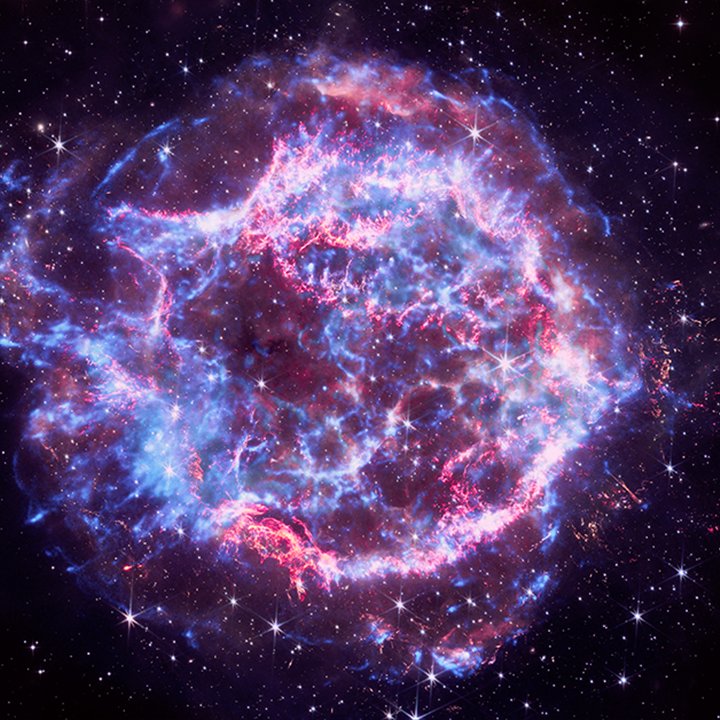
🔭 Galaxy Guide: Find Cassiopeia A in the CRV Science Deep Sky Galaxy Guide to see its Hubble, JWST or ground-based image, the diagnostic clue used to classify it, and the Nebula / SNR class it belongs to. Test your eye in the Deep Sky Classification game.
Radio Discovery and a Hidden Explosion
Martin Ryle and colleagues found the radio source in 1947 and 1948. The expanding shell, about 10 light-years across, traces back to roughly 1680, though no clear record of the explosion exists, possibly because dust absorbed the light. A faint star recorded by Flamsteed in 1680 has been proposed as an observation.
A Light Echo and Type IIb Identity
Scattered light from the explosion, a light echo, was detected in 2008 and its spectrum showed that Cas A was a Type IIb supernova, in which the star had lost most of its hydrogen envelope, possibly to a binary companion.
Mapping the Explosion
Chandra's first light image in 1999 revealed a neutron star at its center. NuSTAR maps of radioactive titanium-44 indicated the explosion was turbulent and asymmetric, and Webb's 2023 image displayed complex loops in the ejecta. Cas A supplies calcium, oxygen and iron to future generations of stars.
Cassiopeia A at a Glance
| Property | Value |
|---|---|
| Catalog designation | Cassiopeia A • 3C 461 |
| Constellation | Cassiopeia |
| Distance | 11,000 light-years |
| Hubble / morphological type | Core-Collapse Supernova Remnant |
| Galaxy Guide class | Galactic Nebula & Supernova Remnant (Nebula / SNR) |
| Estimated explosion | About 1680 |
| Supernova type | Type IIb |
| Image credit (Galaxy Guide) | NASA / ESA / CSA / STScI (JWST NIRCam) / Chandra / Hubble |
Light Echo Spectroscopy & the Stripped-Envelope `Type IIb` Progenitor
For half a century after Walter Baade and Rudolph Minkowski identified the optical filaments of Cas A in 1954, astronomers could only infer the nature of its progenitor star indirectly from the high velocities (v ≈ 4,000–15,000 km·s−1) and hydrogen-depleted composition of its Fast-Moving Knots (FMKs). In 2008, Oliver Krause and collaborators discovered infrared and optical light echoes—pulses of the original ~1680 supernova flash scattered off interstellar dust clouds located up to 300 light-years from the remnant and reaching Earth three centuries later.
Optical spectroscopy of these light echoes obtained with the Subaru 8.2-meter telescope revealed the time-integrated flash spectrum of the explosion itself, showing strong P Cygni absorption profiles of He I λ5876 alongside weak Hα emission nearly identical to the prototype Type IIb supernova SN 1993J. This proved that the Cas A progenitor was a red or yellow supergiant of initial mass MZAMS ≈ 15–25 M☉ that had been stripped of almost its entire outer hydrogen envelope (retaining <0.5 M☉ of H above a ~4–6 M☉ helium core, Total Ejecta Mass Mej ≈ 2–4 M☉) via Roche-lobe overflow onto a binary companion prior to core collapse. Multi-directional light echoes subsequently analyzed by Armin Rest and colleagues (2011) revealed directional line-velocity asymmetries, demonstrating that the explosion was intrinsically multi-polar.
Blast-Wave Dynamics, Reverse-Shock Nucleosynthesis & `44Ti` Asymmetry
Forward Shock, Reverse Shock, and Diffusive Shock Acceleration
Cas A is currently transitioning from the free-expansion phase toward the Sedov–Taylor adiabatic stage, governed by a two-shock hydrodynamic structure:
- The Outer Forward Blast Wave (RFS ≈ 2.6 pc): Propagating into the pre-supernova circumstellar wind at vFS ≈ 4,900–5,800 km·s−1. In Chandra 4–6 keV images, this blast wave appears as a razor-thin (~0.05 pc wide) non-thermal X-ray synchrotron rim, where diffusive shock acceleration (first-order Fermi acceleration) in amplified turbulent magnetic fields (B ≈ 250–500 μG) accelerates cosmic-ray electrons to multi-TeV energies (Emax ≈ 10–40 TeV).
- The Inward Reverse Shock (RRS ≈ 1.7 pc): Driven backward into the cold, expanding supernova ejecta (vRS ≈ 2,000–3,000 km·s−1 in the frame of the unshocked ejecta), heating metal-rich debris to Te ≈ 107–4 × 10⁷ K (kBT ≈ 1–4 keV).
Overturned Nucleosynthetic Layers and NuSTAR Titanium-44 Mapping
One-dimensional stellar evolution models predict an onion-skin stratification of elements inside a high-mass star prior to collapse: outer He/C/N, intermediate O/Ne/Mg, deeper Si/S/Ar/Ca from explosive oxygen burning, and innermost Fe-group isotopes (56Ni and 44Ti) synthesized by alpha-rich freeze-out near the proto-neutron star boundary. However, spatially resolved X-ray Doppler tomography with Chandra (Una Hwang, J. Martin Laming, et al.) revealed that in Cas A, iron-rich plasma (Te ≈ 3 keV, high ionization age net) lies outside the silicon- and oxygen-rich layers along the southeastern rim, while a collimated silicon/sulfur-rich northeast jet (and southwest counterjet) punches through the outer shell at speeds up to 14,000 km·s−1.
In 2014, Brian Grefenstette and the NuSTAR team imaged Cas A directly in the 67.9 keV and 78.4 keV hard X-ray decay lines of radioactive 44Ti (half-life t1/2 = 59.1 ± 0.3 years, decaying via 44Ti → 44Sc → 44Ca). Detecting an initial yield of M(44Ti) = (1.25 ± 0.3) × 10−4 M☉ concentrated in clumpy plumes inside the interior unshocked cavity and receding away from the neutron star kick vector, NuSTAR provided direct proof that low-mode convective neutrino-driven turbulence and the Standing Accretion Shock Instability (SASI) overturned the core during the first second of explosion—a mechanism mirrored in SN 1987A inside the Large Magellanic Cloud.
JWST Infrared Ejecta ("The Green Monster") & the Central Compact Object
JWST NIRCam and MIRI Dust and Unshocked Interior Diagnostics
In 2023–2024, Danny Milisavljevic, Ilse De Looze, and collaborators observed Cas A with the James Webb Space Telescope (JWST) NIRCam (1.62–4.44 μm) and MIRI (5.6–25.5 μm) at ~0.1-arcsecond (~500 AU) resolution. The JWST images revealed a pristine network of unshocked inner ejecta filaments glowing in [Ar II], [Ar III], [Ne II], and [S IV] emission lines alongside freshly condensed supernova dust (0.3–0.5 M☉ of silicate and Al2O3 grains at Td ≈ 50–150 K), demonstrating that core-collapse supernovae are prolific dust producers. Extending across the central southern face of the remnant is a loop of infrared-emitting rings dubbed the "Green Monster," which combined Chandra and JWST analysis identified as a sheet of pre-supernova circumstellar mass-loss material punctured by small bullet-like clumps of high-velocity supernova ejecta.
The Central Compact Object (CCO) CXOU J232327.8+584842
Unlike the Crab Nebula, which houses a magnetized pulsar and plerion, *Chandra*'s 1999 "First Light" observation discovered a radio-quiet, unpulsed point source near the center of Cas A (CXOU J232327.8+584842), the prototype of Central Compact Objects (CCOs) ("anti-magnetars" with dipole fields B ≈ 1010–1011 G) recoiling at v⊥ ≈ 350 km·s−1 toward the southeast. In 2009, Wynn Ho and Craig Heinke showed that its X-ray spectrum (Teff ≈ 1.8 × 10⁶ K, R ≈ 11–13 km) fits a non-magnetic carbon atmosphere, while multi-year Chandra monitoring detected surface cooling (~2–4% per decade) attributed to neutrino emission from neutron triplet-state superfluidity in the core.
References
- Krause, O., Birkmann, S. M., Usuda, T., Hattori, T., Goto, M., Rieke, G. H., & Misselt, K. A. (2008). "The Cassiopeia A Supernova Was of Type IIb." Science, 320(5880), 1195–1197. doi:10.1126/science.1155788
- Grefenstette, B. W., Harrison, F. A., Boggs, S. E., Reynolds, S. P., Fryer, C. L., Madsen, K. K., et al. (2014). "Asymmetries in core-collapse supernovae from maps of radioactive 44Ti in Cassiopeia A." Nature, 506(7488), 339–342. doi:10.1038/nature12997
- Ho, W. C. G., & Heinke, C. O. (2009). "A neutron star with a carbon atmosphere in the Cassiopeia A supernova remnant." Nature, 462(7269), 71–73. doi:10.1038/nature08525
- Milisavljevic, D., Temim, T., De Looze, I., Dickinson, D., Laming, J. M., Fesen, R., et al. (2024). "A JWST Survey of the Supernova Remnant Cassiopeia A." The Astrophysical Journal Letters, 965(2), L27. doi:10.3847/2041-8213/ad324b