Large Magellanic Cloud
The Large Magellanic Cloud (LMC) is a satellite galaxy of the Milky Way about 163,000 light-years away, visible to the naked eye from the Southern Hemisphere in Dorado and Mensa.
The Large Magellanic Cloud (LMC, ESO 56-115) is a satellite galaxy of the Milky Way about 163,000 light-years (49.59 ± 0.54 kiloparsecs) away, visible to the naked eye from the Southern Hemisphere in Dorado and Mensa. Spanning 10.7 × 9.2 degrees (~32,000 light-years) at V ≈ +0.9, it is the fourth-largest galaxy in the Local Group. It is a barred Magellanic irregular galaxy (SB(s)m) holding roughly ten billion solar masses of visible material (and a dark halo exceeding 1011 M☉), and it hosts the Tarantula Nebula and SN 1987A.
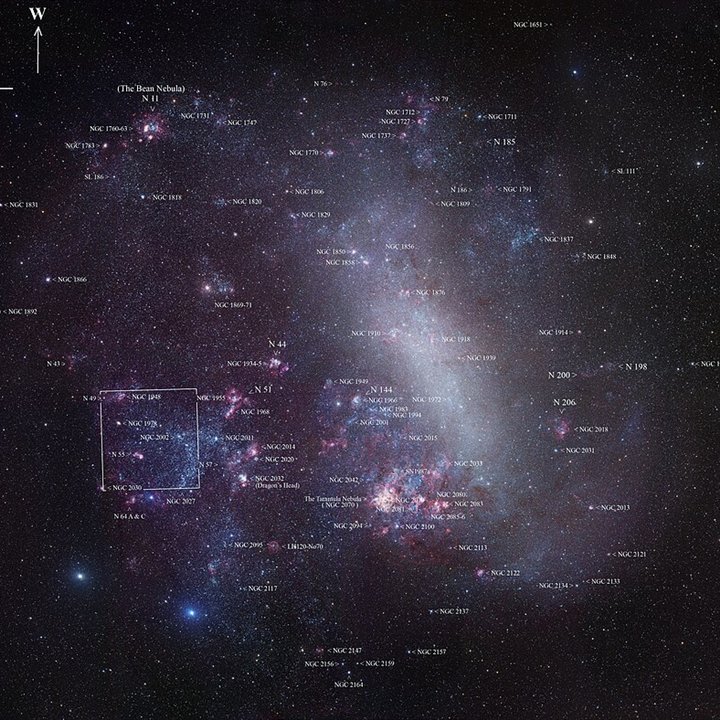
🔭 Galaxy Guide: Find Large Magellanic Cloud in the CRV Science Deep Sky Galaxy Guide to see its Hubble, JWST or ground-based image, the diagnostic clue used to classify it, and the Ring / Irregular class it belongs to. Test your eye in the Deep Sky Classification game.
A Nearby Laboratory for Stars
Because the LMC is so close and nearly face-on, astronomers can study its stars one by one at a known distance. It is a benchmark for calibrating Cepheid variable stars, whose period-luminosity relation, discovered by Henrietta Leavitt in the Magellanic Clouds, anchors the cosmic distance ladder.
The Tarantula Nebula and 30 Doradus
The Tarantula Nebula is the most active star-forming region known in the Local Group, containing some of the highest-mass stars found. It reaches hundreds of light-years across, far larger than the Orion Nebula.
SN 1987A: The Nearest Supernova in Four Centuries
On February 23, 1987 the explosion of a blue supergiant in the LMC became the closest observed supernova since Kepler's in 1604. Neutrino detectors recorded a couple dozen neutrinos, confirming core-collapse models. The remnant has been tracked since by Hubble, Chandra and Webb.
Large Magellanic Cloud at a Glance
| Property | Value |
|---|---|
| Catalog designation | LMC • ESO 56-115 |
| Constellation | Dorado / Mensa |
| Distance | 163,000 light-years |
| Hubble / morphological type | SB(s)m (Magellanic Irregular) |
| Galaxy Guide class | Ring & Starburst Irregular Galaxy (Ring / Irr) |
| Mass | About ten billion solar masses |
| Companion | Small Magellanic Cloud |
| Image credit (Galaxy Guide) | ESO / VMC Survey |
Magellanic Spiral (`SB(s)m`) Architecture & First-Infall Orbital Dynamics
Off-Center Bar, One-Armed Spiral, and Magellanic Stream
As the prototype of Gérard de Vaucouleurs' SB(s)m class ("Magellanic barred spiral"), the LMC exhibits an asymmetric disk inclined at i ≈ 34.7° ± 6.2° to the plane of the sky. Its visual morphology is dominated by a luminous, warped stellar bar (~3 kpc long) whose photometric center is displaced by ~0.5–1.0 kpc from the kinematic center of the outer neutral hydrogen (H I) rotation curve (vmax ≈ 92 ± 5 km·s−1), alongside a single stubby northwestern spiral arm.
This lopsidedness is driven by recurrent gravitational interactions with its smaller companion, the Small Magellanic Cloud (SMC) (M* ≈ 4 × 10⁸ M☉, lying ~23 kpc behind and southwest of the LMC), and by ram-pressure stripping against the Milky Way's hot circumgalactic corona. Together, the LMC and SMC are linked by the gaseous Magellanic Bridge and trail the 200-degree-long Magellanic Stream and Leading Arm across the southern Galactic hemisphere, containing over 109 M☉ of stripped neutral and ionized hydrogen.
HST and Gaia Proper Motions: First Pericenter Passage
Astrometric proper motions measured with the Hubble Space Telescope (HST) by Gurtina Besla, Nitya Kallivayalil, and collaborators (2007, 2013) and confirmed by Gaia DR3 demonstrated that the LMC is traveling at a galactocentric velocity of v3D = 321 ± 24 km·s−1, near the local escape speed of the Milky Way halo. Perturbations induced by the LMC on Galactic stellar streams and the reflex motion of the Milky Way's outer halo constrain the LMC's dark-matter virial mass to Mhalo ≈ (1.4–1.8) × 1011 M☉, confirming that the Magellanic system is just past the pericenter (rperi ≈ 48 kpc) of its first infall into the Milky Way potential.
Cosmic Distance Scale Calibration: Leavitt's Law & Eclipsing Binaries
Henrietta Swan Leavitt and the Period–Luminosity Relation
In 1908 and 1912, Harvard astronomer Henrietta Swan Leavitt analyzed 1,777 variable stars in the Magellanic Clouds, establishing for 25 classical Cepheids that the logarithm of the pulsation period P scales linearly with apparent magnitude (m):
MV = a log10(P / 10 days) + b
Calibrating the zero point b of Leavitt's Law in the LMC anchors the extragalactic distance ladder used by the SH0ES collaboration to measure the Hubble constant (H0). To eliminate metallicity and reddening systematics in the LMC distance modulus (μ0), Grzegorz Pietrzyński and the Araucaria Project (2019) analyzed 20 detached eclipsing binary systems of late-type giant stars across the LMC bar, yielding a geometric distance accurate to 1.1%:
DLMC = 49.59 ± 0.09 (stat.) ± 0.54 (sys.) kpc (μ0 = 18.477 ± 0.026 mag)
30 Doradus (Tarantula Nebula) & Supernova 1987A
R136 and Starburst Feedback
On the southeastern edge of the LMC where ram pressure and tidal compression pile up dense molecular gas (MH2 ≈ 5 × 10⁷ M☉) lies 30 Doradus (the Tarantula Nebula, NGC 2070)—an H II region spanning ~300 pc (~1,000 light-years) with a bolometric luminosity exceeding 109 L☉, providing a Local Group analog to high-redshift starburst galaxies and the Cigar Galaxy. At its core sits the young super star cluster R136 (age ~1–2 Myr, mass ~4.5 × 10⁵ M☉). Adaptive-optics VLT/SINFONI and HST/STIS spectroscopy by Paul Crowther and collaborators (2010) identified individual Wolf–Rayet stars (WN5h spectral type) inside R136—R136a1, R136a2, and R136a3—with initial zero-age main-sequence masses of Minit ≈ 200–300 M☉, effective temperatures Teff ≈ 53,000 K, and luminosities up to L ≈ 7 × 10⁶ L☉, doubling the previously assumed 150 M☉ stellar upper mass limit.
SN 1987A: Core-Collapse Neutrinos, Equatorial Ring, and Compact Remnant
On the outskirts of 30 Doradus, Supernova 1987A was detected optically on February 23, 1987, following the core collapse of the B3 Iab blue supergiant progenitor Sanduleak −69° 202 (Minit ≈ 18–20 M☉). Three hours prior to optical shock breakout, the Kamiokande II, IMB, and Baksan underground detectors recorded 24 electron antineutrinos (ν̄e, energies 7.5–40 MeV) over a 13-second burst, confirming that >99% of a core-collapse supernova's gravitational binding energy (Eν ≈ 3 × 1053 erg) is radiated as neutrinos during proto-neutron star formation. Subsequent gamma-ray and bolometric light-curve decay tracked the synthesis of 0.075 M☉ of radioactive 56Ni → 56Co → 56Fe and 44Ti—complementing Galactic core-collapse remnants such as Cassiopeia A.
Since 1994, HST, Chandra, ALMA, and JWST have monitored the supernova blast wave (v ≈ 4,000–10,000 km·s−1) crashing into the triple-ring circumstellar hourglass nebula shed ~20,000 years before explosion, lighting up shocked X-ray and optical hotspots. In 2024, Claes Fransson and collaborators used JWST MIRI Medium Resolution Spectrometer (MRS) observations to detect narrow emission lines of singly and quintuply ionized argon ([Ar II] 6.985 μm and [Ar VI] 4.529 μm) and sulfur at the center of the inner ejecta, providing direct spectroscopic evidence for ionizing radiation from the cooling neutron star (or pulsar wind nebula) formed in SN 1987A.
References
- Pietrzyński, G., Graczyk, D., Gallenne, A., Gieren, W., Thompson, I. B., Pilecki, B., et al. (2019). "A distance to the Large Magellanic Cloud that is precise to one per cent." Nature, 567(7747), 200–203. doi:10.1038/s41586-019-0999-4
- Besla, G., Kallivayalil, N., Hernquist, L., Robertson, B., Cox, T. J., van der Marel, R. P., & Alcock, C. (2007). "Are the Magellanic Clouds on Their First Passage about the Milky Way?" The Astrophysical Journal, 668(2), 949–967. doi:10.1086/521385
- Crowther, P. A., Schnurr, O., Hirschi, R., Yusof, N., Parker, R. J., Goodwin, S. P., & Kassim, H. A. (2010). "The R136 star cluster hosts several stars whose individual masses greatly exceed the accepted 150 M☉ stellar mass limit." Monthly Notices of the Royal Astronomical Society, 408(2), 731–751. doi:10.1111/j.1365-2966.2010.17167.x
- Fransson, C., Barlow, M. J., Kavanagh, P. J., Larsson, J., Jones, O. C., Sargent, B., et al. (2024). "Emission lines due to ionizing radiation from a compact object in the remnant of Supernova 1987A." Science, 383(6685), 898–903. doi:10.1126/science.adj5796