Cigar Galaxy
The Cigar Galaxy (Messier 82, NGC 3034) is a starburst galaxy in Ursa Major about 12 million light-years away.
The Cigar Galaxy (Messier 82, NGC 3034) is a starburst galaxy in Ursa Major about 12 million light-years (3.53 ± 0.14 megaparsecs) away. Spanning 11.2 × 4.3 arcminutes (~40,000 light-years) and classified as I0 (starburst irregular), M82 shines five times brighter than the Milky Way in the infrared (LIR ≈ 5.6 × 10¹⁰ L☉). Seen nearly edge-on (i ≈ 80°), it forms stars roughly ten times faster than the Milky Way, and red filaments of gas stream out perpendicular to its disk. Johann Bode discovered it in 1774.
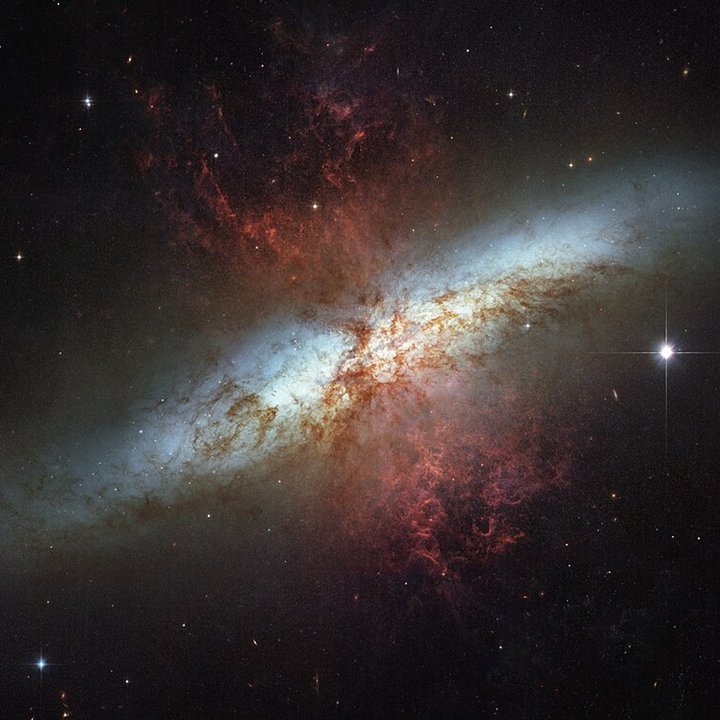
🔭 Galaxy Guide: Find Cigar Galaxy in the CRV Science Deep Sky Galaxy Guide to see its Hubble, JWST or ground-based image, the diagnostic clue used to classify it, and the Ring / Irregular class it belongs to. Test your eye in the Deep Sky Classification game.
What Triggered the Starburst?
A close pass with its larger neighbor M81 a few hundred million years ago is thought to have driven gas toward M82's center and sparked intense star formation. Starbursts of this size can exhaust their gas in under a billion years.
The Superwind
Collective supernovae and winds blast hot gas out of the disk in a bipolar outflow. Hubble's mosaic shows hydrogen-alpha filaments extending thousands of light-years, and the outflow enriches the intergalactic medium with heavy elements.
SN 2014J and a Black Hole Candidate
In January 2014 a Type Ia supernova, SN 2014J, exploded in M82, the nearest of its kind in decades and extensively observed. The galaxy also hosts an X-ray source, M82 X-1, considered a candidate intermediate-mass black hole of a few hundred solar masses.
Cigar Galaxy at a Glance
| Property | Value |
|---|---|
| Catalog designation | M82 • NGC 3034 |
| Constellation | Ursa Major |
| Distance | 12 million light-years |
| Hubble / morphological type | I0 (Starburst Irregular) |
| Galaxy Guide class | Ring & Starburst Irregular Galaxy (Ring / Irr) |
| Discoverer | Johann Bode, 1774 |
| Star formation | About ten times the Milky Way's rate |
| Image credit (Galaxy Guide) | NASA / ESA & The Hubble Heritage Team (STScI/AURA) |
M81–M82–NGC 3077 Tidal Interaction & the Central Starburst Engine
H I Tidal Bridges and Bar-Driven Gas Funneling
Roughly 37 arcminutes (~130,000 light-years in projection) south of M82 lies the grand-design spiral galaxy Messier 81 (Bode's Galaxy, NGC 3031), accompanied to the southeast by the irregular galaxy NGC 3077. High-sensitivity 21-cm neutral hydrogen (H I) aperture-synthesis mapping with the Very Large Array (VLA) by M. S. Yun, P. T. P. Ho, and K. Y. Lo (1994) revealed that all three galaxies are enveloped in an intricate web of intergalactic H I tidal bridges, tails, and streamers containing ~109 M☉ of stripped atomic gas, proving that M82 underwent a pericenter gravitational encounter within ~20–30 kpc of M81 approximately 220 to 500 million years ago.
Tidal torques during this passage excited a non-axisymmetric stellar bar (~1 kpc long, detected in near-infrared 2.2 μm photometry that penetrates the heavy optical dust extinction, AV ≈ 10–25 mag) and destabilized M82's outer gas disk. Over the past 50–200 Myr, gravitational torques from this bar funneled MH2 ≈ 2 × 10⁸ M☉ of cold molecular gas into the central 500-parsec starburst core, igniting a star-formation rate of SFR ≈ 10 M☉·yr−1—a star-formation surface density ΣSFR ≈ 20 M☉·yr−1·kpc−2 more than a thousand times higher than the Solar neighborhood and comparable to the nuclear starbursts of the Sculptor Galaxy (NGC 253) and the Southern Pinwheel Galaxy (M83).
Super Star Clusters and Radio Supernova Remnants
Within the central 500 pc, Hubble Space Telescope (HST) optical/near-infrared and James Webb Space Telescope (JWST) NIRCam (1.4 to 3.6 μm, Alberto Bolatto et al., 2024) imaging resolves more than 200 super star clusters (SSCs)—such as the luminous cluster M82-A1—each containing 105 to 2 × 10⁶ M☉ of young stars within half-light radii of rh ≈ 3–5 pc. In the centimeter radio continuum, VLA and Multi-Element Radio Linked Interferometer Network (MERLIN) VLBI arrays resolve over 50 compact supernova remnants expanding inside the obscured nuclear torus, establishing a core-collapse supernova rate of νSN ≈ 0.07–0.10 yr−1 (one explosion every 10 to 15 years).
The Multiphase Galactic Superwind (Chevalier–Clegg Hydrodynamics)
Adiabatic Core Thermalization and Sonic Nozzle Breakout
M82 is the premier astrophysical laboratory for galactic-scale stellar feedback and multiphase superwinds. In the analytical wind model formulated by Roger Chevalier and Andrew Clegg (1985), kinetic energy (Ėkin ≈ 3 × 1042 erg·s−1) and metal-enriched ejecta (Ṁej ≈ 2–3 M☉·yr−1) injected by overlapping core-collapse supernovae and OB/Wolf–Rayet stellar winds thermalize within the 500-parsec starburst core, creating a high-pressure cavity of hot X-ray plasma at temperature Tc ≈ (3–8) × 107 K (kBT ≈ 3–7 keV, observed in Fe XXV Kα 6.7 keV emission by Chandra and XMM-Newton).
At the boundary of the starburst zone (R = R* ≈ 250 pc), the hot gas passes through a sonic point (M = 1) and expands adiabatically along the steep vertical pressure gradient perpendicular to the galactic disk (the minor axis), accelerating to an asymptotic terminal velocity of:
v∞ = (2 Ėkin / Ṁ)1/2 ≈ 1,500–2,200 km·s−1
Four Coexisting Outflow Phases
Because this terminal velocity exceeds the escape velocity of M82's gravitational potential (vesc ≈ 400–450 km·s−1), the superwind escapes into the intergalactic medium as a biconical outflow extending >11 kpc (36,000 light-years) above and below the disk across four coupled thermodynamic phases:
- Hot X-Ray-Emitting Plasma (T ≈ 107–108 K): Fills the interior of the wind cone, carrying the bulk of the mechanical energy and α-element metals (O, Ne, Mg, Si, Fe).
- Warm Ionized Filaments (T ≈ 104 K): Traced by the red Hα λ6563 and [N II] λ6583 shock-ionized and photoionized filaments in the Hubble Heritage mosaic, moving outward along the walls of the wind cone at v ≈ 500–650 km·s−1.
- Cold Molecular Gas and PAH Plumes (T ≈ 10–100 K): Mapped by ALMA and NOEMA in CO (MH2,outflow ≈ 3 × 10⁸ M☉ at v ≈ 100–400 km·s−1) and resolved by JWST NIRCam at 3.3 μm into intricate loops and magnetic plumes of polycyclic aromatic hydrocarbons (PAHs) entrained within the base of the wind.
- Relativistic Cosmic-Ray Halo: Synchrotron radio halos and GeV–TeV gamma rays detected by Fermi-LAT and VERITAS from cosmic-ray protons interacting with dense gas via neutral pion decay (π0 → 2γ).
Ultraluminous X-Ray Sources (M82 X-1 and M82 X-2) & SN 2014J
Pointed X-ray observations of M82 resolved two luminous ultraluminous X-ray sources (ULXs) ~200 pc from the center:
- M82 X-1: Reaching LX ≈ 1041 erg·s−1 with twin quasi-periodic oscillations (QPOs) at a 3:2 ratio (3.32 Hz and 5.07 Hz), modeled by Dheeraj Pasham et al. to yield an intermediate-mass black hole (IMBH) candidate of mass MBH = 428 ± 105 M☉.
- M82 X-2 (NuSTAR J095551+6940.8): Discovered by Matteo Bachetti and the NuSTAR team in 2014 to emit coherent X-ray pulsations (P = 1.37 s, orbital period 2.5 days). Exceeding the Eddington limit for a 1.4 M☉ neutron star by a factor of ~100 (LX ≈ 1.8 × 1040 erg·s−1), M82 X-2 proved that many ULXs are super-Eddington accreting neutron stars.
On January 21, 2014, Steve Fossey and students at the University of London Observatory discovered the Type Ia supernova SN 2014J in M82, which peaked at V ≈ +10.5 and enabled the direct gamma-ray detection of 56Ni → 56Co → 56Fe radioactive decay lines (158, 812, and 847 keV) by the INTEGRAL satellite.
References
- Chevalier, R. A., & Clegg, A. W. (1985). "Wind from a starburst galaxy nucleus." Nature, 317(6032), 44–45. doi:10.1038/317044a0
- Yun, M. S., Ho, P. T. P., & Lo, K. Y. (1994). "A high-resolution image of atomic hydrogen in the M81 group of galaxies." Nature, 372(6506), 530–532. doi:10.1038/372530a0
- Bachetti, M., Harrison, F. A., Walton, D. J., Grefenstette, B. W., Chakrabarty, D., Fürst, F., et al. (2014). "An ultraluminous X-ray source powered by an accreting neutron star." Nature, 514(7521), 202–204. doi:10.1038/nature13791
- Bolatto, A. D., Levy, R. C., Tarantino, E., Boyer, M. L., Fisher, D. B., Cronin, S. A., et al. (2024). "JWST Observations of Starbursts: Polycyclic Aromatic Hydrocarbon Emission at the Base of the M82 Wind." The Astrophysical Journal, 967(1), 63. doi:10.3847/1538-4357/ad335b