Sculptor Galaxy
The Sculptor Galaxy (NGC 253, Caldwell 65) is a nearly edge-on spiral about 11 million light-years away, the brightest member of the Sculptor Group and one of the nearest starburst galaxies. Caroline Herschel discovered it in 1783.
The Sculptor Galaxy (NGC 253, Caldwell 65) is a nearly edge-on spiral about 11 million light-years away, the brightest member of the Sculptor Group and one of the nearest starburst galaxies. Caroline Herschel discovered it in 1783.
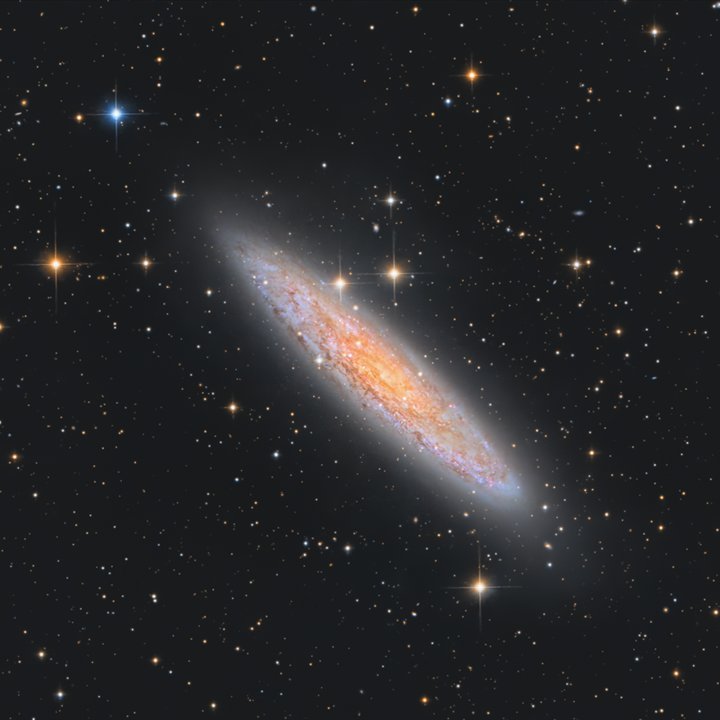
🔭 Galaxy Guide: Find Sculptor Galaxy in the CRV Science Deep Sky Galaxy Guide to see its Hubble, JWST or ground-based image, the diagnostic clue used to classify it, and the Barred Spiral class it belongs to. Test your eye in the Deep Sky Classification game.
A Nearby Starburst: How Fast Is It Forming Stars?
The central region forms stars several times faster than the Milky Way, fed by a reservoir of dense molecular gas. Because it is so close, telescopes such as ALMA can resolve individual giant clouds and measure how much gas is being turned into stars.
The Superwind: Gas Blown Out of the Disk
Supernovae and stellar winds from the starburst drive hot gas out of the disk in a galactic wind seen in X-rays and radio. ALMA observations traced cold molecular gas streaming out, showing that the wind carries away material that would otherwise form stars, a feedback process thought to limit galaxy growth.
High-Energy Emission
NGC 253 was among the first starburst galaxies detected in very-high-energy gamma rays, evidence that cosmic rays are accelerated in regions of intense star formation. It is also a bright infrared and radio source, and its tilted dusty disk makes a striking silhouette.
Sculptor Galaxy at a Glance
| Property | Value |
|---|---|
| Catalog designation | NGC 253 • Caldwell 65 |
| Constellation | Sculptor |
| Distance | 11.4 million light-years |
| Hubble / morphological type | SAB(s)c |
| Galaxy Guide class | Barred Spiral Galaxy (SB) |
| Discoverer | Caroline Herschel, 1783 |
| Group | Sculptor Group |
| Image credit (Galaxy Guide) | ESO / VISTA / VLT |
Nuclear Starburst Architecture, Bar-Driven Inflow & Proto-Super Star Clusters
The Central Molecular Zone and Bar Torques
Discovered by Caroline Herschel on September 23, 1783, while sweeping for comets from Slough, England, with a 27-inch focal-length Newtonian reflector built by her brother William, the Sculptor Galaxy (NGC 253, Caldwell 65, the Silver Coin Galaxy) lies at a Tip of the Red Giant Branch (TRGB) distance of 3.5 ± 0.2 megaparsecs (~11.4 million light-years; Radburn-Smith et al. 2011; Rekola et al. 2005). As the dominant, gravitating centerpiece of the Sculptor Filament (one of the nearest galaxy groups outside the Local Group, alongside NGC 247, NGC 55, NGC 300, and NGC 7793), NGC 253 is a nearly edge-on barred spiral galaxy (i ≈ 78.5°, optical diameter ~28 kiloparsecs / 90,000 light-years, total dynamical halo mass Mdyn ≈ 8 × 10¹¹ M☉) that serves alongside M82 as the closest archetype of a nuclear starburst galaxy.
Near-infrared imaging with the ESO VISTA telescope and the Spitzer Space Telescope penetrates the heavy optical dust extinction (AV ≈ 10–50 mag in the core) to reveal a 7-kiloparsec-long stellar bar inclined at ~18° to the disk's longitudinal axis. Gravitational torques from this bar funnel cold gas inward into a compact Central Molecular Zone (CMZ) spanning ~300 × 100 parsecs around the dynamical center. Within this 300-pc nuclear ring, over 3 × 10⁸ M☉ of dense molecular hydrogen (H2) fuels a localized nuclear star formation rate of SFRnuc ≈ 2.0 to 3.5 M☉·yr−1—accounting for more than half of the galaxy's star formation (total SFRtot ≈ 4.2–5.0 M☉·yr−1, total infrared luminosity LIR ≈ 3 × 10¹⁰ L☉) inside less than 0.01% of its disk volume.
ALMA Parsec-Scale Resolution of 14 Proto-Super Star Clusters
Using the Atacama Large Millimeter/submillimeter Array (ALMA) at 1.4-parsec (0.08″) angular resolution in submillimeter dust continuum, CO, HCN, HCO+, and millimeter hydrogen recombination lines (H40α, H30α), Leroy et al. (2018) and Levy et al. (2021) discovered a linear chain of 14 deeply embedded, nascent Super Star Clusters (SSCs) aligned like beads along the 300-pc central bar ring of NGC 253.
These proto-SSCs possess individual stellar and gas masses of 105.0 to 106.0 M☉, half-mass radii of Rh ≈ 0.5 to 3.0 parsecs, gas number densities of n(H2) > 105–106 cm−3, and ionizing photon production rates reaching Q(H0) ≈ 1052.5 s−1 (headed by the central super-cluster TH2 / Knot 14, discovered in the mid-infrared by Keto et al. 1999 and Watson et al. 1996). High-resolution ALMA spectroscopy detected inverse P Cygni velocity profiles and outflowing dense gas envelopes around several of these proto-SSCs, capturing the brief transition epoch (t < 1–3 Myr) where radiation pressure and OB winds expel residual birth gas from newly formed globular-cluster analogs.
The Multiphase Starburst Superwind & Molecular Mass Loading
Chevalier–Clegg Hot X-Ray Plume and Cold ALMA Molecular Outflow
Because NGC 253's nuclear starburst injects mechanical energy at a rate of Ėmech ≈ 1.5 × 1042 erg·s−1 via a core-collapse supernova rate of νSN ≈ 0.05 to 0.10 yr−1 (1 supernova every 10–20 years, traced by more than 60 compact VLBI radio supernova remnants in the inner 200 pc; Ulvestad & Antonucci 1997), the overpressured nuclear cavity (P / kB > 107 K·cm−3) ruptures vertically out of the thin disk as a bipolar galactic superwind modeled by the adiabatic wind solution of Roger Chevalier and Andrew Clegg (1985).
Because NGC 253 is viewed nearly edge-on (i ≈ 78.5°), multi-wavelength observatories resolve the vertical stratification of this biconical outflow from the central 100 parsecs out to 10 kiloparsecs into the halo:
- Hot X-Ray Core and Halo (T ≈ 3 × 10⁶ to 107 K): Chandra and XMM-Newton X-ray imaging (Strickland et al. 2000, 2002) resolves a limb-brightened, hollow frustum cone of soft thermal X-ray emission (kBT ≈ 0.2–0.6 keV) collimated by the dense molecular ring, expanding outward along the minor axis at terminal speeds of vwind ≈ 600 to 900 km·s−1 into two 9-kpc halo lobes.
- Warm Ionized Hα / [N II] Filaments (T ≈ 104 K): VLT/MUSE integral-field spectroscopy and HST Hα imaging trace shock-ionized gas filaments entrained along the shear walls of the X-ray cone at outflow velocities of 200 to 400 km·s−1.
- Cold Molecular Outflow Pillars (T ≈ 20–50 K): In a landmark ALMA discovery, Alberto Bolatto and collaborators (2013) mapped bright CO(J = 1–0) molecular pillars streaming directly up the walls of the biconical superwind to heights of 300–500 parsecs at velocities of 100 to 300 km·s−1. The measured cold molecular outflow rate is Ṁout(H2) ≈ 9 to 30 M☉·yr−1, yielding a mass-loading factor of η = Ṁout / SFRnuc ≈ 3 to 10. Thus, stellar feedback ejects cold star-forming gas out of the nucleus several times faster than it is locked into stars, directly demonstrating negative star-formation feedback in disk galaxies.
Cosmic-Ray Calorimeter: Fermi-LAT GeV & H.E.S.S. TeV Gamma-Ray Detection
In 2009, the H.E.S.S. Cherenkov array in Namibia and the Fermi-LAT space telescope detected high-energy (0.2–300 GeV) and very-high-energy (>220 GeV to multi-TeV) gamma-ray emission from the central starburst of NGC 253 (Acero et al. 2009; Abdo et al. 2010)—identifying NGC 253 alongside M82 as the first extragalactic starburst galaxies resolved in TeV gamma rays. Relativistic cosmic-ray protons (Ep ≈ 1010–1014 eV) accelerated by supernova remnants inside the nuclear ring collide inelastically with the dense n(H2) > 103 cm−3 molecular gas, producing neutral pions that decay into gamma-ray photons (p + p → π0 → 2γ) and establishing NGC 253's core as a hadronic cosmic-ray calorimeter.
References
- Strickland, D. K., Heckman, T. M., Weaver, K. A., Dahlem, M., & Sturm, E. (2000). "Chandra observations of NGC 253: New insights into the nature of starburst-driven superwinds." The Astronomical Journal, 120(6), 2965–2974. doi:10.1086/316846
- Acero, F., Aharonian, F., Akhperjanian, A. G., Anton, G., Barres de Almeida, U., Bazer-Bachi, A. R., ... & H.E.S.S. Collaboration. (2009). "Detection of gamma rays from a starburst galaxy." Science, 326(5956), 1080–1082. doi:10.1126/science.1176113
- Bolatto, A. D., Warren, S. R., Leroy, A. K., Walter, F., Veilleux, S., Ostriker, E. C., ... & Zwaan, M. (2013). "Suppression of star formation in the galaxy NGC 253 by a starburst-driven molecular wind." Nature, 499(7459), 450–453. doi:10.1038/nature12351
- Leroy, A. K., Bolatto, A. D., Ostriker, E. C., Rosolowsky, E., Ginsburg, A., Utomo, D., ... & Zhang, Q. (2018). "Forming super star clusters in the central starburst of NGC 253." The Astrophysical Journal, 869(2), 126. doi:10.3847/1538-4357/aaedbd