Southern Pinwheel Galaxy
The Southern Pinwheel Galaxy (Messier 83, NGC 5236) is a starburst spiral in Hydra, about 15 million light-years away, discovered by Nicolas-Louis de Lacaille in 1752.
The Southern Pinwheel Galaxy (Messier 83, NGC 5236) is a starburst spiral in Hydra, about 15 million light-years away, discovered by Nicolas-Louis de Lacaille in 1752. It is one of the nearest big spirals, with an intermediate bar and arms packed with young stars, and it is typed SAB(s)c.
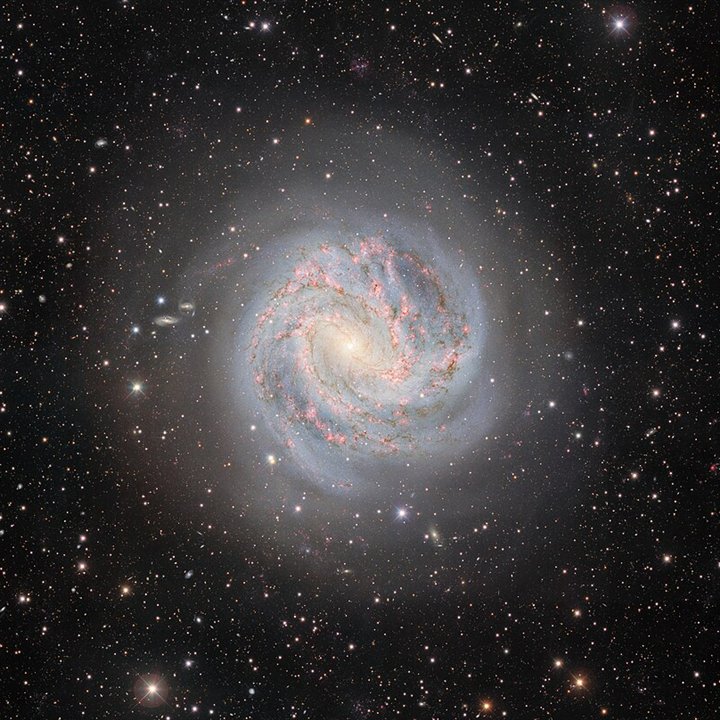
🔭 Galaxy Guide: Find Southern Pinwheel Galaxy in the CRV Science Deep Sky Galaxy Guide to see its Hubble, JWST or ground-based image, the diagnostic clue used to classify it, and the Barred Spiral class it belongs to. Test your eye in the Deep Sky Classification game.
Starburst Arms: Where Are the Newest Stars?
Hubble images of M83 resolve thousands of young star clusters, bright red hydrogen nebulae and dark dust lanes along the arms. The nucleus also forms stars at an enhanced rate, a circumnuclear starburst probably fed by gas funneled inward by the bar. The galaxy is about half the Milky Way's width.
A Supernova Factory
Since 1923, six supernovae have been observed in M83, a count unmatched by most galaxies of its size. Such frequent explosions reflect a high rate of high-mass star formation. The ejected heavy elements and expanding shock waves enrich and stir the surrounding gas, feeding later generations of stars.
Reading the Cluster Ages
Because M83 is close and nearly face-on, astronomers can map clusters of different ages across the disk and test how long young clusters remain bound. Studies find that many clusters dissolve within a few tens of millions of years, which helps explain why most stars end up scattered in the field rather than in clusters.
Southern Pinwheel Galaxy at a Glance
| Property | Value |
|---|---|
| Catalog designation | M83 • NGC 5236 |
| Constellation | Hydra |
| Distance | 15 million light-years |
| Hubble / morphological type | SAB(s)c |
| Galaxy Guide class | Barred Spiral Galaxy (SB) |
| Discoverer | Nicolas-Louis de Lacaille, 1752 |
| Supernovae observed | Six since 1923 |
| Image credit (Galaxy Guide) | NASA / ESA / Hubble / WFC3 |
Bar-Driven Gas Inflow, Inner Lindblad Resonances & the Nuclear Starburst Ring
x1 and x2 Periodic Orbits and Offset Bar Dust Shocks
Discovered on February 23, 1752, by Abbé Nicolas-Louis de Lacaille from the Cape of Good Hope and cataloged by Charles Messier in 1781 as the southernmost galaxy in his list (M83, NGC 5236), the Southern Pinwheel Galaxy lies at a Cepheid variable distance of 4.5 to 4.61 megaparsecs (~14.7 to 15.0 million light-years; Thim et al. 2003), where it anchors the northern subgroup of the Centaurus A / M83 Group. Viewed at a low inclination of i ≈ 24° and spanning an optical diameter of ~17 kiloparsecs (~55,000 light-years, with stellar mass M* ≈ 3.5 × 10¹⁰ M☉ and galaxy-wide SFR ≈ 3.5 to 4.5 M☉·yr−1), M83 is the nearest face-on barred starburst spiral galaxy (SAB(s)c) in the sky.
The central engine driving M83's nuclear activity is its 3.5-kiloparsec-long stellar bar (pattern speed Ωb ≈ 45–55 km·s−1·kpc−1). As analyzed in hydrodynamical bar simulations by Athanassoula (1992) and confirmed via ALMA CO(J = 1–0 and 2–1) interferometry (Hirota et al. 2014; Koda et al. 2023), interstellar gas orbiting within the bar potential follows elongated x1 periodic orbits aligned parallel to the bar's longitudinal axis. Along the leading edges of the bar, converging streamlines create two narrow, offset standing dust-lane shocks where molecular clouds lose up to 50% of their angular momentum per orbit through gravitational torques and shear viscosity.
Funneled radially inward along these bar dust lanes at inflow rates of 1 to 3 M☉·yr−1, the cold molecular gas encounters a pair of Inner Lindblad Resonances (ILRs)—where Ω(R) − Ωb = κ(R) / 2—within the central R < 300 parsecs. At the ILR, gas streamlines shift by 90° onto orthogonal x2 periodic orbits, piling up over 3 × 10⁸ M☉ of dense H2 into a 250-parsec circumnuclear starburst ring.
The Double Nucleus and Chronological "Pearls on a String"
High-resolution Hubble Space Telescope Wide Field Camera 3 (WFC3) and JWST NIRCam/MIRI observations of the central 300 parsecs of M83 (Thatte et al. 2000; Harris et al. 2001) resolve two distinct dynamical centers inside the nuclear starburst ring:
- The Visible Optical Nucleus: An eccentric nuclear star cluster (M ≈ 107 M☉) offset by ~3.7 arcseconds (~80 pc) northeast of the galaxy's large-scale isophotal centroid.
- The Dust-Hidden Kinematic Center: A second, dust-obscured stellar concentration coinciding with the dynamical center of rotation.
Along the western and southern arc of the circumnuclear ring, HST and JWST resolve dozens of Super Star Clusters (SSCs) (M ≈ 104–106 M☉) that exhibit an azimuthal "pearls on a string" age progression: clusters are born at the two opposing bar-inflow contact points (t < 2 Myr, detected in mid-infrared PAH and [Ne II] lines) and age monotonically from 3 Myr to 25 Myr as they orbit counterclockwise along the x2 ring.
Stellar Cluster Demographics, Super-Solar Metallicity & the XUV Outer Disk
WFC3 Cluster Dissolution and Super-Solar Oxygen Abundances
Across the spiral arms of M83, Hubble WFC3 imaging in 10 UV, optical, and Hα bands (Chandar et al. 2010; Bastian et al. 2012) cataloged over 3,000 young star clusters, establishing that while the Initial Cluster Mass Function follows a truncated power law (Schechter cutoff mass M* ≈ 2 × 10⁵ M☉ in the disk versus >106 M☉ in the high-pressure nuclear starburst), two-body relaxation and molecular cloud tidal shocks dissolve ~70–85% of low-mass clusters within 30 to 100 Myr.
Spectroscopic abundance mapping of over 200 H II regions by Bresolin et al. (2005, 2009) demonstrates that M83 possesses one of the highest gas-phase metallicities of any nearby spiral: the inner optical disk maintains a super-solar oxygen abundance of 12 + log(O/H) ≈ 8.9 to 9.0 (~1.6–2.0 Z☉) out to the Holmberg radius (R25 ≈ 8.5 kpc). Beyond the optical edge, VLA/ATCA H I 21-cm and GALEX ultraviolet observations discovered an 80-kiloparsec neutral hydrogen envelope (MH I ≈ 6.5 × 10⁹ M☉) hosting Extended Ultraviolet (XUV) spiral arms out to 3–4 R25, where young OB associations form at a flat metallicity plateau of 12 + log(O/H) ≈ 8.2 (~0.3 Z☉) amidst a northern stellar tidal stream (KK 208).
Six Historical Supernovae & the X-Ray Binary Population
Tied with NGC 6946 as one of the most prolific supernova factories in the local universe, M83 has produced six visually confirmed supernovae since 1923—SN 1923A (Type II-P), SN 1945B, SN 1950B, SN 1957D, SN 1968L (Type II inside the nuclear starburst ring), and SN 1983N—alongside over 300 optically and X-ray resolved supernova remnants mapped by Blair et al. (2012) and Chandra surveys (Long et al. 2014):
- SN 1957D: Exploding in the inner northern spiral arm, SN 1957D was recovered in the 1980s as a young radio and optical [O III]-emitting core-collapse supernova remnant, and in 2012 Chandra detected its central X-ray pulsar wind nebula.
- SN 1983N (The Prototype Type Ib Supernova): Discovered on July 3, 1983, at peak magnitude V = +11.4, ultraviolet (IUE), optical, and VLA radio observations of SN 1983N revealed the absence of hydrogen Balmer lines alongside strong He I absorption lines (587.6, 667.8, 706.5 nm) and Wolf-Rayet/binary circumstellar radio emission—defining the Type Ib class of core-collapse supernovae from high-mass stars stripped of their outer hydrogen envelopes.
References
- Thim, F., Tammann, G. A., Saha, A., Dolphin, A., Sandage, A., Tolstoy, E., & Labhardt, L. (2003). "The Cepheid distance to NGC 5236 (M83) with the Very Large Telescope." The Astrophysical Journal, 590(1), 256–270. doi:10.1086/374888
- Harris, J., Calzetti, D., Gallagher, J. S., III, Conselice, C. J., & Smith, D. A. (2001). "Waiting for the fireworks: Starburst evolution in the center of M83." The Astronomical Journal, 122(6), 3046–3064. doi:10.1086/324230
- Bresolin, F., Ryan-Weber, E., Kennicutt, R. C., & Goddard, Q. (2009). "The flat oxygen abundance gradient in the extended disk of M83." The Astrophysical Journal, 695(1), 580–595. doi:10.1088/0004-637X/695/1/580
- Long, K. S., Kuntz, K. D., Blair, W. P., Godfrey, L., Plucinsky, P. P., Soria, R., ... & Winkler, P. F. (2014). "A deep Chandra ACIS survey of M83." The Astrophysical Journal Supplement Series, 212(2), 21. doi:10.1088/0067-0049/212/2/21