NGC 1300
NGC 1300 is a classic barred spiral galaxy in Eridanus, about 61 million light-years away.
NGC 1300 is a classic barred spiral galaxy in Eridanus, about 61 million light-years away. Spanning 6.2 × 4.1 arcminutes (~110,000 light-years or 33.7 kiloparsecs) at a distance of 18.7 ± 1.8 megaparsecs, NGC 1300 serves as the morphological archetype of the SB(rs)bc class. A straight stellar bar cuts across its center, and the spiral arms begin at the bar's ends rather than at the nucleus, the signature that separates barred (SB) from unbarred (SA) spirals in the Hubble classification.
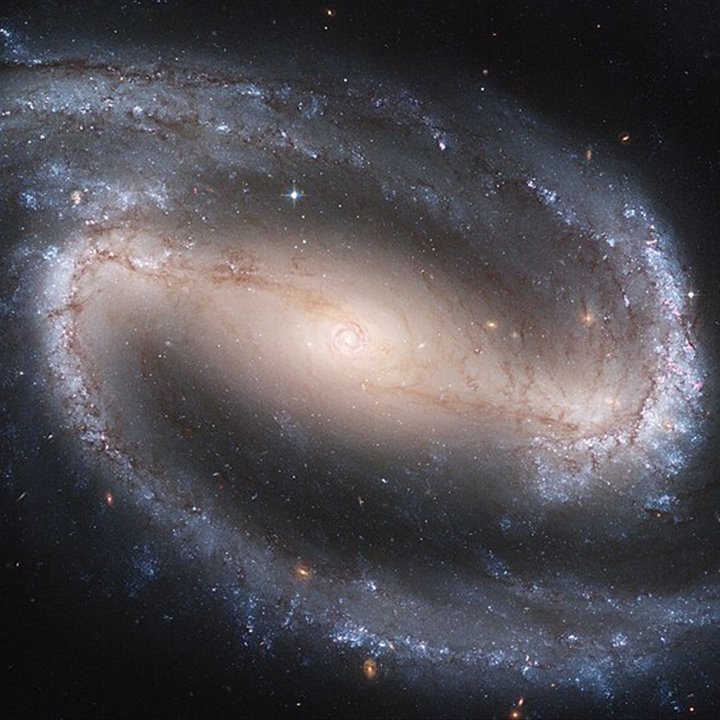
🔭 Galaxy Guide: Find NGC 1300 in the CRV Science Deep Sky Galaxy Guide to see its Hubble, JWST or ground-based image, the diagnostic clue used to classify it, and the Barred Spiral class it belongs to. Test your eye in the Deep Sky Classification game.
The Bar: How Do Stars and Gas Respond to a Rotating Bar?
A bar is a rotating elongated pattern of stars that gravitationally torques gas, causing it to lose angular momentum and drift inward along the bar's dust lanes. Roughly two thirds of nearby disk galaxies show some bar, so the Milky Way is likely among them. In NGC 1300 the bar is long and strong, and the outer arms connect to its ends.
A Spiral Within a Spiral
A 2005 Hubble image revealed a small, tightly wound grand-design spiral some 3,300 light-years across at the heart of NGC 1300, embedded inside the bar. This nuclear spiral may channel gas toward a central supermassive black hole, estimated at tens of millions of solar masses. John Herschel recorded the galaxy in 1835.
Why It Anchors the Classification Scheme
Its symmetrical bar and arms make NGC 1300 the standard image for barred spirals in textbooks and for the Galaxy Guide's barred spiral class. Compare it with NGC 1365, which has an even stronger bar, and with M83, whose bar is weak.
NGC 1300 at a Glance
| Property | Value |
|---|---|
| Catalog designation | NGC 1300 |
| Constellation | Eridanus |
| Distance | 61 million light-years |
| Hubble / morphological type | SB(rs)bc |
| Galaxy Guide class | Barred Spiral Galaxy (SB) |
| Nuclear spiral | About 3,300 light-years across |
| First recorded | John Herschel, 1835 |
| Image credit (Galaxy Guide) | NASA / ESA / Hubble Heritage Team (STScI/AURA) |
Barred Spiral Dynamics & Shock-Front Physics
Orbital Skeleton and Offset Dust-Lane Shocks
The stellar bar of NGC 1300 has a semi-major axis of abar ≈ 80–90 arcseconds (~7.5–8.0 kpc), making it one of the longest and best-defined bars in the local Universe. Unlike a solid structural rod, the bar is a self-gravitating density wave composed predominantly of older K- and M-giant stars trapped on elongated x1 periodic orbits that rotate with a uniform pattern speed Ωp ≈ 20–26 km·s−1·kpc−1. Because the interstellar gas is dissipative and collisional, gas clouds entering the non-axisymmetric gravitational potential of the bar cannot follow the intersecting stellar trajectories where the x1 family develops loops near the inner Lindblad resonance (ILR, where Ω(R) − κ(R)/2 = Ωp).
As demonstrated in the two-dimensional hydrodynamical simulations of E. Athanassoula (1992), supersonic gas streams crowding along the leading edges of the bar undergo hydrodynamic compression, forming the pair of razor-sharp, slightly curved offset dust lanes visible in the Hubble Space Telescope (HST) Advanced Camera for Surveys (ACS) mosaic. Across these shock fronts, the gas experiences velocity jumps of Δ*v* ≈ 50–100 km·s−1 and strong velocity shear. While this shear suppresses star formation along the straight shaft of the bar itself—explaining why the bar of NGC 1300 appears yellow-red and largely devoid of H II regions except at its outer tips—the shocks strip angular momentum from the cold gas, driving radial inflow at rates of 0.1 to 1.0 M☉·yr−1 toward the galactic center.
Ansae, Corotation, and Outer Spiral Arm Launching
At the eastern and western ends of the bar (R ≈ 7.8 kpc), the stellar surface brightness rises into bright knots known as ansae ("handles"), accompanied by intense H II complexes ionized by young OB associations. Here, orbital crowding near the 4:1 ultraharmonic resonance and the corotation radius (RCR ≈ 1.25 abar ≈ 9.8 kpc) compresses molecular clouds with low shear, triggering vigorous star formation. From the ansae, two symmetric grand-design spiral arms sweep outward through the disk at a pitch angle of ip ≈ 15°–18° before bending sharply back toward the opposite bar ends, creating the broken pseudo-ring morphology that earns NGC 1300 its intermediate SB(rs)bc classification alongside sandbank-prototype SB(s)b/bc systems.
The Circumnuclear Grand-Design Disk & Supermassive Black Hole
Structure of the 1-Kiloparsec Nuclear Spiral
In September 2004, the Hubble Heritage Project imaged NGC 1300 across 81.5 orbits using the ACS Wide Field Channel in four optical broadband and narrowband filters (F435W B, F555W V, F658N Hα+[N II], and F814W I). Within the central 11 arcseconds (diameter ~1.0 kpc or 3,300 light-years), the ACS images resolved a miniature, two-armed grand-design nuclear spiral and circumnuclear star-forming ring embedded inside the large-scale bar. This structure forms along the perpendicular x2 orbital family between the inner and outer ILRs, where inflowing gas from the bar's offset dust lanes settles into a cold, dynamically decoupled nuclear disk.
High-angular-resolution millimeter interferometry with the Atacama Large Millimeter/submillimeter Array (ALMA) in the 12CO (J = 2 → 1) transition as part of the PHANGS-ALMA survey mapped the molecular gas architecture of this inner kiloparsec at ~100 pc resolution. The ALMA data confirm that the dark dust spirals traced by HST correspond to acoustic and weakly shocked m = 2 spiral density waves in molecular hydrogen (MH2,nuc ≈ 2 × 10⁸ M☉), which transport gas inward from the ILR ring at R ≈ 400 pc down to the central tens of parsecs.
Central Black Hole Mass and Quiescent Nucleus
Despite possessing both a primary bar and an inner nuclear spiral capable of funneling gas to the center, NGC 1300 currently lacks a luminous active galactic nucleus (AGN), contrasting sharply with the Seyfert nucleus of NGC 1365 or the nuclear starburst of the Southern Pinwheel Galaxy (M83). Spatially resolved gas kinematics obtained with HST Space Telescope Imaging Spectrograph (STIS) slit spectroscopy of the nuclear [N II] λ6583 and Hα emission lines and velocity dispersion modeling by J. W. Atkinson and collaborators (2005) measured a central supermassive black hole mass of:
MBH = 7.3−3.5+6.9 × 10⁷ M☉
Consistent with the MBH–σ relation for a central bulge stellar velocity dispersion of σ ≈ 145–160 km·s−1, the black hole's current low bolometric Eddington ratio (Lbol / LEdd < 10−5) indicates that bar-driven AGN fueling is episodic: gas currently accumulates in the 400-parsec ILR ring faster than viscous torques within the nuclear spiral can deliver it across the inner parsec to the black hole accretion disk.
Observational History & the Eridanus Group
John Herschel discovered NGC 1300 on December 11, 1835, from the Cape of Good Hope using his 18.7-inch (47.5 cm) speculum-metal reflector, cataloging it as h 2552. In 1918, Heber D. Curtis photographed the galaxy with the 36-inch Crossley Reflector at Lick Observatory, noting its straight central bar and abrupt spiral arm junctions, and Edwin Hubble selected NGC 1300 in his 1926 and 1936 morphological treatises (The Realm of the Nebulae) as the defining visual standard for the SBb class. In three-dimensional space, NGC 1300 resides within the Eridanus Cloud (part of the larger Eridanus–Fornax–Dorado supergroup complex at vhel = 1,577 ± 4 km·s−1), an unvirialized filament of loose galaxy groups currently assembling into a cluster environment.
References
- Athanassoula, E. (1992). "The existence and shapes of dust lanes in galactic bars." Monthly Notices of the Royal Astronomical Society, 259(2), 345–364. doi:10.1093/mnras/259.2.345
- Lindblad, P. A. B., & Kristen, H. (1996). "Hydrodynamical simulations of the barred spiral galaxy NGC 1300." Astronomy & Astrophysics, 313, 733–749. doi:10.48550/arXiv.astro-ph/9602135
- Atkinson, J. W., Collett, J. L., Marconi, A., Axon, D. J., Alonso-Herrero, A., Batcheldor, D., et al. (2005). "Supermassive black hole mass measurements for NGC 1300 and NGC 2748 based on HST/STIS emission-line spectroscopy." Monthly Notices of the Royal Astronomical Society, 359(2), 504–520. doi:10.1111/j.1365-2966.2005.08904.x
- Leroy, A. K., Schinnerer, E., Hughes, A., Rosolowsky, E., Pety, J., Schruba, A., et al. (2021). "PHANGS-ALMA: Arcsecond CO(2–1) Imaging of Nearby Star-Forming Galaxies." The Astrophysical Journal Supplement Series, 257(2), 43. doi:10.3847/1538-4365/ac17f3