Messier 109
Messier 109 (NGC 3992), sometimes called the Vacuum Cleaner Galaxy, is a barred spiral in Ursa Major about 67 million light-years away. Its prominent bar and faint outer arms surround a bright inner ring, a pattern typed SB(rs)bc.
Messier 109 (NGC 3992), sometimes called the Vacuum Cleaner Galaxy, is a barred spiral in Ursa Major about 67 million light-years away. Situated 39.5 arcminutes southeast of Phecda (γ Ursae Majoris) at the bottom-left corner of the Big Dipper, M109 spans 7.6 × 4.7 arcminutes (~148,000 light-years or 45.4 kiloparsecs) at its distance of 20.5 ± 2.4 megaparsecs. Its prominent stellar bar and faint outer arms surround a partial inner transition ring, a pattern typed SB(rs)bc in the de Vaucouleurs system.
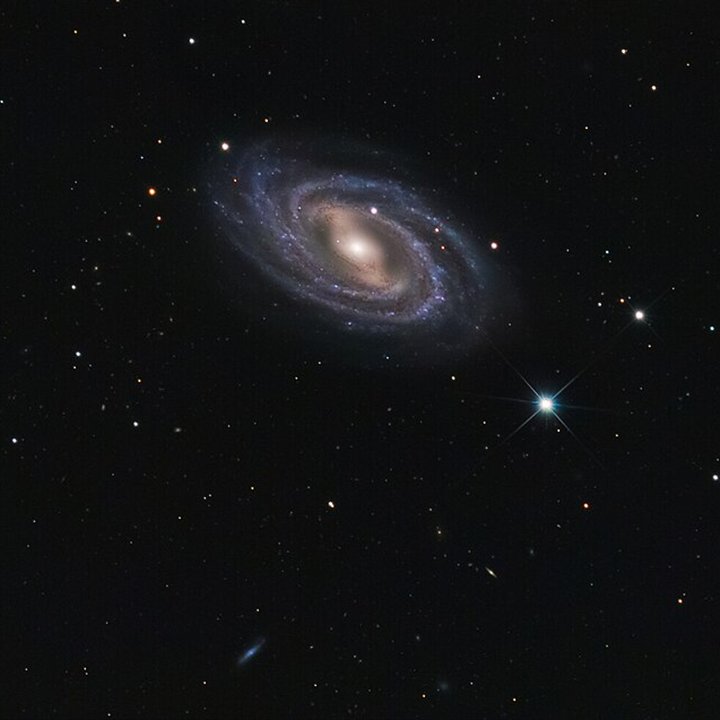
🔭 Galaxy Guide: Find Messier 109 in the CRV Science Deep Sky Galaxy Guide to see its Hubble, JWST or ground-based image, the diagnostic clue used to classify it, and the Barred Spiral class it belongs to. Test your eye in the Deep Sky Classification game.
Bar and Ring: What Do Resonances Do to a Disk?
The ring at the ends of the bar is a resonance feature, a region where the bar's rotation matches the orbital motions of stars and gas so that material collects. The arms emerge from this ring and fade into a faint outer disk, a layout that is common among barred spirals.
Group Life and Supernovae
M109 is the brightest member of a group of dozens of galaxies and sits close to Phecda (Gamma Ursae Majoris) in the Big Dipper. Pierre Méchain found it in 1781. A supernova, SN 1956A, was recorded in the galaxy.
Why It Matters for Classification
Its structure highlights the difference between barred spirals with clear rings (rs) and the more open arms of NGC 1300, helping students practice reading the subtler letters of the Hubble notation.
Messier 109 at a Glance
| Property | Value |
|---|---|
| Catalog designation | M109 • NGC 3992 |
| Constellation | Ursa Major |
| Distance | 67 million light-years |
| Hubble / morphological type | SB(rs)bc |
| Galaxy Guide class | Barred Spiral Galaxy (SB) |
| Alternate designation | NGC 3992 |
| Cataloged | Pierre Méchain, 1781 |
| Image credit (Galaxy Guide) | NOAO / AURA / NSF |
Barred Spiral Architecture & Orbital Resonance Dynamics
The SB(rs)bc Morphological Decomposition
In Gérard de Vaucouleurs' three-dimensional classification volume, the designation SB(rs)bc encodes three distinct structural axes of NGC 3992. The prefix SB identifies a prominent non-axisymmetric stellar bar dominating the inner disk gravitational potential. The parenthetical (rs) denotes an intermediate "broken-ring" or pseudo-ring transition zone at the bar's semi-major axis (abar ≈ 60–70 arcseconds, or ~6.5 kpc), where the inner spiral arms wind by roughly 180° around the bar ends before branching outward into the main disk. The suffix bc places the galaxy between moderately wound (b) and loosely wound (c) spirals, with a central bulge-to-total luminosity ratio of B/T ≈ 0.12 in the Ks band and a multi-armed outer disk.
Bar Pattern Speed, Corotation, and Lindblad Resonances
The dynamical evolution of M109 is governed by the interaction between its tumbling triaxial stellar bar, which rotates as a solid-body pattern at angular frequency Ωp, and the differentially rotating stellar and gaseous disk characterized by angular velocity Ω(R) and epicyclic frequency κ(R), where:
κ2(R) = R (dΩ2/d*R*) + 4Ω2(R)
The primary stellar backbone of the bar is supported by elongated, periodic x1 orbits aligned parallel to the bar semi-major axis. As analyzed by George Contopoulos and Prendergast, the x1 orbital family extends outward up to the corotation radius (RCR), where stars orbit at the same angular speed as the bar pattern (Ω(RCR) = Ωp), or the inner 4:1 ultraharmonic resonance (Ω(R) − κ(R)/4 = Ωp). Near this boundary, net gravitational torques exerted by the bar change sign: gas clouds inside corotation lose angular momentum and drift inward, whereas gas outside corotation gains angular momentum and is driven outward toward the outer Lindblad resonance (OLR, where Ω(R) + κ(R)/2 = Ωp), assembling the (rs) pseudo-ring at the bar tips of M109.
Closer to the galactic center, where the central mass concentration establishes an inner Lindblad resonance (ILR, Ω(R) − κ(R)/2 = Ωp), the principal orbital family shifts by 90° to x2 orbits oriented perpendicular to the bar. Fabry–Pérot Hα velocity fields of NGC 3992 indicate a fast bar with a dimensionless corotation-to-bar radius ratio ℛ = RCR / abar ≈ 1.2 ± 0.2, placing M109 in the fast-bar regime (ℛ < 1.4) where dynamical friction against the dark matter halo has not braked the bar's rotation.
Neutral Hydrogen Kinematics & the Central H I Depression
Westerbork and VLA 21-cm H I Synthesis Mapping
High-resolution 21-cm neutral hydrogen (H I) aperture-synthesis observations of NGC 3992 conducted by Roelof Bottema and Marc Verheijen with the Westerbork Synthesis Radio Telescope (WSRT) and the Very Large Array (VLA) reveal an extended atomic gas disk containing MH I ≈ 9.2 × 10⁹ M☉ spanning 1.5 times the optical diameter (D25). Across the region swept by the stellar bar (R < 6.5 kpc), however, M109 exhibits a central H I hole where the neutral hydrogen surface density drops below ΣH I ≈ 1–2 M☉·pc−2, surrounded by a dense H I ridge coinciding with the (rs) pseudo-ring and spiral arms.
Millimeter-wave carbon monoxide (12CO J = 1 → 0) mapping and Spitzer IRAC 3.6–8.0 μm imaging show that the central bar zone is also depleted of cold molecular gas (H2) and ongoing star formation, hosting a quiescent LINER nucleus. Bar-driven gravitational torques over several rotation periods (~2 × 10⁸ yr per revolution) funneled the primordial inner disk gas into the nuclear region, where earlier star formation consumed it while the bar barrier near corotation prevented outer-disk H I gas from replenishing the interior.
Rotation Curve and Dark Matter Halo Constraints
The 21-cm H I velocity field of M109 provides a well-resolved rotation curve in the Ursa Major cluster environment. Correcting for the disk inclination (i ≈ 56° ± 2°) and position angle (PA ≈ 68°), the circular velocity rises within the inner 4 kpc to vmax ≈ 272 km·s−1 across the bar before settling into a flat outer plateau at vflat ≈ 242 ± 5 km·s−1 out to R ≈ 40 kpc. Because the declining Keplerian contribution of the stellar bulge and radial exponential surface-brightness distribution (I(R) = I0 exp(−*R*/hR) with hR ≈ 4.8 kpc) cannot sustain a flat rotation curve beyond ~18 kpc even under a maximum-disk mass-to-light ratio (M/LI ≈ 3.5 M☉/L☉), mass decomposition requires a dark matter halo with an enclosed dynamical mass exceeding Mdyn(<40 kpc) ≈ 5.4 × 10¹¹ M☉.
The Ursa Major Cluster Environment & SN 1956A
NGC 3992 is the brightest member (MB ≈ −21.3) of the M109 Group (the northern condensation of the Ursa Major Cluster, Tully group 12-1), a spiral-rich aggregation of ~50–79 galaxies with a radial velocity dispersion of σv ≈ 148 km·s−1. Within the gravitational halo of M109 orbit three dwarf irregular companions detected in WSRT 21-cm H I cubes—UGC 6923, UGC 6940, and UGC 6969—at projected separations of 30 to 90 kpc with heliocentric velocities near M109's vsys = 1,048 ± 4 km·s−1.
Pierre Méchain discovered M109 on March 12, 1781, near γ Ursae Majoris while verifying M108 (NGC 3556). William Herschel cataloged it on April 12, 1789, as H IV.61 (later NGC 3992), and Helen Sawyer Hogg added M109 to the Messier list in 1953. On March 8, 1956, Fritz Zwicky and Emil Herzog discovered SN 1956A at Palomar Observatory along the inner (rs) ring. Reaching photographic magnitude mpg ≈ 12.3, SN 1956A was a Type Ia supernova that provided an independent distance check alongside barred spirals such as NGC 1300 and active-nucleus systems such as NGC 1365.
References
- Bottema, R., & Verheijen, M. A. W. (2002). "Dark and luminous matter in the NGC 3992 group of galaxies. I. The large barred spiral NGC 3992." Astronomy & Astrophysics, 388(3), 793–808. doi:10.1051/0004-6361:20020539
- Verheijen, M. A. W., & Sancisi, R. (2001). "The Ursa Major cluster of galaxies. IV. H I synthesis observations." Astronomy & Astrophysics, 370(3), 765–867. doi:10.1051/0004-6361:20010090
- Aguerri, J. A. L., Méndez-Abreu, J., & Corsini, E. M. (2009). "Population of barred galaxies in the local universe. I. Detection and characterisation of bars." Astronomy & Astrophysics, 495(2), 491–504. doi:10.1051/0004-6361:200810931
- Tully, R. B., Verheijen, M. A. W., Pierce, M. J., Huang, J.-S., & Wainscoat, R. J. (1996). "The Ursa Major Cluster of Galaxies. I. Cluster Definition and Photometric Data." The Astronomical Journal, 112, 2471–2499. doi:10.1086/118196