NGC 1365
NGC 1365 is a barred spiral in the Fornax Cluster, about 56 million light-years away and roughly 200,000 light-years across, among the largest and most prominent barred spirals known.
NGC 1365 (the Great Barred Spiral Galaxy) is a barred spiral in the Fornax Cluster, about 56 million light-years away and roughly 200,000 light-years across, among the largest and most prominent barred spirals known. Spanning 11.2 × 6.2 arcminutes on the sky at a Cepheid and Tip of the Red Giant Branch (TRGB) distance of 17.2–18.1 megaparsecs, this supergiant SB(s)b system has twice the linear diameter of the Milky Way. A thick stellar bar dominates its core, and it hosts a luminous Seyfert active galactic nucleus fed by molecular gas flowing down the bar's shock fronts.
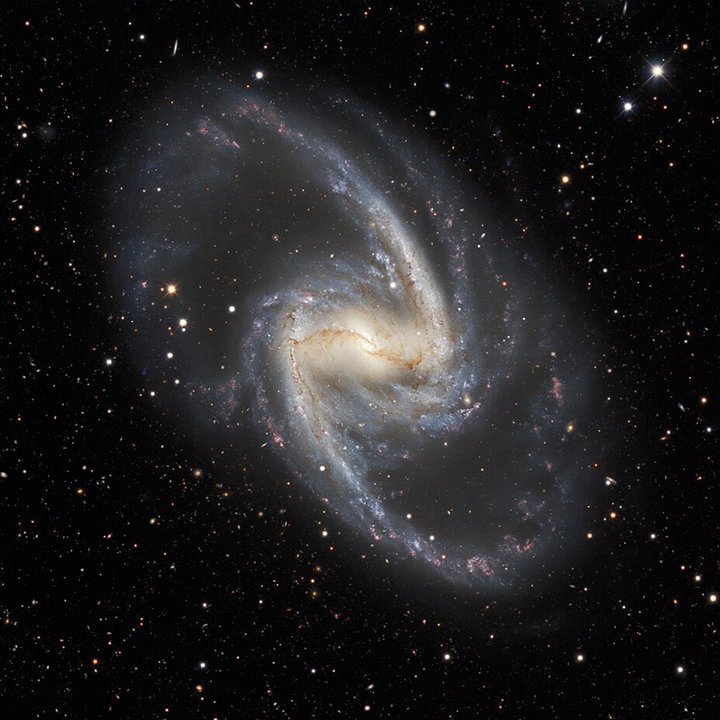
🔭 Galaxy Guide: Find NGC 1365 in the CRV Science Deep Sky Galaxy Guide to see its Hubble, JWST or ground-based image, the diagnostic clue used to classify it, and the Barred Spiral class it belongs to. Test your eye in the Deep Sky Classification game.
Bar-Driven Inflow: How Does Gas Reach a Black Hole?
Gas on the bar's dust lanes spirals toward the center, building a bright ring of star formation and then feeding the supermassive black hole. NGC 1365 is a Seyfert galaxy, with a nucleus whose X-ray brightness varies as clouds of gas pass in front of the central source.
A Rapidly Spinning Black Hole
Combined observations from XMM-Newton and NuSTAR in 2013 measured X-ray light reflected from gas swirling close to the black hole, and indicated it spins at close to the maximum rate allowed by relativity. The result is one of the clearest direct measurements of a black hole spin and constrains how such objects grow.
Life in the Fornax Cluster
NGC 1365 belongs to the Fornax Cluster, the second richest galaxy cluster within about 100 million light-years after Virgo. It is often used alongside NGC 1300 and M83 to illustrate how bars of different strength shape galaxy interiors.
NGC 1365 at a Glance
| Property | Value |
|---|---|
| Catalog designation | NGC 1365 |
| Constellation | Fornax |
| Distance | 56 million light-years |
| Hubble / morphological type | SB(s)b |
| Galaxy Guide class | Barred Spiral Galaxy (SB) |
| Nucleus | Seyfert (active galactic nucleus) |
| Diameter | About 200,000 light-years |
| Image credit (Galaxy Guide) | ESO /IDA / Danish 1.5 m / R. Gendler, J.-E. Ovaldsen |
Bar-Driven Hydrodynamics & the Circumnuclear Starburst Ring
Non-Axisymmetric Gravitational Torques and Shock Inflow
The central bar of NGC 1365 spans an angular semi-major axis of abar ≈ 100 arcseconds (~8.5–9.0 kpc), making it substantially thicker and more gravitationally dominant than the bar of NGC 1300. Comprehensive review and hydrodynamical modeling by Per Olof Lindblad (1999) established that the bar rotates with a pattern speed of Ωp ≈ 18–24 km·s−1·kpc−1, placing its corotation radius at RCR ≈ 10.5–12.5 kpc and its inner Lindblad resonance (ILR) sequence at RILR ≈ 1.0–1.8 kpc. Within the bar potential, non-circular streaming motions reach amplitudes of 100 to 150 km·s−1: cold atomic and molecular clouds orbiting on elongated x1 trajectories collide with the leading-edge dust-lane shocks, dissipating kinetic energy and losing up to 50% of their specific angular momentum in a single orbital passage.
JWST and ALMA Views of the Inner Starburst Ring
Inwardly migrating molecular gas accumulates along the perpendicular x2 orbital family near the ILR, assembling a dense circumnuclear starburst ring with a semi-major axis of ~1.0–1.5 kpc (12–18 arcseconds) containing MH2 ≈ 5 × 10⁹ M☉ of molecular gas. High-resolution mid-infrared observations taken with the James Webb Space Telescope (JWST) Mid-Infrared Instrument (MIRI, 7.7 to 21 μm) and Near-Infrared Camera (NIRCam) as part of the PHANGS-JWST Treasury survey—combined with ALMA 12CO (J = 2 → 1) interferometry—resolved dozens of embedded super star clusters (SSCs) along this ring. Individual young clusters inside the ring have stellar masses of 105 to 106 M☉, ages under 10 Myr, and visual extinctions of AV ≈ 10–30 magnitudes, driving a circumnuclear star-formation rate of SFR ≈ 5–10 M☉·yr−1 and launching a biconical ionized superwind perpendicular to the galactic disk.
Seyfert 1.8 AGN, X-Ray Eclipses & Relativistic Kerr Spin
Variable Clumpy Torus Absorption ("Changing-Look" Eclipses)
Inside the starburst ring, secondary magnetic and acoustic torques feed a central supermassive black hole of mass MBH ≈ (2–5) × 107 M☉, powering a Seyfert 1.8 active galactic nucleus with broad and narrow optical emission lines. In the X-ray regime, NGC 1365 is famous as a prototype changing-look AGN whose line-of-sight neutral hydrogen column density fluctuates between Compton-thin (NH ≈ 1022 cm−2) and Compton-thick (NH > 1.5 × 1024 cm−2) states over timescales of hours to days. Continuous monitoring with XMM-Newton, Chandra, and Suzaku by Guido Risaliti and collaborators demonstrated that these rapid occultations are caused by discrete broad-line region (BLR) clouds (ne ≈ 1010–1011 cm−3, diameter ~1013 cm) orbiting at Keplerian velocities of v ≈ 5,000–10,000 km·s−1 at distances of ~102–103 gravitational radii (rg = GMBH/c2) and periodically eclipsing the compact X-ray corona.
Relativistic Fe Kα Reflection and the ISCO Radius
In 2013, Risaliti, Fiona Harrison, and the NuSTAR / XMM-Newton team obtained broadband X-ray spectroscopy of NGC 1365 spanning 0.5 to 79 keV during an unabsorbed window. Separating the variable foreground absorption from the intrinsic continuum revealed a broadened iron Kα fluorescence line (rest energy 6.4 keV) skewed down to 4 keV by gravitational redshift and relativistic Doppler beaming, accompanied by a Compton reflection hump peaking at 20–30 keV. In the Kerr metric for a rotating black hole with dimensionless spin parameter a* = cJ / (GMBH2), the radius of the innermost stable circular orbit (rISCO) shrinks from 6 rg for a non-rotating Schwarzschild black hole (a* = 0) to 1.235 rg for a Thorne-limited prograde rotator (a* = 0.998). Relativistic disk-reflection modeling yielded:
a* ≥ 0.84 (90% confidence; best fit a* ≈ 0.97)
and rISCO < 2.5 rg, proving that the central black hole of NGC 1365 spins near the relativistic limit and grew primarily through coherent, radiatively efficient prograde disk accretion fueled by its galactic bar.
Observational History, Cepheid Calibration & Supernovae
Scottish astronomer James Dunlop discovered NGC 1365 on September 24, 1826, from Parramatta, New South Wales, cataloging it as Δ 562. As a foreground-to-infalling spiral member on the southwestern periphery of the Fornax Cluster—which is anchored by the giant radio elliptical Fornax A (NGC 1316) and comparable in AGN laboratory proximity to Centaurus A—NGC 1365 was selected by the HST Key Project on the Extragalactic Distance Scale (Wendy Freedman, Barry Madore, et al., 1999) to calibrate the Hubble constant (H0), yielding 52 Cepheid variables. Four historical supernovae have been recorded in NGC 1365: SN 1957C, the Type Ic SN 1983V, the Type II-P SN 2001du, and the Type Ia SN 2012fr, making the galaxy a premier rung linking Cepheid, TRGB, and Type Ia supernova distance scales.
References
- Lindblad, P. O. (1999). "NGC 1365: A review." Astronomy and Astrophysics Review, 9(3), 221–271. doi:10.1007/s001590050018
- Risaliti, G., Harrison, F. A., Madsen, K. K., Walton, D. J., Boggs, S. E., Christensen, F. E., et al. (2013). "A rapidly spinning supermassive black hole at the centre of NGC 1365." Nature, 494(7438), 449–451. doi:10.1038/nature11938
- Silbermann, N. A., Harding, P., Ferrarese, L., Stetson, P. B., Madore, B. F., Kennicutt, R. C., et al. (1999). "The Hubble Space Telescope Key Project on the Extragalactic Distance Scale. XIV. The Cepheids in NGC 1365." The Astrophysical Journal, 515(1), 1–28. doi:10.1086/307005
- Schinnerer, E., Emsellem, E., Henshaw, J. D., Liu, D., Meidt, S. E., Querejeta, M., et al. (2023). "A (Sub)kiloparsec View of Gas-Phase Metallicity and Star Formation in NGC 1365 with JWST and ALMA." The Astrophysical Journal Letters, 944(2), L19. doi:10.3847/2041-8213/acac9e