Fornax A
Fornax A (NGC 1316) is a giant lenticular-elliptical galaxy in the Fornax Cluster, about 62 million light-years away, and one of the brightest radio galaxies in the sky. Its visible light shows shells, loops and dust lanes, leftovers of a merger.
Fornax A (NGC 1316, Arp 154) is a giant lenticular-elliptical galaxy on the southwestern outskirts of the Fornax Cluster, located about 62 million light-years (19.0–20.8 megaparsecs) away, and the fourth-brightest extragalactic radio source in the sky at meter wavelengths. Spanning an optical angular size of 12.0 × 8.5 arcminutes (~220,000 light-years or 68 kiloparsecs) with an intrinsic visual magnitude of MV ≈ −22.8, NGC 1316 is the most luminous galaxy in the Fornax complex, surpassing the central cluster cD galaxy NGC 1399. Its visible light shows concentric stellar shells, tidal loops, and chaotic dust lanes—the morphological signatures of a gas-rich merger—earning it the classification SAB0 pec (or D/S0 pec).
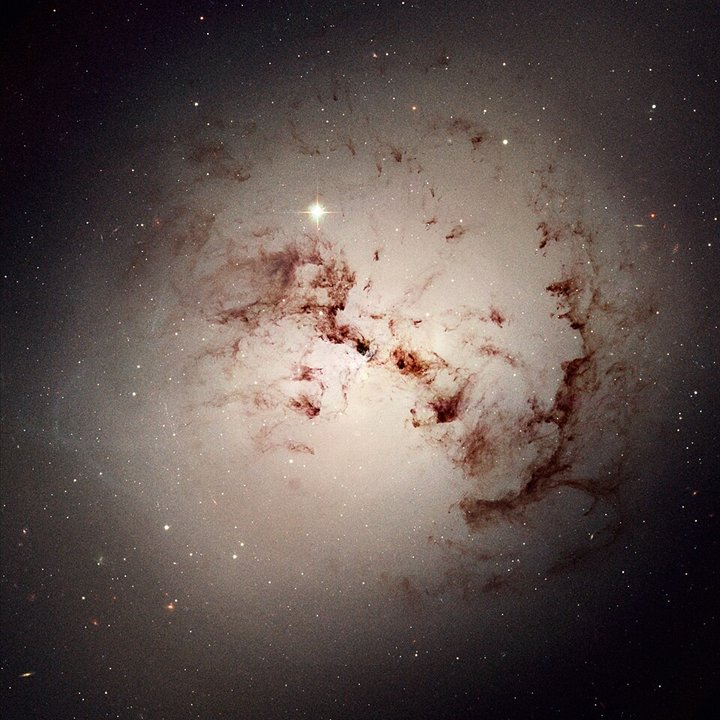
🔭 Galaxy Guide: Find Fornax A in the CRV Science Deep Sky Galaxy Guide to see its Hubble, JWST or ground-based image, the diagnostic clue used to classify it, and the Elliptical / Lenticular class it belongs to. Test your eye in the Deep Sky Classification game.
A Merger Remnant: What Do Shells and Dust Lanes Reveal?
Tidal loops and dust filaments around NGC 1316 point to the absorption of a gas-rich spiral galaxy a few billion years ago. Globular clusters of intermediate age suggest that the merger triggered a burst of cluster formation.
Giant Radio Lobes
Radio telescopes reveal two huge lobes of plasma extending far beyond the visible galaxy, fed by jets from the central supermassive black hole. They are the origin of the name Fornax A, marking the strongest radio source in the constellation.
Four Type Ia Supernovae
NGC 1316 has hosted four Type Ia supernovae, SN 1980N, SN 1981D, SN 2006dd and SN 2006mr. Because the host is so well studied, these events help calibrate the standard-candle use of Type Ia supernovae in galaxies with old stellar populations.
Fornax A at a Glance
| Property | Value |
|---|---|
| Catalog designation | NGC 1316 • Arp 154 |
| Constellation | Fornax |
| Distance | 62 million light-years |
| Hubble / morphological type | SAB0 pec (Elliptical/Lenticular) |
| Galaxy Guide class | Elliptical & Lenticular Galaxy (E / S0) |
| Radio source | Fornax A |
| Cluster | Fornax Cluster |
| Image credit (Galaxy Guide) | NASA / ESA & The Hubble Heritage Team (STScI/AURA) |
Merger History, Tidal Shells & Intermediate-Age Globular Clusters
François Schweizer's 1980 Merger Paradigm
In a landmark 1980 observational study at Cerro Tololo Inter-American Observatory, François Schweizer demonstrated that NGC 1316 is a dynamic post-merger remnant bridging active gas-rich collisions (such as the Antennae Galaxies) and relaxed early-type spheroids. Deep optical imaging reveals an extensive network of outer tidal tails, loops (specifically features L1, L2, and L3 extending up to 100 kpc from the core), and interleaved phase-space ripples (shells), while the inner 2 arcminutes (~12 kpc) are crossed by complex, non-coplanar filaments of cold dust and ionized gas rotating along an axis tilted ~70° relative to the major axis of the stellar spheroid.
Unlike typical slow-rotating giant ellipticals, the stellar spheroid of NGC 1316 displays rapid rotation (vmax ≈ 150 km·s−1) and a relatively low central velocity dispersion for its high luminosity (σ0 ≈ 226 ± 9 km·s−1, lying offset from the standard Faber–Jackson relation), consistent with a SAB0 pec lenticular-elliptical remnant sculpted by a 4:1 to 10:1 mass-ratio merger with a gas-rich spiral galaxy (and subsequent minor satellite accretions, including ongoing interaction with the neighboring spiral NGC 1317 to the north).
Dating the Merger with Globular Cluster Spectroscopy
To determine when the main merger occurred, Paul Goudfrooij and collaborators used the Hubble Space Telescope (HST) Advanced Camera for Surveys (ACS) and VLT multi-object spectroscopy to analyze the globular cluster system of NGC 1316. In addition to an ancient, metal-poor halo population (~12 Gyr old), NGC 1316 contains a prominent subpopulation of luminous, metal-rich ([Z/H] ≈ −0.1 to +0.1) red globular clusters formed during the merger-induced starburst. Balmer (Hβ, Hγ) and metallic Lick absorption-line indices yield a spectroscopic age of 3.0 ± 0.5 Gyr for the main merger event, accompanied by a younger 1–2 Gyr subpopulation indicating recurrent satellite cannibalism. Millimeter-wave ALMA and IRAM observations of the inner dust lanes detect MH2 ≈ 5 × 10⁸ M☉ of clumpy molecular gas still settling toward the galactic center.
Supermassive Black Hole & Episodic Radio-Jet Activity
Central Black Hole Dynamics
Adaptive-optics near-infrared stellar kinematics with VLT/SINFONI and HST/STIS slit spectroscopy modeled by N. Nowak and collaborators (2008) via axisymmetric Schwarzschild orbit superposition measured a central supermassive black hole mass of:
MBH = (1.5 ± 0.8) × 108 M☉
Consistent with the host bulge's modest velocity dispersion (σ0 ≈ 226 km·s−1), this black hole powers a currently low-luminosity active nucleus (LX, 0.3–10 keV ≈ 5 × 1039 erg·s−1) accompanied by a 5-kiloparsec S-shaped inner radio jet oriented along position angle PA ≈ 150°.
The Giant Radio Lobes of Fornax A and Inverse-Compton X-Rays
Extending far beyond the optical galaxy along an east–west axis (PA ≈ 110°) are two orange-peel-shaped giant radio lobes imaged by Edward Fomalont and collaborators with the Very Large Array (VLA) at 1.4 GHz and recently at broadband frequencies with MeerKAT. Spanning 33 arcminutes (~185 kpc or 600,000 light-years) from tip to tip, these polarized synchrotron lobes yield an integrated 1.4 GHz flux density of S1.4 GHz ≈ 125 Jy, making Fornax A one of the brightest radio sources in the sky alongside Centaurus A.
The misalignment between the inner S-shaped kiloparsec jet (PA ≈ 150°) and the outer giant lobes (PA ≈ 110°), combined with spectral-index aging analysis of the synchrotron break frequency across the lobes by Davide Maccagni and colleagues, demonstrates that the AGN in NGC 1316 has undergone multiple flickering outbursts over the past ~108 years as cold gas clouds from the dust lanes sporadically fell onto the black hole. Furthermore, ASCA, XMM-Newton, and Suzaku detected diffuse hard X-ray emission co-spatial with the giant radio lobes—providing a textbook measurement of inverse-Compton scattering of cosmic microwave background (CMB) photons (TCMB = 2.725 K) by relativistic electrons (γe ≈ 103–104), which independently pins the lobe magnetic field strength at B ≈ 1.5–3.0 μG near equipartition.
Four Type Ia Supernovae & Extragalactic Distance Calibration
NGC 1316 is renowned as one of the most prolific Type Ia supernova hosts known, having produced four well-observed thermonuclear white dwarf explosions within 26 years: SN 1980N (December 1980), SN 1981D (March 1981), SN 2006dd (June 2006), and the rapid-declining subluminous SN 2006mr (November 2006). Because all four supernovae lie at the identical host distance inside the Fornax Cluster—which also contains the Cepheid-calibrated barred spiral NGC 1365—their Phillips light-curve decline-rate relations (Δ*m*15(B)) provide a stringent internal test of Type Ia standard-candle precision and planetary nebula luminosity function (PNLF) / surface-brightness fluctuation (SBF) distance scales (D = 19.0–20.8 Mpc). James Dunlop originally discovered NGC 1316 on September 2, 1826 (cataloging it as Δ 548), and Byron Mills identified its radio counterpart Fornax A in 1952–1954.
References
- Schweizer, F. (1980). "An optical study of the giant radio galaxy NGC 1316 (Fornax A)." The Astrophysical Journal, 237, 303–318. doi:10.1086/157870
- Goudfrooij, P., Mack, J., Kissler-Patig, M., Meylan, G., & Minniti, D. (2001). "Kinematics, ages and metallicities of star clusters in NGC 1316: a 3-Gyr-old merger remnant." Monthly Notices of the Royal Astronomical Society, 322(4), 643–657. doi:10.1046/j.1365-8711.2001.04160.x
- Nowak, N., Saglia, R. P., Thomas, J., Bender, R., Davies, R. I., & Gebhardt, K. (2008). "The supermassive black hole of Fornax A." Monthly Notices of the Royal Astronomical Society, 391(4), 1629–1649. doi:10.1111/j.1365-2966.2008.13960.x
- Maccagni, D., Murgia, M., Serra, P., Govoni, F., Morokuma-Matsui, K., Kleiner, D., et al. (2020). "The flickering nuclear activity of Fornax A." Astronomy & Astrophysics, 634, A9. doi:10.1051/0004-6361/201936867