Centaurus A
Centaurus A (NGC 5128) is the closest radio-loud active galaxy, about 12 million light-years away.
Centaurus A (NGC 5128, Arp 153) is the closest radio-loud active galaxy to Earth, located about 12 million light-years (3.8 ± 0.1 megaparsecs) away in Centaurus. Spanning 25.7 × 20.0 arcminutes (~90,000 light-years) at V ≈ +6.84, it is the fifth-brightest galaxy in the sky. A dark dust lane cuts across a giant elliptical-like body (S0 pec / E2 pec), the result of a merger with a smaller spiral, while jets from the central black hole inflate extended radio lobes. James Dunlop discovered it in 1826.
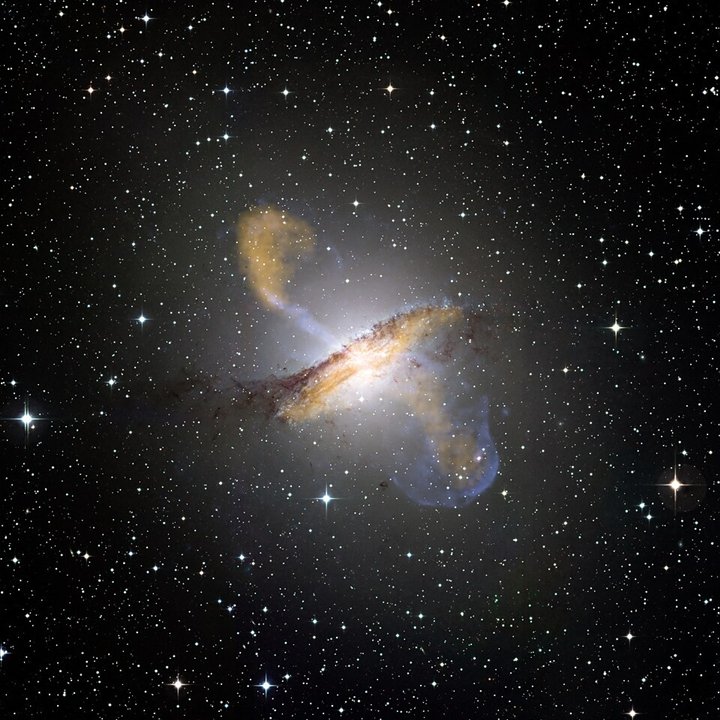
🔭 Galaxy Guide: Find Centaurus A in the CRV Science Deep Sky Galaxy Guide to see its Hubble, JWST or ground-based image, the diagnostic clue used to classify it, and the Elliptical / Lenticular class it belongs to. Test your eye in the Deep Sky Classification game.
A Collision in Progress: Why Is There a Dust Lane?
The warped disk of dust and gas crossing NGC 5128 is thought to be the remains of a small spiral galaxy that merged with the elliptical within the last few hundred million years. The infall is feeding new star formation in the disk and fueling the central engine.
Jets and Lobes
A central black hole of roughly 55 million solar masses launches jets visible in X-rays and radio and inflates lobes extending about a million light-years. The Event Horizon Telescope has imaged the base of the jet, giving a close look at how it is launched.
Why Distance Matters
Most radio galaxies lie hundreds of millions of light-years away, so Centaurus A is a rare opportunity to study the interplay among black hole, jet and host galaxy in detail. It has also been detected in very-high-energy gamma rays.
Centaurus A at a Glance
| Property | Value |
|---|---|
| Catalog designation | NGC 5128 • Arp 153 |
| Constellation | Centaurus |
| Distance | 12 million light-years |
| Hubble / morphological type | S0 pec / E pec |
| Galaxy Guide class | Elliptical & Lenticular Galaxy (E / S0) |
| Central black hole | About 55 million solar masses |
| Discoverer | James Dunlop, 1826 |
| Image credit (Galaxy Guide) | ESO / WFI (Optical); MPIfR / APEX / A. Weiss (Submillimetre); NASA / CXC (X-ray) |
Post-Merger Morphology, Warped Dust Disk & Tidal Shells
Differential Precession of the Accreted Gas Disk
As reviewed by F. P. Israel (1998), the peculiar morphology of NGC 5128 combines a triaxial early-type spheroid dominated by an old, metal-rich stellar population (age ~10–12 Gyr) with a strongly warped, tilted equatorial disk of cold dust, atomic hydrogen (MH I ≈ 4.5 × 10⁸ M☉), and molecular gas (MH2 ≈ 4 × 10⁸ M☉) containing active H II regions and young OB star clusters. N-body and smoothed-particle hydrodynamical simulations show that this configuration arose 200 to 700 million years ago when the giant elliptical host cannibalized a smaller, gas-rich late-type spiral galaxy (comparable in mass to the Triangulum Galaxy, M33).
Because the orbital angular momentum vector of the infalling spiral was misaligned with the principal symmetry axes of the triaxial elliptical gravitational potential, differential nodal precession—in which the precession frequency Ωprec(R) ∝ R−3/2 decreases with radius—coupled with viscous dissipation twisted the settling gas disk into a folded S-shaped warp. When viewed nearly edge-on, the overlapping folds of this warped disk project across the bulge as the famous bifurcated dark dust lane, while Spitzer 8–24 μm and APEX 870 μm submillimeter maps reveal that the inner warped disk forms a 6-kiloparsec parallelogram-shaped star-forming ring.
Outer Phase-Space Shells and Jet-Induced Star Formation
In the outer halo of NGC 5128 (R = 10 to 80 kpc), deep optical photography first obtained by David Malin in 1979 resolved a concentric system of faint stellar shells and arcs. As modeled by Peter Quinn (1984), these ripples represent phase-wrapped density caustics where stars stripped from the disrupted secondary galaxy reach the apocenters of their radial orbits. Extending northeastward from the inner shells along the path of the northern radio jet are luminous optical filaments containing young blue supergiants and ionized gas knots (age <15 Myr), demonstrating positive AGN jet-induced star formation triggered when expanding radio-jet bow shocks compressed cold H I clouds left behind in the tidal debris trail.
Supermassive Black Hole, EHT Jet Collimation & Multiscale Radio Lobes
Central Black Hole Dynamics and EHT 228 GHz Imaging
Behind AV ≈ 15–25 magnitudes of visual extinction in the dust lane lies an active galactic nucleus powered by a supermassive black hole. Adaptive-optics integral-field stellar kinematics of the near-infrared CO bandheads (2.29 μm) with VLT/SINFONI and molecular H2 kinematics by Michele Cappellari and collaborators (2009) measured a black hole mass of:
MBH = (5.5 ± 3.0) × 107 M☉
At a distance of 3.8 Mpc, this corresponds to a Schwarzschild radius of RS = 2*GM*BH/c2 ≈ 1.6 × 1013 cm (~1.1 AU) and an angular gravitational radius of θg ≈ 0.14 microarcseconds. In July 2021, Michael Janssen and the Event Horizon Telescope (EHT) Collaboration published 228 GHz (1.3 mm) VLBI observations of Centaurus A at 25-microarcsecond resolution—corresponding to a linear scale of 0.6 light-days (~200 RS), ten times sharper than any previous TANAMI centimeter-VLBI map. The EHT image revealed a strongly edge-brightened biconical jet (with a faint counterjet) whose width W scales with distance z along the jet axis as a parabolic collimation profile (W ∝ z0.33–0.65), matching the helical magnetic sheath topology observed in Messier 87 despite a hundredfold lower black hole mass.
Fanaroff–Riley Class I Lobes and TeV/UHECR Particle Acceleration
From the sub-parsec core, the relativistic jet (inclined at θ ≈ 50°–80° to our line of sight with intrinsic speed v ≈ 0.5*c*) propagates outward across three distinct spatial scales—similar in merger-driven radio revitalization to Fornax A:
- The Inner Kiloparsec Jet and Lobes: Extending ~5 kpc (~4.5 arcminutes) northeast and southwest, resolved by Chandra into over 30 X-ray synchrotron knots (such as Knot AX1A and BX2) where in-situ diffusive shock acceleration energizes electrons to γe ≈ 107–108, and where the jet drives a M ≈ 8 bow shock into the interstellar medium around the southwest inner radio lobe.
- The Northern Middle Lobe: A buoyant, 30-kiloparsec plume where the jet deflects off dense H I clouds.
- The Giant Outer Radio Lobes: Spanning 8° × 4° on the sky (~600 kpc or 2 million light-years end-to-end), storing >1058–1059 erg of relativistic plasma and magnetic fields (B ≈ 1–3 μG) accumulated over multiple AGN duty cycles during the past 108 years.
In the gamma-ray regime, the Fermi Large Area Telescope (LAT) resolved inverse-Compton emission from the giant outer lobes (where relativistic electrons upscatter cosmic microwave background photons), while the H.E.S.S. Cherenkov array detected TeV gamma rays along the kiloparsec jet, and the Pierre Auger Observatory identified an anisotropy of ultra-high-energy cosmic rays (UHECRs) (E > 5.5 × 10¹⁹ eV) near the sky position of Centaurus A.
Observational History
James Dunlop recorded NGC 5128 on April 29, 1826, from Parramatta Observatory in Australia. In 1949, John G. Bolton, Gordon J. Stanley, and O. B. Slee used sea-cliff radio interferometry at Dover Heights near Sydney to identify Centaurus A with NGC 5128, establishing it as one of the first extragalactic radio sources linked to an optical galaxy.
References
- Israel, F. P. (1998). "Centaurus A – NGC 5128." Astronomy and Astrophysics Review, 8(4), 237–278. doi:10.1007/s001590050011
- Cappellari, M., Neumayer, N., Reunanen, J., van der Werf, P. P., de Zeeuw, P. T., & Rix, H.-W. (2009). "The mass of the black hole in Centaurus A from SINFONI observations of its stellar kinematics." Monthly Notices of the Royal Astronomical Society, 394(2), 660–674. doi:10.1111/j.1365-2966.2008.14377.x
- Janssen, M., Falcke, H., Kadler, M., Ros, E., Wielgus, M., Akiyama, K., et al. (2021). "Event Horizon Telescope observations of the jet launching and collimation in Centaurus A." Nature Astronomy, 5(10), 1017–1028. doi:10.1038/s41550-021-01417-w
- Kraft, R. P., Vázquez, S. E., Forman, W. R., Jones, C., Murray, S. S., Hardcastle, M. J., Worrall, D. M., & Churazov, E. (2003). "X-Ray Emission from the Hot Interstellar Medium and Southwest Radio Lobe of the Nearby Radio Galaxy Centaurus A." The Astrophysical Journal, 592(1), 129–146. doi:10.1086/375533