Messier 87
Messier 87 (M87, NGC 4486, Virgo A) is a supergiant elliptical galaxy about 53 million light-years away at the heart of the Virgo Cluster.
Messier 87 (M87, NGC 4486, Virgo A) is a supergiant elliptical galaxy about 53.5 million light-years (16.8 ± 0.8 megaparsecs) away at the center of the Virgo Cluster. Classified as E0-1 pec (or cD) because of its extended stellar envelope and non-thermal optical jet, M87 has a stellar mass exceeding 2.4 × 10¹² M☉ and a virial mass within 300 kpc of (1.5–3.0) × 1013 M☉. In April 2019 the Event Horizon Telescope collaboration published the first image of a black hole's shadow, that of the roughly 6.5-billion-solar-mass black hole (M87\*) at M87's center.
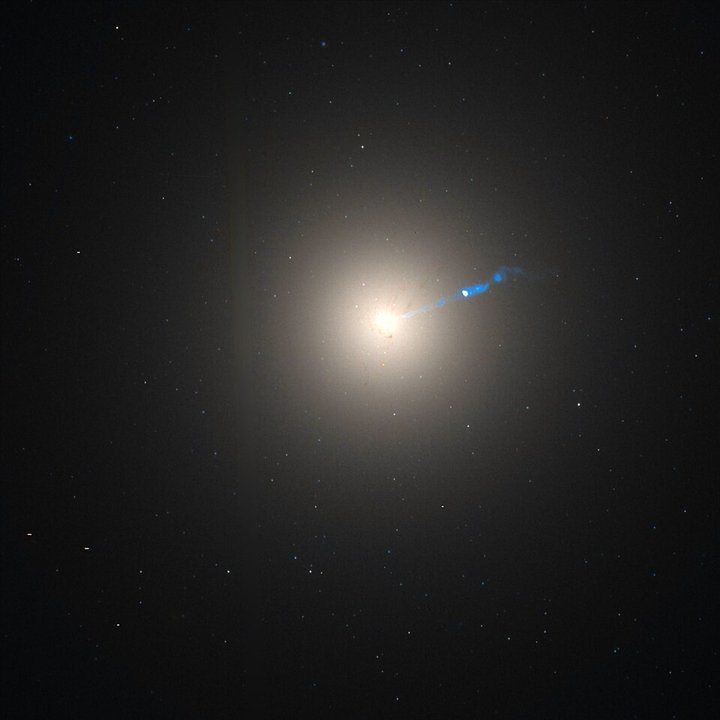
🔭 Galaxy Guide: Find Messier 87 in the CRV Science Deep Sky Galaxy Guide to see its Hubble, JWST or ground-based image, the diagnostic clue used to classify it, and the Elliptical / Lenticular class it belongs to. Test your eye in the Deep Sky Classification game.
The Black Hole Shadow: What Did the Event Horizon Telescope See?
A global network of radio dishes combined into an Earth-sized interferometer resolved a bright ring of hot gas surrounding a dark central region. The ring's size matched the prediction of general relativity for a black hole of that mass. Polarized images released in 2021 traced the magnetic field structure near the horizon, the same fields thought to launch the galaxy's jet.
A Jet Across Thousands of Light-Years
M87 emits a relativistic jet of plasma visible from radio to X-rays that extends about 5,000 light-years. Heber Curtis noted a "curious straight ray" in 1918, long before its nature was understood. The jet is a prime example of how a central black hole can influence a whole galaxy and cluster.
Giant Ellipticals: Smooth, Old and Rich in Clusters
Elliptical galaxies lack prominent spiral structure and hold mostly old stars, and M87 is thought to have grown through many mergers. It carries an extensive population of globular clusters, estimated in the many thousands. The smooth, featureless look is why the Galaxy Guide uses it for the elliptical class.
Messier 87 at a Glance
| Property | Value |
|---|---|
| Catalog designation | M87 • NGC 4486 |
| Constellation | Virgo |
| Distance | 53.5 million light-years |
| Hubble / morphological type | E0-1 pec |
| Galaxy Guide class | Elliptical & Lenticular Galaxy (E / S0) |
| Central black hole | About 6.5 billion solar masses |
| Cluster | Virgo Cluster |
| Image credit (Galaxy Guide) | NASA / ESA & the Hubble Heritage Team (STScI/AURA) |
Horizon-Scale Physics of M87* & the Event Horizon Telescope
230 GHz VLBI Shadow Measurement and Kerr Metric Verification
In April 2017, the Event Horizon Telescope (EHT) linked eight millimeter/submillimeter observatories across four continents at λ = 1.3 mm (230 GHz) using Very Long Baseline Interferometry (VLBI), achieving a diffraction-limited resolution of θ ≈ λ / Bmax ≈ 20 microarcseconds (μas). The resulting image of M87\* revealed an asymmetric crescent ring of diameter d = 42 ± 3 μas surrounding a central brightness depression—the black hole shadow cast by photon capture inside the unstable photon orbit (rph = 3 rg for a Schwarzschild black hole).
In general relativity, strong gravitational lensing magnifies the apparent shadow radius to Rsh = √27 rg ≈ 5.20 rg (varying by only ±4% across all Kerr spins a* and inclinations), where the gravitational radius is rg = GMBH/c2. At the surface-brightness fluctuation distance of D = 16.8 ± 0.8 Mpc, an angular gravitational radius of θg = rg/D = 3.8 ± 0.4 μas directly implies a black hole mass of:
MBH = (6.5 ± 0.7) × 109 M☉
This horizon-scale measurement agrees closely with axisymmetric stellar-dynamical Schwarzschild orbit modeling of M87's central velocity dispersion profile (σ* ≈ 400 km·s−1 inside 1 arcsecond) by Karl Gebhardt and collaborators (MBH = 6.6 ± 0.4 × 10⁹ M☉). The north–south brightness asymmetry of the 230 GHz ring results from relativistic Doppler beaming of synchrotron-emitting electrons (Te ≈ 1010–1011 K) orbiting clockwise on the sky with a spin vector tilted ~17° away from our line of sight, matching the orientation of the large-scale northwest jet.
Polarized GRMHD and Magnetically Arrested Disks (MAD)
General Relativistic Magnetohydrodynamic (GRMHD) simulations coupled to polarized radiative transfer (EHT Collaboration Papers VII and VIII, 2021) analyzed the spiral linear polarization pattern across the emission ring. The fractional polarization (~15% in the southwest sector) and Faraday rotation measure constrain the horizon-scale accretion flow to a Magnetically Arrested Disk (MAD) state, in which poloidal magnetic fields (B ≈ 1–30 Gauss near the event horizon) exert outward magnetic pressure comparable to the inward ram pressure of the radiatively inefficient accretion flow (Ṁ ≈ 3 × 10⁻⁴ to 2 × 10⁻³ M☉·yr−1).
Relativistic Jet Launching & AGN Mechanical Feedback
Blandford–Znajek Extraction and Superluminal Knot Kinematics
The collimated one-sided plasma jet of M87—first described by Heber Curtis in 1918 at Lick Observatory and identified as polarized optical synchrotron emission by Walter Baade in 1956—extends ~20 arcseconds (~1.6 kpc or 5,200 light-years in projection) along position angle PA ≈ 290°. Powered by the Blandford–Znajek mechanism, frame-dragging inside the ergosphere of the rotating Kerr black hole winds horizon-threading magnetic field lines into a tightly coiled helical flux tube, extracting rotational energy at a power scaling as:
PBZ ∝ κB ΦBH2 ΩH2 / c ≈ (1–5) × 1043 erg·s−1
where ΦBH is the magnetic flux threading the horizon and ΩH is the horizon angular velocity. Multi-epoch HST and VLA monitoring of discrete internal shocks along the jet—including Knot A, Knot C, and the flaring site HST-1 located ~0.85 arcseconds (~70 pc, near the Bondi accretion radius) from the core—measures apparent superluminal proper motions of βapp = vapp/c ≈ 4.0 to 6.3. Because a relativistic plasmoid moving at speed β*c* at angle θ ≈ 15°–19° to the line of sight yields βapp = β sin θ / (1 − β cos θ), these motions require intrinsic bulk Lorentz factors of Γ = (1 − β2)−1/2 ≈ 6.
Chandra X-Ray Cavities and Virgo Intracluster Medium Heating
On scales of tens of kiloparsecs, Chandra X-ray Observatory imaging by William Forman and colleagues reveals how M87's radio lobes (Virgo A) regulate the Virgo intracluster medium (ICM, kBT ≈ 2–3 keV). Periodic outbursts from M87\* every ~107 years inflate buoyant X-ray cavities and drive weak spherical shock fronts (M ≈ 1.2) into the hot cluster halo. This mechanical "radio-mode" AGN feedback offsets radiative X-ray cooling losses across the cluster core, preventing a runaway cooling flow and quenching late-time star formation in M87, just as similar jet systems operate in Messier 60 and the nearer merger-built active galaxy Centaurus A.
cD Envelope & the 12,000-Cluster Globular System
Unlike standard elliptical galaxies whose surface-brightness profiles follow a single de Vaucouleurs R1/4 law (Sérsic index n ≈ 4), M87 possesses a flattened stellar core of radius rb ≈ 560 pc (created when binary supermassive black holes ejected stars via three-body gravitational slingshots during past dry mergers) and an outer cD stellar halo extending beyond 150 kpc into the Virgo cluster potential. Within this halo orbit approximately 12,000 to 13,000 globular clusters—compared to ~150–170 in the Milky Way—yielding an elevated globular cluster specific frequency of SN = NGC × 100.4(MV + 15) ≈ 14. Photometric and spectroscopic surveys resolve a bimodal color distribution: a metal-poor blue subpopulation ([Fe/H] ≈ −1.5) stripped from accreted dwarf satellites and a metal-rich red subpopulation ([Fe/H] ≈ −0.3) formed during early gas-rich galaxy mergers.
References
- Event Horizon Telescope Collaboration, Akiyama, K., Alberdi, A., Alef, W., Asada, K., Azulay, R., et al. (2019). "First M87 Event Horizon Telescope Results. I. The Shadow of the Supermassive Black Hole." The Astrophysical Journal Letters, 875(1), L1. doi:10.3847/2041-8213/ab0ec7
- Event Horizon Telescope Collaboration, Akiyama, K., Algaba, J. C., Alberdi, A., Alef, W., Anantua, R., et al. (2021). "First M87 Event Horizon Telescope Results. VIII. Magnetic Field Structure near The Event Horizon." The Astrophysical Journal Letters, 910(1), L13. doi:10.3847/2041-8213/abe4de
- Gebhardt, K., Adams, J., Richstone, D., Lauer, T. R., Faber, S. M., Gültekin, K., Murphy, J., & Tremaine, S. (2011). "The Black-Hole Mass in M87 from Gemini/NIFS Adaptive Optics Observations." The Astrophysical Journal, 729(2), 119. doi:10.1088/0004-637X/729/2/119
- Forman, W., Jones, C., Churazov, E., Markevitch, M., Nulsen, P., Vikhlinin, A., et al. (2007). "Filaments, Bubbles, and Weak Shocks in the Gaseous Atmosphere of M87." The Astrophysical Journal, 665(2), 1057–1066. doi:10.1086/519480