Messier 60
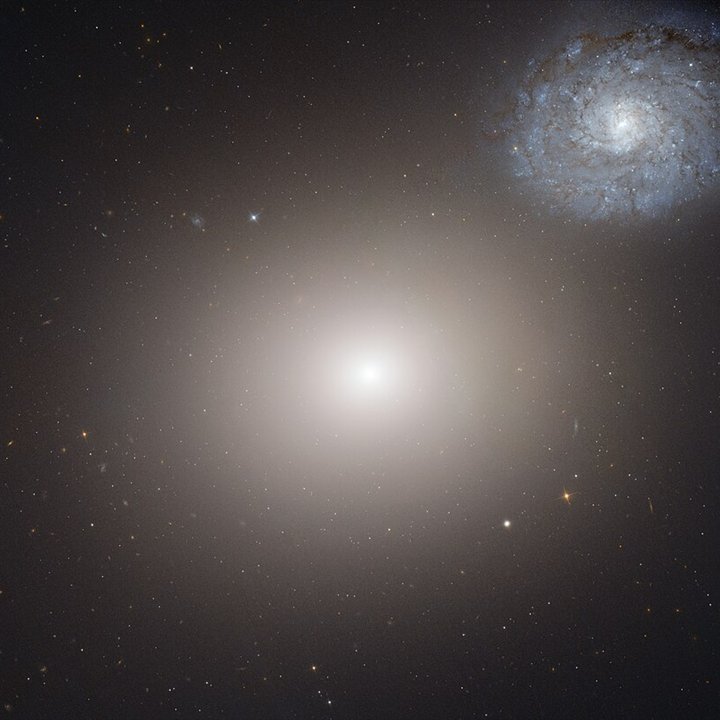
Messier 60 (NGC 4649) is a giant elliptical galaxy in Virgo, about 54 million light-years away, one of the largest and brightest members of the Virgo Cluster. It is classed E2, meaning a mildly flattened smooth ellipse.
Messier 60 (NGC 4649) is a giant elliptical galaxy in Virgo, about 54 million light-years (16.5 ± 0.6 megaparsecs) away, one of the largest and brightest members of the Virgo Cluster. Spanning 7.4 × 6.0 arcminutes (~116,000 light-years or 35.5 kiloparsecs in diameter) with an intrinsic visual magnitude of MV ≈ −22.4, M60 anchors the eastern Virgo subcluster ("Cluster C"). It is classed E2, meaning a mildly flattened smooth ellipse whose apparent axis ratio is b/a ≈ 0.8.
🔭 Galaxy Guide: Find Messier 60 in the CRV Science Deep Sky Galaxy Guide to see its Hubble, JWST or ground-based image, the diagnostic clue used to classify it, and the Elliptical / Lenticular class it belongs to. Test your eye in the Deep Sky Classification game.
A Heavyweight Black Hole
Stellar velocities near the center imply a supermassive black hole of several billion solar masses, comparable to M87's. Elliptical galaxies this high-mass tend to host the biggest black holes, evidence that the two grow together through mergers.
A Spiral Companion and an Ultra-Dense Dwarf
M60 appears next to the spiral NGC 4647, and the pair is cataloged as Arp 116 although they are only grazing each other. A nearby object, M60-UCD1, is one of the densest ultra-compact dwarf galaxies known, possibly the stripped core of a former dwarf galaxy.
Hot Gas and Dark Matter
Chandra images show an extended halo of hot X-ray gas and many X-ray binaries in globular clusters. Because the gas is in hydrostatic balance, its temperature profile lets astronomers weigh the dark matter halo.
Messier 60 at a Glance
| Property | Value |
|---|---|
| Catalog designation | M60 • NGC 4649 |
| Constellation | Virgo |
| Distance | 54 million light-years |
| Hubble / morphological type | E2 |
| Galaxy Guide class | Elliptical & Lenticular Galaxy (E / S0) |
| Peculiar pair | Arp 116 (with NGC 4647) |
| Type | E2 giant elliptical |
| Image credit (Galaxy Guide) | NASA / ESA / Hubble |
Stellar Dynamics, Core-Sérsic Profile & the 4.5 × 10<sup>9</sup> *M*<sub>☉</sub> Black Hole
Anisotropic Velocity Dispersion and Slow-Rotator Architecture
In the Hubble–Sandage morphological sequence, the numerical suffix n of an elliptical galaxy E*n* is defined by its sky-projected ellipticity ε:
n = 10 × ε = 10 × (1 − b/a)
For NGC 4649, an apparent semi-minor to semi-major axis ratio of b/a ≈ 0.81 yields E2. Unlike lenticular (S0) disks such as the Spindle Galaxy, whose flattening is supported by coherent bulk rotation (vrot / σ* > 1), integral-field stellar kinematics from the ATLAS3D survey show that M60 is a triaxial slow rotator (dimensionless spin parameter λR ≈ 0.12 within one effective radius Re ≈ 8.2 kpc) supported primarily by an anisotropic stellar velocity dispersion tensor with a central dispersion of σ0 ≈ 385 ± 10 km·s−1.
Surface photometry obtained with the Hubble Space Telescope (HST) shows that M60 follows a Core-Sérsic profile: an outer envelope described by Sérsic index nS ≈ 5.4 transitions inward across a break radius of rb ≈ 3.2 arcseconds (~260 pc) to a shallow central stellar core. In hierarchical galaxy evolution, such depleted stellar cores form via binary black hole scouring during dissipationless ("dry") mergers of gas-poor progenitor galaxies, where three-body gravitational interactions eject stars on radial orbits from the galactic center.
Schwarzschild Orbit Modeling of the Central Black Hole
By combining HST Space Telescope Imaging Spectrograph (STIS) stellar kinematics with ground-based long-slit and globular cluster velocities out to the halo, Juntai Shen and Karl Gebhardt (2010) constructed axisymmetric three-integral Schwarzschild orbit-superposition models of NGC 4649. Explicitly accounting for the dark matter halo potential to break the mass-anisotropy degeneracy, they measured a central supermassive black hole mass of:
MBH = (4.5 ± 1.0) × 109 M☉
With a Schwarzschild gravitational sphere of influence of radius rinfl = GMBH / σ02 ≈ 130 pc (~1.6 arcseconds), M60 hosts one of the highest-mass black holes in the local Universe, second in the Virgo Cluster only to Messier 87 (6.5 × 10⁹ M☉).
Hydrostatic X-Ray Halo, AGN Cavities & Dark Matter
Deep observations with the Chandra X-ray Observatory and XMM-Newton reveal that M60 is embedded in a hot, thermally emitting corona of ionized plasma (kBT ≈ 0.80–1.1 keV) extending beyond 40 kpc, alongside more than 160 discrete low-mass X-ray binaries (LMXBs) concentrated inside its ~4,000 globular clusters. Because the hot interstellar medium is close to hydrostatic equilibrium within the galaxy's gravitational potential Φ(r), the enclosed gravitating mass profile Mtot(<*r*) is determined directly from the radial gas density ρg(r) and temperature T(r) gradients:
Mtot(<*r*) = −(kB T(r) r) / (G μ mp) × [ (d ln ρg / d ln r) + (d ln T / d ln r) ]
where μ ≈ 0.61 is the mean molecular weight per particle. Hydrostatic X-ray mass modeling by Philip Humphrey and collaborators confirms that dark matter dominates outside ~1.5 Re, reaching an enclosed mass of Mtot(<40 kpc) ≈ 2.2 × 10¹² M☉ (M/LB > 50 M☉/L☉). Within the inner 2 kpc, weak radio jets from the low-luminosity nucleus (LX ≈ 1039 erg·s−1) inflate small pairs of X-ray cavities that balance radiative cooling.
Arp 116 & the Tidal Stripping Origin of M60-UCD1
The NGC 4649 / NGC 4647 Pair (Arp 116)
Projected 2.5 arcminutes (~12 kpc on the sky) northwest of M60's center lies the dusty SAB(rs)c spiral galaxy NGC 4647, forming the pair cataloged by Halton Arp in 1966 as Arp 116 (where the Type Ia supernova SN 1979B appeared in NGC 4649 and SN 2022hrs in NGC 4647). Multi-band HST Advanced Camera for Surveys (ACS) and Wide Field Camera 3 (WFC3) imaging analysed by Roberto De Propris and collaborators shows zero dust-lane silhouette absorption from NGC 4647 against the smooth background starlight of M60, demonstrating that NGC 4647 lies slightly behind M60 along the line of sight and is only beginning a weak grazing tidal encounter.
M60-UCD1: A Stripped Galactic Nucleus
Located 1.8 kpc in projection south of M60's center lies M60-UCD1, an ultracompact dwarf (UCD) galaxy discovered by Jay Strader and colleagues in 2013. Containing a total stellar mass of M* ≈ 2.0 × 10⁸ M☉ compressed within a half-light radius of only rh = 24.2 ± 0.5 parsecs (~80 light-years), M60-UCD1 reaches a central stellar density ~15,000 times higher than the Solar neighborhood and shows supersolar α-element abundances ([Fe/H] ≈ −0.02, [Mg/Fe] ≈ +0.25). Adaptive-optics integral-field spectroscopy with Gemini/NIFS by Anil Seth and collaborators (2014) detected a central supermassive black hole inside M60-UCD1 of mass:
MBH = (2.1−0.7+1.4) × 107 M☉
comprising 15% of the UCD's total stellar mass. Because a 2 × 10⁷ M☉ black hole cannot form inside a globular cluster, M60-UCD1 provides definitive proof that high-mass UCDs are the tidally stripped nuclear star clusters of former ~1010 M☉ nucleated dwarf or low-mass disk galaxies shredded by the gravitational tides of M60.
Observational History
German astronomer Johann Gottfried Koehler discovered both M60 and its neighbor M59 on April 11, 1779, while tracking the comet of 1779 through Virgo. Barnaba Oriani independently recorded M60 one day later, and Charles Messier observed M59, M60, and M58 four days afterward on April 15, 1779, adding all three to his catalog.
References
- Shen, J., & Gebhardt, K. (2010). "The Supermassive Black Hole and Dark Matter Halo of NGC 4649 (M60)." The Astrophysical Journal, 711(1), 484–494. doi:10.1088/0004-637X/711/1/484
- Seth, A. C., van den Bosch, R., Mieske, S., Baumgardt, H., Brok, M. D., Strader, J., et al. (2014). "A supermassive black hole in an ultra-compact dwarf galaxy." Nature, 513(7518), 398–400. doi:10.1038/nature13762
- Strader, J., Seth, A. C., Forbes, D. A., Fabbiano, G., Romanowsky, A. J., Brodie, J. P., et al. (2013). "The Densest Galaxy." The Astrophysical Journal Letters, 775(1), L6. doi:10.1088/2041-8205/775/1/L6
- Humphrey, P. J., Buote, D. A., Brighenti, F., Gebhardt, K., & Mathews, W. G. (2008). "weighing the Black Hole and Dark Matter in the Giant Elliptical Galaxy NGC 4649 with Chandra." The Astrophysical Journal, 683(1), 161–171. doi:10.1086/589712