Spindle Galaxy
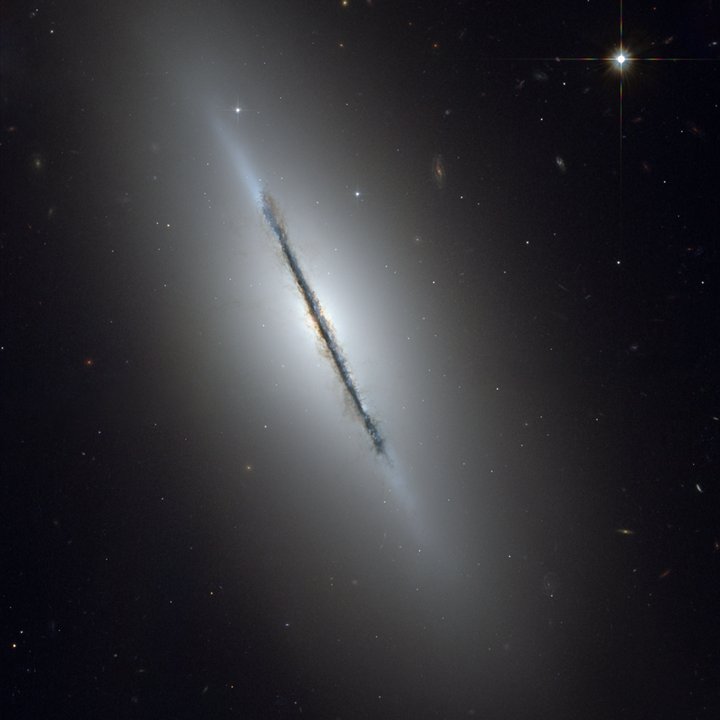
The Spindle Galaxy (NGC 5866) is an edge-on lenticular galaxy in Draco, about 44 million light-years away.
The Spindle Galaxy (NGC 5866) is an edge-on lenticular galaxy in Draco, about 44 million light-years (14.9–15.3 megaparsecs) away. Spanning 4.7 × 1.9 arcminutes (~60,000 light-years) at V ≈ +9.9, it is classified as S03 (or SA0+ edge-on). A razor-thin dust lane bisects its bright disk, giving the spindle shape. The name is also applied to NGC 3115 in Sextans, and NGC 5866 is sometimes identified with Messier 102.
🔭 Galaxy Guide: Find Spindle Galaxy in the CRV Science Deep Sky Galaxy Guide to see its Hubble, JWST or ground-based image, the diagnostic clue used to classify it, and the Elliptical / Lenticular class it belongs to. Test your eye in the Deep Sky Classification game.
Lenticular Galaxies: Why Are S0s Called Transition Objects?
Lenticulars (S0) have a disk and a bulge like spirals but almost no spiral arms or star formation. They are often explained as spirals that lost or used up their gas, perhaps through interactions or ram pressure from a hot cluster medium, leaving a smooth disk of old stars. NGC 5866 keeps a little of its dust, which shows up as the dark lane.
The M102 Puzzle
Messier's catalog entry M102 is probably a duplicate observation of M101, but NGC 5866 has been proposed as the object Pierre Méchain actually described, and many catalogs list the two together. The ambiguity is a reminder of how historical catalogs were built from hasty visual notes.
A Faint Outer Halo
Deep Hubble imaging shows a faint halo around the disk and a dust lane that looks fragmented. Edge-on views like this make it possible to measure the thickness of a galaxy's disk directly, something impossible for face-on systems.
Spindle Galaxy at a Glance
| Property | Value |
|---|---|
| Catalog designation | NGC 5866 • M102 |
| Constellation | Draco |
| Distance | 44 million light-years |
| Hubble / morphological type | S0_3 (Lenticular) |
| Galaxy Guide class | Elliptical & Lenticular Galaxy (E / S0) |
| Type | Lenticular (S0) |
| Alternate designation | Possibly Messier 102 |
| Image credit (Galaxy Guide) | NASA / ESA & The Hubble Heritage Team (STScI/AURA) |
Lenticular (`S0_3`) Architecture & Vertical Disk Structure
Position on the Hubble Tuning-Fork Diagram
In Edwin Hubble's 1936 morphological sequence (The Realm of the Nebulae) and Allan Sandage's 1961 Hubble Atlas of Galaxies, lenticular galaxies (S0) occupy the bifurcation point connecting the smooth, spheroidal sequence of elliptical galaxies (E0–E7) to the barred (SB) and unbarred (SA) spiral branches. Sandage subdivided the S0 class into three sequential stages—S01, S02, and S03—based on increasing dust-absorption content. Whereas S01 galaxies lack any trace of interstellar dust, S03 galaxies such as NGC 5866 contain a well-defined equatorial dust ring or disk embedded within an otherwise smooth, arm-free stellar disk, contrasting with the much larger bulge-to-disk ratio of early-type spirals like the Sombrero Galaxy (M104) or the chaotic merger-driven dust lane of Centaurus A.
Edge-On Photometric Decomposition and Isothermal Scale Heights
Because NGC 5866 is viewed nearly edge-on at an inclination of i = 88.5° ± 0.5° along position angle PA ≈ 128°, the vertical density profile ρ(R, z) of its stellar and gaseous disk can be measured directly without projection degeneracy. For a self-gravitating isothermal stellar sheet in vertical hydrostatic equilibrium, the three-dimensional luminosity density follows C. H. van der Kruit and Searle's (1981) profile:
L(R, z) = L0 exp(−*R* / hR) sech2(z / z0)
where hR ≈ 2.6 kpc is the radial exponential scale length and z0 is the vertical scale height. Multi-filter Hubble Space Telescope (HST) Advanced Camera for Surveys (ACS) imaging in B (F435W), V (F555W), and I (F814W) resolves three nested vertical layers in NGC 5866:
- The Cold Equatorial Dust and Molecular Disk: Confined within a vertical full width at half maximum of FWHMz ≈ 100–140 parsecs (~1.5 arcseconds) and truncated radially at Rtrunc ≈ 3.1 kpc (considerably smaller than the surrounding stellar disk), exhibiting a slight ~2° warp at its northwestern and southeastern tips and vertical filamentary chimneys driven by localized stellar feedback.
- The Thin and Thick Stellar Disks: A high-surface-brightness stellar disk (z0,thin ≈ 350 pc, z0,thick ≈ 1.1 kpc) dominated by K- and M-giant stars with rotational velocity vrot ≈ 250 km·s−1 and central velocity dispersion σ0 ≈ 162 ± 5 km·s−1, making NGC 5866 a prototypical ATLAS3D fast rotator (λR ≈ 0.35).
- The Spheroidal Bulge and Outer Halo: Extending perpendicular to the disk out to z > 15 kpc and hosting NGC ≈ 300–400 globular clusters with a bimodal color distribution, from which surface-brightness fluctuations and globular cluster luminosity functions yield a distance of 14.9–15.3 Mpc.
Interstellar Medium Quenching & Evolutionary Origin of the `S0` State
Molecular Ring Diagnostics and Low Star-Formation Efficiency
Millimeter-wave interferometry and single-dish mapping in 12CO (J = 1 → 0 and J = 2 → 1) combined with Spitzer and Herschel far-infrared dust continuum photometry show that the dark equatorial band of NGC 5866 is actually an edge-on projection of a cold molecular and dust ring containing MH2 ≈ 4.5 × 10⁸ M☉ and MH I ≈ 2.2 × 10⁸ M☉ of atomic gas. Despite this cold gas reservoir, the total integrated star-formation rate derived from ultraviolet and mid-infrared polycyclic aromatic hydrocarbon (PAH) emission is only SFR ≈ 0.05–0.10 M☉·yr−1—roughly an order of magnitude below the standard Kennicutt–Schmidt relation for late-type spiral disks of comparable surface density.
This morphological quenching (analyzed by Martig et al., 2009) arises because the steep gravitational potential of NGC 5866's central bulge and high-mass stellar spheroid elevates the epicyclic frequency κ(R), raising the Toomre stability parameter for the gas disk:
Qgas = (κ cs) / (π G Σgas) > 1
where cs is the effective turbulent sound speed and Σgas is the gas surface density. With Qgas > 1.5 across the ring, large-scale gravitational instabilities and spiral density waves are suppressed, allowing the cold dust lane to persist for billions of years with minimal star formation.
The NGC 5866 Group Environment
Unlike cluster lenticulars stripped by high-speed ram pressure in the Virgo or Coma clusters, NGC 5866 is the dominant galaxy of the NGC 5866 Group (LGG 396), a small, loose group of just three main members including the spirals NGC 5907 (the Knife Edge or Splinter Galaxy) and NGC 5879 at systemic velocity vhel = 672 ± 9 km·s−1. Deep optical imaging by David Martínez-Delgado and collaborators (2010) uncovered a faint stellar tidal stream looping around the halo of NGC 5866, indicating that minor satellite accretion combined with secular internal gas exhaustion transformed NGC 5866 into a lenticular galaxy.
The Historical Mystery of Messier 102
In the published 1781 edition of Charles Messier's catalog (Connaissance des Temps for 1784), entry M102 was printed without equatorial coordinates, accompanied by Pierre Méchain's description of a faint nebula situated "between the stars Omicron (ο) Boötis and Iota (ι) Draconis." On May 6, 1783, however, Méchain wrote a letter to J. Bernoulli in Berlin stating that M102 was an accidental chart-transposition duplicate of M101 (the Pinwheel Galaxy in Ursa Major). Nevertheless, historical astronomers led by Helen Sawyer Hogg (1947) and Owen Gingerich noted that Omicron Boötis was a likely typographical error for Theta (θ) Boötis, and that NGC 5866—independently cataloged by William Herschel on May 5, 1788, as H I.215—is the brightest galaxy matching Méchain's sky description near ι Draconis.
References
- Cantiello, M., Blakeslee, J. P., Raimondo, G., Brocato, E., & Capaccioli, M. (2007). "Surface Brightness Fluctuations and Globular Clusters in the Edge-on S0 Galaxy NGC 5866." The Astrophysical Journal, 668(2), 846–857. doi:10.1086/521390
- Xilouris, E. M., Madden, S. C., Galliano, F., Vigroux, L., & Sauvage, M. (2004). "Mid-infrared observations of the early-type galaxies NGC 5866 and NGC 4486 (M87) with ISOCAM." Astronomy & Astrophysics, 416(1), 41–55. doi:10.1051/0004-6361:20034020
- Li, J.-T., Wang, Q. D., Li, Z., & Chen, Y. (2009). "Chandra Observation of the Edge-on Sombrero-like S0 Galaxy NGC 5866." The Astrophysical Journal, 706(1), 693–704. doi:10.1088/0004-637X/706/1/693
- Martínez-Delgado, D., Gabany, R. J., Crawford, K., Zibetti, S., Majewski, S. R., Rix, H.-W., et al. (2010). "Stellar Tidal Streams in Spiral Galaxies of the Local Volume: A Pilot Survey with Modest Aperture Telescopes." The Astronomical Journal, 140(4), 962–967. doi:10.1088/0004-6256/140/4/962