Sombrero Galaxy
The Sombrero Galaxy (Messier 104, NGC 4594) is a nearly edge-on spiral about 31 million light-years away in Virgo, named for the broad-brimmed hat suggested by its bright bulge and razor-thin dust lane.
The Sombrero Galaxy (Messier 104, NGC 4594) is a nearly edge-on early-type galaxy about 31 million light-years (9.55 ± 0.31 megaparsecs) away on the southern boundary of Virgo, named for the broad-brimmed Mexican hat suggested by its luminous stellar spheroid and razor-thin equatorial dust lane. Spanning 8.7 × 3.5 arcminutes on the sky—corresponding to a linear disk diameter of roughly 80,000 light-years (24.2 kiloparsecs)—and shining at an intrinsic visual magnitude of MV ≈ −21.9 (V ≈ +8.0), its large central bulge makes it an early-type unbarred spiral, classified SA(s)a.
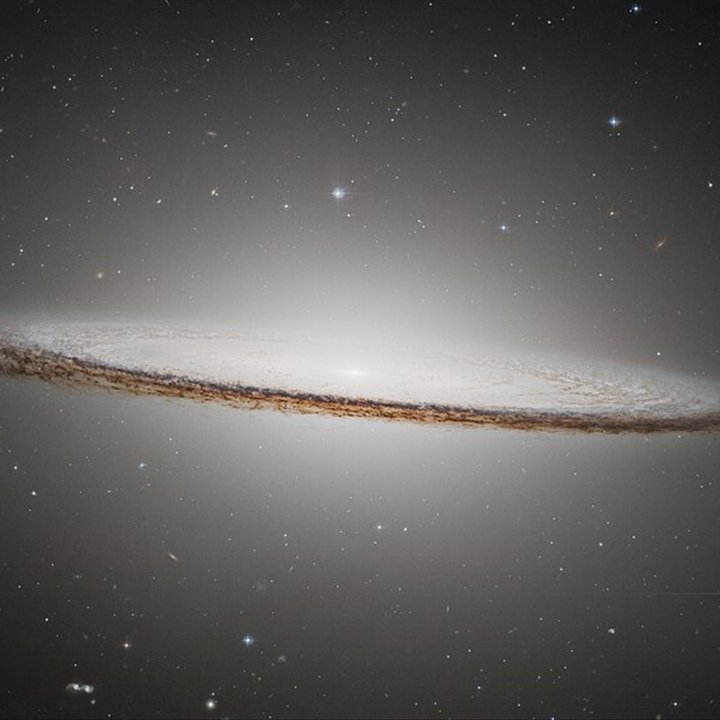
🔭 Galaxy Guide: Find Sombrero Galaxy in the CRV Science Deep Sky Galaxy Guide to see its Hubble, JWST or ground-based image, the diagnostic clue used to classify it, and the Unbarred Spiral class it belongs to. Test your eye in the Deep Sky Classification game.
Anatomy of a Hat: Why Is the Bulge So Dominant?
Unlike late-type spirals, whose light comes mostly from a star-forming disk, M104 is dominated by a prominent bulge of old stars. Seen about 6 degrees from edge-on, the thin disk and its dark dust lane cut across the bulge like a hatband. Infrared images show the dust lane glowing as a faint ring where a little star formation persists.
A Central Giant: Black Hole and Globular Clusters
Stellar motions near the center imply a supermassive black hole of roughly a billion solar masses, among the highest-mass measured in a nearby galaxy. The halo holds a very rich system of globular clusters, on the order of two thousand, many times more than the Milky Way's roughly 150. Such a large cluster population is characteristic of galaxies that have assembled through many mergers.
Historical Significance: The First Big Redshift Hint
In 1912 Vesto Slipher measured the Doppler shift of the Sombrero and found it receding at roughly a thousand kilometers per second, a much higher speed than any known star. Slipher's velocities for "spiral nebulae" were an early clue that these objects were separate galaxies, and part of the evidence later used to show that the universe is expanding.
Sombrero Galaxy at a Glance
| Property | Value |
|---|---|
| Catalog designation | M104 • NGC 4594 |
| Constellation | Virgo |
| Distance | 31 million light-years |
| Hubble / morphological type | SA(s)a |
| Galaxy Guide class | Unbarred Spiral Galaxy (SA) |
| Cataloged | Pierre Méchain, 1781 |
| Notable feature | Prominent dust lane seen nearly edge-on |
| Image credit (Galaxy Guide) | NASA / ESA & The Hubble Heritage Team (STScI/AURA) |
Dual-Component Morphology: Spiral Disk Embedded in an Elliptical Halo
Multi-Component Photometric Decomposition
Although traditionally classified as an SA(s)a early-type spiral due to its tightly wound inner spiral arms and equatorial dust ring viewed at an inclination of i = 84.3° ± 0.2° (just 5.7° from edge-on), two-dimensional infrared surface photometry with the Spitzer Space Telescope at 3.6 μm by Dimitri Gadotti and Rubén Sánchez-Janssen (2012) demonstrates that NGC 4594 is structurally a hybrid system bridging spiral and elliptical galaxies. When decomposed into two components (a bulge and a radial exponential distribution I(R) = I0 exp(−*R*/hR)), the apparent bulge accounts for B/T ≈ 0.77 of the total light; however, including a third outer spheroidal halo component reveals:
- A Classical Central Bulge (~13% of the 3.6 μm stellar light) with effective radius Re ≈ 0.45 kpc and Sérsic index n ≈ 2.0.
- An Embedded Stellar and Dusty Disk (~23% of the light) with radial scale length hR ≈ 3.4 kpc, hosting an inner nuclear disk inside 100 pc.
- An Extended Elliptical Stellar Halo (~64% of the light) following a de Vaucouleurs profile (Re ≈ 3.9 kpc) extending beyond 40 kpc.
This dual architecture indicates that M104 evolved as a giant elliptical or lenticular spheroid—akin to the Spindle Galaxy (NGC 5866)—that subsequently accreted cold gas from its environment several billion years ago, rebuilding a thin, dynamically cold stellar and dust disk inside its pre-existing spheroid.
JWST MIRI and Spitzer Views of the Outer Dust Ring
In the optical Hubble Heritage ACS mosaic, the equatorial dust ring appears as an opaque silhouette (AV ≈ 2–4 mag) absorbing background bulge starlight between radii of R ≈ 7 and 11 kpc. In mid-infrared images acquired with Spitzer (8 and 24 μm) and the James Webb Space Telescope (JWST) MIRI instrument at 7.7, 11.3, and 12.8 μm (released in 2024), the foreground bulge stars fade into a smooth central point source while the dust ring transforms into a clumpy emission torus of polycyclic aromatic hydrocarbons (PAHs) and warm dust (Td ≈ 25–40 K). Combined with VLA 21-cm H I (MH I ≈ 3.2 × 10⁸ M☉) and CO observations, the ring maintains a quiescent star-formation rate of SFR ≈ 0.13 M☉·yr−1.
The 10<sup>9</sup> *M*<sub>☉</sub> Black Hole, Radiatively Inefficient AGN & Globular Halo
Stellar Dynamics of the Central Supermassive Black Hole
The nucleus of M104 was analyzed for a central dark mass concentration via CFHT and HST spectroscopy by John Kormendy and collaborators (1996). Subsequent three-integral axisymmetric Schwarzschild orbit-superposition modeling of HST/STIS kinematics by J. Jardel and Karl Gebhardt (2011) established a central supermassive black hole mass of:
MBH = (6.6 ± 0.4) × 108 to 1.0 × 10⁹ M☉
Consistent with the central velocity dispersion of σ0 ≈ 240–255 km·s−1, the black hole exhibits a gravitational sphere of influence of radius rinfl = GMBH / σ02 ≈ 45–65 pc.
Advection-Dominated Accretion Flow (ADAF) and Globular Cluster Halo
Despite hosting a nearly billion-solar-mass black hole bathed in a hot X-ray halo (kBT ≈ 0.6 keV imaged by Chandra) that supplies a Bondi accretion rate of ṀBondi ≈ 10−3 M☉·yr−1, the LINER nucleus of M104 shines at an X-ray luminosity of only LX, 2–10 keV ≈ 1.5 × 1040 erg·s−1—roughly 10−7 of its Eddington luminosity (LEdd ≈ 1.3 × 1047 erg·s−1). Along with Messier 87, M104 serves as a benchmark for Advection-Dominated Accretion Flows (ADAFs), in which tenuous collisionless plasma advects thermal energy across the event horizon while launching compact parsec-scale VLBI radio jets. Orbiting within the outer spheroidal halo of M104 are NGC = 1,900 ± 200 globular clusters (SN ≈ 2–3), dividing into a metal-poor blue subpopulation ([Fe/H] ≈ −1.4) and a metal-rich red subpopulation ([Fe/H] ≈ −0.5) alongside the ultra-compact dwarf SUCD1 (M* ≈ 3.3 × 10⁷ M☉, rh ≈ 14.7 pc).
Observational History & Vesto Slipher's 1912 Redshift Measurement
Pierre Méchain discovered the Sombrero Galaxy on May 11, 1781; Charles Messier added it by hand as number 104 in his personal copy of the 1781 catalog, William Herschel independently observed its dark dust lane on May 9, 1784 (H I.43), and Camille Flammarion incorporated M104 into the Messier list in 1921. In 1912–1914 at Lowell Observatory, Vesto Melvin Slipher obtained spectrograms of NGC 4594, measuring both spectroscopic rotation (vrot ≈ 330 km·s−1) and a heliocentric recession velocity of vr = +1,100 km·s−1 (modern value +1,024 ± 5 km·s−1), providing foundational evidence for the extragalactic nature of spirals and Edwin Hubble's 1929 velocity–distance law (v = H0 d).
References
- Kormendy, J., Bender, R., Ajhar, E. A., Dressler, A., Faber, S. M., Gebhardt, K., et al. (1996). "Hubble Space Telescope Spectroscopic Evidence for a 1 × 10⁹ M☉ Black Hole in NGC 4594." The Astrophysical Journal Letters, 473(2), L91–L94. doi:10.1086/310399
- Jardel, J. R., Gebhardt, K., Shen, J., Drory, N., Williams, M. J., Bender, R., et al. (2011). "Orbit-based Dynamical Models of the Sombrero Galaxy (NGC 4594)." The Astrophysical Journal, 739(1), 21. doi:10.1088/0004-637X/739/1/21
- Gadotti, D. A., & Sánchez-Janssen, R. (2012). "Surprises in image decomposition of edge-on galaxies: does Sombrero have a (classical) bulge?" Monthly Notices of the Royal Astronomical Society, 423(1), 877–888. doi:10.1111/j.1365-2966.2012.20925.x
- Rhode, K. L., & Zepf, S. E. (2004). "The Globular Cluster System of the Spiral Galaxy NGC 4594 (M104)." The Astronomical Journal, 127(1), 302–316. doi:10.1086/380616