Crab Nebula
The Crab Nebula (Messier 1, NGC 1952) is the remnant of the supernova SN 1054, about 6,500 light-years away in Taurus.
The Crab Nebula (Messier 1, NGC 1952, Taurus A) is the prototypical pulsar wind nebula (plerion) and remnant of the supernova SN 1054, about 6,500 light-years (2.0 ± 0.5 kiloparsecs) away in Taurus. Spanning 6 × 4 arcminutes (~11 × 7.5 light-years) at V ≈ +8.4, the nebula is an expanding cage of filaments enveloping a polarized synchrotron bubble. Chinese and Japanese astronomers recorded the "guest star" on July 4, 1054 CE, bright enough (V ≈ −6) to be seen in daylight for weeks. At its center is a pulsar (PSR B0531+21) rotating about 30 times per second.
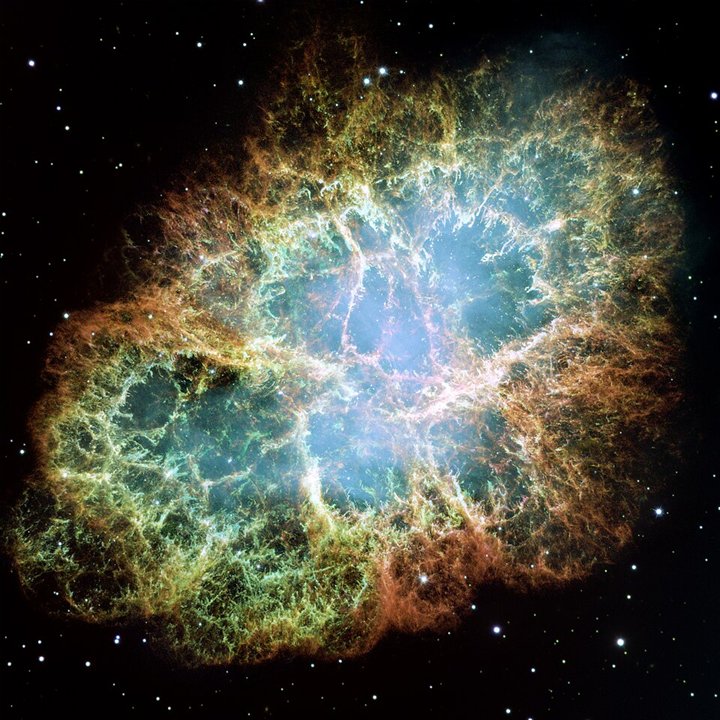
🔭 Galaxy Guide: Find Crab Nebula in the CRV Science Deep Sky Galaxy Guide to see its Hubble, JWST or ground-based image, the diagnostic clue used to classify it, and the Nebula / SNR class it belongs to. Test your eye in the Deep Sky Classification game.
Remnant of a Medieval Supernova
The nebula is an expanding cloud of gas, about 11 light-years across and growing at roughly 1,500 kilometers per second, whose measured expansion points back to the 11th century. John Bevis found it in 1731, and it became the first entry in Messier's catalog of objects that could be mistaken for comets.
The Pulsar and Its Wind
The central neutron star, a pulsar discovered in 1968, spins about 30 times per second and powers the nebula's glowing blue synchrotron emission with a wind of relativistic particles. This makes the Crab a pulsar wind nebula, sometimes called a plerion.
A Calibration Source
The Crab is bright and stable across the electromagnetic spectrum, from radio to gamma rays, so astronomers use it as a standard to calibrate X-ray and gamma-ray instruments. Surprising gamma-ray flares detected since 2010 challenge simple models of how it accelerates particles.
Crab Nebula at a Glance
| Property | Value |
|---|---|
| Catalog designation | M1 • NGC 1952 |
| Constellation | Taurus |
| Distance | 6,500 light-years |
| Hubble / morphological type | Supernova Remnant (Plerion) |
| Galaxy Guide class | Galactic Nebula & Supernova Remnant (Nebula / SNR) |
| Progenitor event | Supernova SN 1054 |
| Central object | Pulsar, about 30 rotations per second |
| Image credit (Galaxy Guide) | NASA / ESA / J. Hester & A. Loll (Arizona State University) |
Rotational Electrodynamics of the Crab Pulsar (`PSR B0531+21`)
Spin-Down Luminosity, Braking Index, and Characteristic Age
In 1968, David Staelin and Edward Reifenstein discovered the radio pulses of PSR B0531+21 (PSR J0534+2200) inside M1 using the Green Bank 300-foot telescope, confirming the 1934 hypothesis of Walter Baade and Fritz Zwicky and the 1967 rotating dipole model of Franco Pacini. The pulsar has a rotation period of P = 33.085 ms (Ω = 2π/P ≈ 190 rad·s−1) and a period derivative of Ṗ = 4.21 × 10⁻¹³ s·s−1. For a neutron star with moment of inertia I ≈ 1045 g·cm2 (M ≈ 1.4 M☉, R ≈ 10–12 km), the loss of rotational kinetic energy—the spin-down luminosity Ėrot—is:
Ėrot = −*I* Ω Ω̇ = 4π2 I Ṗ / P3 ≈ 4.6 × 1038 erg·s−1 (≈ 1.2 × 10⁵ L☉)
This power supplies the bolometric non-thermal luminosity of the Crab Nebula (~1.3 × 1038 erg·s−1), balancing the short synchrotron cooling lifetime (tsync ∝ B−3/2 ν−1/2) of its X-ray electrons. Magnetic dipole radiation yields a surface field of Bsurf ≈ 3.2 × 10¹⁹ (P Ṗ)1/2 ≈ 3.8 × 10¹² G. While pure dipole braking predicts a braking index n = Ω Ω̈ / Ω̇2 = 3 and τc = P / (2*Ṗ*) ≈ 1,240 yr, timing measures n = 2.51 ± 0.01, matching the 972-year interval since 1054 CE.
Magnetohydrodynamics of the Pulsar Wind Nebula (Plerion)
The Kennel–Coroniti Relativistic Wind Termination Shock
In the magnetohydrodynamic (MHD) framework developed by Martin Rees and John Gunn (1974) and formalized by Charles Kennel and Ferdinand Coroniti (1984), the pulsar magnetosphere launches a cold, ultrarelativistic outflow of electron–positron pairs (e−/e+) with bulk Lorentz factor Γw ≈ 104–106. To match the non-relativistic expansion velocity of the outer nebular cage (vexp ≈ 1,500 km·s−1), the magnetization ratio σM of Poynting electromagnetic flux to wind kinetic energy flux must drop from σM >> 1 near the light cylinder (RLC = c / Ω ≈ 1,580 km) to σM ≈ 0.003–0.01 at the wind termination shock located at radius RTS ≈ 0.10–0.14 pc (~10–14 arcseconds) from the pulsar, where the wind ram pressure balances the internal nebular pressure:
RTS = [ Ėrot / (4π c Pneb) ]1/2
Coordinated sub-arcsecond imaging with the Chandra X-ray Observatory and the Hubble Space Telescope (HST) by Jeff Hester and colleagues resolved this termination shock into an inclined equatorial X-ray torus of wisps moving outward at ~0.5*c*, flanked by curved polar jets escaping along the pulsar's spin axis.
Broadband Synchrotron / Inverse-Compton Spectrum and GeV Gamma-Ray Flares
Downstream of the termination shock, relativistic e−/e+ pairs gyrating in the nebular magnetic field (B ≈ 150–300 μG) emit polarized synchrotron radiation (predicted by Iosif Shklovsky in 1953 and confirmed via optical linear polarization by Viktor Dombrovsky and Jan Oort) spanning from radio up to ~100 MeV gamma rays, while synchrotron self-Compton (SSC) scattering of nebular photons generates TeV–PeV gamma-ray emission extending up to 1.1 PeV (detected by the Whipple Cherenkov telescope in 1989 and LHAASO in 2021). Beginning in September 2010, the AGILE and Fermi-LAT satellites discovered day-scale short-timescale gamma-ray flares above 100 MeV in which the unpulsed synchrotron flux increased by factors of 5 to 30—requiring relativistic magnetic reconnection that accelerates electrons above the classical radiation-reaction (synchrotron burnoff) energy limit of Esync,max ≈ 160 MeV.
Filamentary Cage, Rayleigh–Taylor Fingers & Electron-Capture Supernova Origin
Photoionized Thermal Filaments and JWST 58Ni/56Fe Diagnostics
Surrounding the diffuse synchrotron bubble is a three-dimensional cage of thermal filaments (Te ≈ 11,000–15,000 K, ne ≈ 1,000 cm−3) glowing in optical forbidden lines of [O III] (495.9/500.7 nm, green), [N II] + Hα (red), and [S II] (671.6/673.1 nm). As analyzed by Hester (2008), these filaments are sculpted by the magnetic Rayleigh–Taylor instability: the low-density, high-pressure relativistic pulsar wind bubble accelerates the denser swept-up supernova ejecta outward (~1.8 km·s−1·yr−1 acceleration measured by proper-motion convergence prior to 1054 CE), driving finger-like Rayleigh–Taylor plumes inward into the synchrotron cavity.
In 2023–2024, James Webb Space Telescope (JWST) NIRCam and MIRI observations by Tea Temim and collaborators mapped both the warm dust filaments (0.03–0.05 M☉ of carbon/silicate grains) and the near-infrared [Fe II] (1.644 μm) and [Ni II] emission across the Crab cage. Unlike high-mass iron-core-collapse remnants such as Cassiopeia A, the Crab Nebula has a low total ejecta mass (Mej ≈ 4.6 ± 1.8 M☉), a low outward motion translational kinetic energy (Ekin ≈ 1050 erg, ten times below a canonical 1051 erg supernova), high helium enrichment, and minimal oxygen/carbon burning products. While proposed as an electron-capture supernova of an 8–10 M☉ super-asymptotic giant branch star with a degenerate O–Ne–Mg core—born in a star-forming complex akin to the Orion Nebula—the elevated Ni/Fe abundance ratio measured by JWST supports either an electron-capture event or a low-energy iron-core collapse of a ~9–11 M☉ progenitor.
Observational History
After Chinese (Songshi), Japanese (Meigetsuki), and Arab chronicles documented the 1054 CE guest star near ζ Tauri, English astronomer John Bevis observed the remnant telescopically in 1731. Independently rediscovered by Charles Messier on August 28, 1758, while searching for Halley's Comet, it became M1, and William Parsons (3rd Earl of Rosse) coined the name "Crab Nebula" after sketching its filaments at Birr Castle in 1844.
References
- Hester, J. J. (2008). "The Crab Nebula: An Astrophysical Chimera." Annual Review of Astronomy and Astrophysics, 46, 127–155. doi:10.1146/annurev.astro.45.051806.110608
- Kennel, C. F., & Coroniti, F. V. (1984). "Confinement of the Crab pulsar's wind by its supernova remnant." The Astrophysical Journal, 283, 694–709. doi:10.1086/162356
- Abdo, A. A., Ackermann, M., Ajello, M., Allafort, A., Baldini, L., Ballet, J., et al. (2011). "Gamma-Ray Flares from the Crab Nebula." Science, 331(6018), 739–742. doi:10.1126/science.1199705
- Temim, T., Laming, J. M., Kavanagh, P. J., Smith, N., Slane, P., Blair, W. P., et al. (2024). "Dissecting the Crab Nebula with JWST: Pulsar Wind, Dusty Filaments, and Ni/Fe Abundance Constraints on the Explosion Mechanism." The Astrophysical Journal Letters, 968(2), L18. doi:10.3847/2041-8213/ad49a7