Orion Nebula
The Orion Nebula (Messier 42, NGC 1976) is a diffuse H II region in Orion's sword, about 1,344 light-years away, the nearest high-mass star-forming region to Earth and visible to the naked eye as a fuzzy star.
The Orion Nebula (Messier 42, NGC 1976) is a diffuse H II emission nebula located south of Orion's Belt in the asterism of Orion's Sword. Situated at a trigonometric parallax distance of 412 ± 6 parsecs (approximately 1,344 light-years) from Earth, M42 is the closest region of high-mass star formation to the Solar System and spans roughly 24 light-years (7.4 parsecs) across the sky (~65 × 60 arcminutes). With an integrated apparent visual magnitude of V ≈ +4.0, it is visible to the unaided eye as the middle "star" (θ Orionis) of Orion's Sword and serves as a benchmark astrophysical laboratory for young stellar objects, photoionization dynamics, and circumstellar disk evolution.
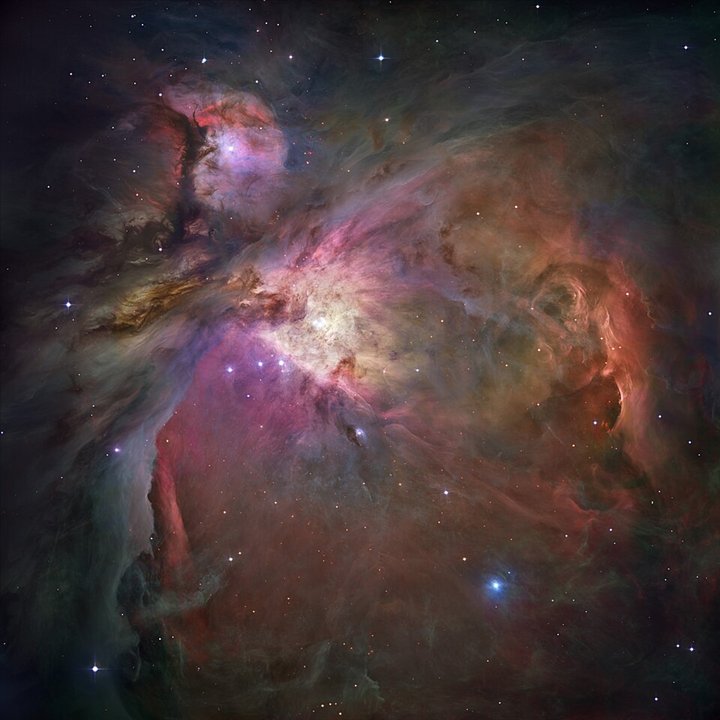
🔭 Galaxy Guide: Find Orion Nebula in the CRV Science Deep Sky Galaxy Guide to see its Hubble, JWST or ground-based image, the diagnostic clue used to classify it, and the Nebula / SNR class it belongs to. Test your eye in the Deep Sky Classification game.
A Stellar Nursery: What Is the Trapezium?
At the core of M42 lies the Trapezium cluster (θ1 Orionis), a compact grouping of luminous O- and B-type stars embedded within the broader Orion Nebula Cluster (ONC) of roughly 2,000 to 2,800 pre-main-sequence stars formed within the past 1 to 2 million years. Ultraviolet radiation (photon energies *h*ν > 13.6 eV) emitted primarily by the hottest member, θ1 Orionis C, photoionizes the surrounding atomic hydrogen and helium gas, while fast stellar winds carve a low-density cavity into the parent molecular cloud.
Protoplanetary Disks
High-angular-resolution observations with the Hubble Space Telescope (HST) in the 1990s—and subsequently with ALMA and the James Webb Space Telescope (JWST)—resolved more than 150 young low-mass stars surrounded by flattened circumstellar dust and gas disks, designated proplyds (ionized protoplanetary disks). Seen either as dark opaque silhouettes against the bright nebular background or as tear-shaped cometary ionization fronts facing θ1 Orionis C, proplyds provided direct visual confirmation that planet-forming disks are common around newborn stars.
History of Observation
French astronomer Nicolas-Claude Fabri de Peiresc recorded the first telescopic observation of the Orion Nebula in 1610, followed by Christiaan Huygens, who published the first sketch of the central Huygens Region in 1659. Charles Messier cataloged the main nebula as M42 (and its northern wing, NGC 1982, as M43) in 1769. In 1865, William Huggins used visual spectroscopy to resolve M42's green emission lines, proving it is a gas cloud, and in 1880 Henry Draper obtained the first astrophotograph of M42. In 2007, Karl Menten and colleagues used VLBA trigonometric parallaxes of non-thermal radio stars in the ONC to establish its distance to within 1.5%.
Orion Nebula at a Glance
| Property | Value |
|---|---|
| Catalog designation | M42 • NGC 1976 |
| Constellation | Orion |
| Distance | 1,344 light-years |
| Hubble / morphological type | Diffuse H II Emission Nebula |
| Galaxy Guide class | Galactic Nebula & Supernova Remnant (Nebula / SNR) |
| Region type | Emission (H II) nebula |
| Diameter | About 24 light-years |
| Image credit (Galaxy Guide) | NASA / ESA / M. Robberto (STScI/ESA) & Hubble Space Telescope Orion Treasury Project |
Astrophysical Architecture of the Orion Molecular Cloud Complex
Blister H II Geometry and Champagne-Flow Dynamics
Three-dimensional kinematic mapping by C. Robert O'Dell and collaborators demonstrates that the visible Orion Nebula is a thin, hemispherical blister H II region (~0.1 to 0.3 pc thick) sculpted into the earthward-facing surface of Orion Molecular Cloud 1 (OMC-1) within the Orion A Giant Molecular Cloud (~2 × 10⁵ M☉ of cold H2, CO, and dust). Because the Trapezium stars formed only ~0.2 to 0.3 pc behind the front boundary of OMC-1, their expanding ionization front ruptured through the near face of the cloud while remaining confined at the rear by dense molecular gas (nH2 ≈ 105–106 cm−3, T ≈ 20–50 K). Photoionized plasma heated to Te ≈ 8,500–10,000 K accelerates outward away from the background wall in a supersonic champagne flow at 10 to 25 km·s−1, blowing out the Extended Orion Nebula cavity and sweeping up the foreground Neutral Veil.
The Orion Bar Photodissociation Region (PDR)
Roughly 2 arcminutes (~0.24 pc) southeast of the Trapezium, the concave ionization blister curls nearly edge-on to our line of sight, forming the linear escarpment known as the Orion Bar. Across this boundary, gas transitions over <0.05 pc from ionized H II plasma (ne ≈ 3,000–5,000 cm−3) to neutral atomic and molecular gas, creating the prototypical Photodissociation Region (PDR). While Lyman-continuum photons (*h*ν > 13.6 eV) stop at the ionization front, far-ultraviolet (FUV) photons (6–13.6 eV) penetrate into the Orion Bar, exciting polycyclic aromatic hydrocarbons (PAHs at 3.3–11.3 μm), dissociating H2, and ionizing carbon ([C II] 158 μm cooling) ahead of the shielded molecular core.
The Trapezium Cluster & Photoionization Physics
θ1 Orionis C and Strömgren Ionization Equilibrium
Over 80% of the Lyman-continuum ionizing flux in M42 is supplied by θ1 Orionis C, an oblique magnetic rotator binary whose primary is a main-sequence O6Vp star (M ≈ 33 M☉, Teff ≈ 39,000 K, L ≈ 2.0 × 10⁵ L☉) emitting Q(H0) ≈ 7 × 1048 ionizing photons·s−1 and driving a fast stellar wind (v∞ ≈ 2,500 km·s−1) that shocks a 2 × 10⁶ K X-ray plasma bubble. Within the H II region, hydrogen photoionization balances radiative recombination according to the Strömgren equilibrium relation:
Q(H0) = (4/3) π RS3 ne np αB(Te)
where αB(Te) ≈ 2.6 × 10⁻¹³ cm3·s−1 (at 104 K) is the Case B recombination coefficient.
Optical and Infrared Nebular Emission Diagnostics
The optical emission spectrum of M42 combines two radiative mechanisms:
- Permitted Recombination Lines: Free electrons captured into excited proton levels (n ≥ 3) cascade downward, emitting the optical Balmer series—red Hα (656.3 nm), cyan-blue Hβ (486.1 nm), and violet Hγ (434.0 nm)—alongside He I 587.6 nm.
- Collisionally Excited Forbidden Lines: Thermal electrons excite trace metal ions into metastable levels that decay radiatively at low nebular densities (ne ≈ 103–104 cm−3). Doubly ionized oxygen emits the green [O III] doublet at 495.9 and 500.7 nm in the inner core, while [N II] (654.8/658.3 nm) and [S II] (671.6/673.1 nm) trace lower-ionization fronts.
Protoplanetary Disks (Proplyds) & Star Formation Evolution
The Orion Nebula Cluster contains ~2,000 young low-mass T Tauri stars and brown dwarfs formed when magnetized cores within OMC-1 exceeded their Jeans mass (MJ ∝ (T / μ)3/2 ρ−1/2) and collapsed into star-disk systems. As analyzed by John Bally, C. Robert O'Dell, and Mark McCaughrean (2000), disks orbiting within 0.1 to 0.5 pc of θ1 Orionis C are heated by external FUV/EUV radiation, driving a thermal photoevaporative wind (10−7 to 10−6 M☉·yr−1) that sculpts a tear-shaped proplyd ionization front and a stationary wind-wind bow shock. Simultaneously, accreting protostars launch bipolar jets that excite Herbig-Haro (HH) objects (HH 202, HH 529), while 0.1 pc northwest of the Trapezium inside OMC-1 lies the Becklin-Neugebauer / Kleinmann-Low (BN/KL) outflow, where a dynamical multi-star encounter ~500 years ago launched supersonic H2 shock fingers at >300 km·s−1.
Galactic Context & Future Evolution
On a Galactic scale, the Orion complex resides in the local Orion Spur and anchors the 2.7-kiloparsec Radcliffe Wave (and Gould Belt). Over 107 years, radiation, winds, and supernovae from θ1 Orionis C and its OB companions—producing supernova remnants akin to the Crab Nebula, while lower-mass stars eventually shed planetary nebulae like the Ring Nebula—will disperse OMC-1's gas, leaving an open cluster resembling the Pleiades.
References
- O'Dell, C. R. (2001). "The Orion Nebula and its associated population." Annual Review of Astronomy and Astrophysics, 39, 99–136. doi:10.1146/annurev.astro.39.1.99
- Bally, J., O'Dell, C. R., & McCaughrean, M. J. (2000). "Disks, microjets, windblown bubbles, and outflows in the Orion Nebula." The Astronomical Journal, 119(6), 2919–2959. doi:10.1086/301385
- Menten, K. M., Reid, M. J., Forbrich, J., & Brunthaler, A. (2007). "The distance to the Orion Nebula." Astronomy & Astrophysics, 474(2), 515–520. doi:10.1051/0004-6361:20078247
- Draine, B. T. (2011). Physics of the Interstellar and Intergalactic Medium. Princeton University Press. doi:10.1515/9781400839087