Cat's Eye Nebula
The Cat's Eye Nebula (NGC 6543, Caldwell 6) is a planetary nebula in Draco about 3,300 light-years away, among the most complex known.
The Cat's Eye Nebula (NGC 6543, Caldwell 6, PN G096.4+29.9) is a planetary nebula in Draco about 3,300 light-years (1.0–1.07 kiloparsecs) away, among the most complex known. Its bright inner core spans 25 × 17 arcseconds (~0.3 light-years) at V ≈ +8.1, while a faint concentric outer halo extends over 5.8 arcminutes (~5.5 light-years). William Herschel found it on February 15, 1786 (H IV.37), and on August 29, 1864, William Huggins observed its spectrum and showed that nebulae of this type are glowing gas rather than unresolved stars.
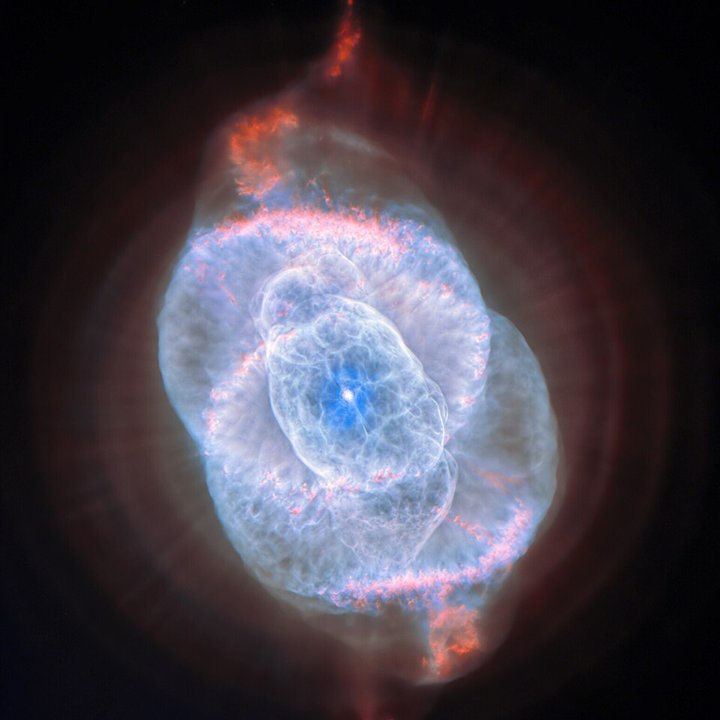
🔭 Galaxy Guide: Find Cat's Eye Nebula in the CRV Science Deep Sky Galaxy Guide to see its Hubble, JWST or ground-based image, the diagnostic clue used to classify it, and the Nebula / SNR class it belongs to. Test your eye in the Deep Sky Classification game.
The 1864 Spectrum: Gas, Not Stars
Huggins saw bright emission lines instead of the continuous spectrum of a star, proving the nebula was a glowing gas cloud. The strongest line, which he could not identify, was attributed to a hypothetical element named nebulium until Ira Bowen showed in 1927 that it came from doubly ionized oxygen.
Concentric Shells and Jets
Hubble's image reveals a series of concentric rings, interpreted as shells ejected in pulses roughly every 1,500 years, along with knots and jets. The pattern may result from a binary companion or from magnetic cycles in the dying star.
Hot Gas and X-Rays
Chandra detected a bubble of very hot gas inside the nebula, created when the fast wind from the central star slams into earlier ejected material. The central star is a hot, luminous object that will become a white dwarf.
Cat's Eye Nebula at a Glance
| Property | Value |
|---|---|
| Catalog designation | NGC 6543 • Caldwell 6 |
| Constellation | Draco |
| Distance | 3,300 light-years |
| Hubble / morphological type | Complex Planetary Nebula |
| Galaxy Guide class | Galactic Nebula & Supernova Remnant (Nebula / SNR) |
| Discoverer | William Herschel, 1786 |
| Ring spacing | Roughly 1,500 years between shells |
| Image credit (Galaxy Guide) | NASA / ESA / HEIC & The Hubble Heritage Team (STScI/AURA) |
Historical Spectroscopy: William Huggins & the "Nebulium" Solution
On the evening of August 29, 1864, at his private Tulse Hill Observatory in London, English pioneer Sir William Huggins pointed an 8-inch Clark refractor equipped with a two-prism visual spectroscope at NGC 6543—making it the very first planetary nebula ever examined spectroscopically. Expecting to see a continuous stellar spectrum crossed by Fraunhofer absorption lines (which would indicate an unresolved cluster of stars), Huggins was astonished to see all the light concentrated into a single monochromatic blue-green emission line near 500.7 nm, flanked by a fainter second blue-green line (495.9 nm) and hydrogen Hβ (486.1 nm). This observation proved beyond doubt that genuine gaseous nebulae exist in interstellar space.
Because the dominant 495.9 nm and 500.7 nm green lines matched no terrestrial laboratory element, Margaret Lindsay Huggins and contemporary spectroscopists attributed them to a hypothetical light gas named "nebulium." The mystery stood for 63 years until 1927, when Caltech physicist Ira Sprague Bowen demonstrated that "nebulium" is ordinary doubly ionized oxygen ([O III]). Under terrestrial vacuum pressures, ions excited by electron collisions to the metastable 1D2 level of the 2*p*2 ground configuration are collisionally de-excited long before their magnetic-dipole and electric-quadrupole radiative transition probabilities (A21 ≈ 0.02 s−1) allow photon emission. In the low particle density of NGC 6543 (ne ≈ 5,000 cm−3), however, mean collision times exceed several minutes, allowing these collisionally excited forbidden lines ([O III] 495.9/500.7 nm, [N II] 654.8/658.3 nm, and [S II] 671.6/673.1 nm) to serve as the primary radiative thermostat cooling the photoionized gas to Te ≈ 8,000–10,500 K.
Interacting Stellar Winds, Concentric AGB Rings & Precessing Jets
The Kwok–Purton–FitzGerald (GISW) Hydrodynamic Framework
The nested structure of NGC 6543—more intricate than canonical bipolar barrels such as the Ring Nebula (M57)—arises from the Generalized Interacting Stellar Winds (GISW) mechanism formulated by Sun Kwok, C. R. Purton, and P. M. FitzGerald (1978) and extended to nonspherical geometries by Bruce Balick (1987). When an intermediate-mass star (Minit ≈ 3–5 M☉, originally formed inside a giant H II region like the Orion Nebula) ascends the asymptotic giant branch (AGB), it sheds its convective envelope via a slow, dense, radiation-pressure-driven AGB superwind (vAGB ≈ 10–15 km·s−1, mass-loss rate Ṁ ≈ 10−4 M☉·yr−1).
Once the hot degenerate carbon-oxygen core is exposed, the central star (HD 164963, spectral type O7 + [WR] Wolf–Rayet-type central star, Teff ≈ 63,000–80,000 K, L ≈ 5,000 L☉, current mass M* ≈ 0.6 M☉) launches a tenuous, supersonic fast post-AGB wind driven by ultraviolet metal line blanketing at terminal velocity vfast ≈ 1,900 km·s−1 (Ṁfast ≈ 10−7 M☉·yr−1). This fast wind rams into the interior of the slow AGB envelope, snowplowing the inner gas into the high-density bright elliptical inner rim (R ≈ 0.06 pc, kinematic age 1,039 ± 260 years measured via multi-epoch HST expansion parallax by Reed et al., 1999, yielding an expansion distance of D = 1,001 ± 269 pc alongside Gaia DR3 parallax D = 1.07 ± 0.04 kpc).
Eleven Concentric Dust Shells and Point-Symmetric FLIERs
Outside the bright inner core, deep Hubble Space Telescope (HST) ACS imaging by Bruce Balick and collaborators (2004) revealed 11 concentric spherical shells (rings) of dust-scattered starlight and Hα emission spanning radii of 15 to 60 arcseconds. Each shell contains ~10−2 M☉ of gas and 10−4 M☉ of silicate dust, separated by a uniform spatial interval corresponding to a quasi-periodic ejection cadence of ~1,500 years over the final 15,000 years of the AGB phase. Because asymptotic giant branch helium-shell thermal pulses occur once every 104–105 years, the 1,500-year spacing is attributed either to solar-like magnetic activity cycles regulating dust-grain nucleation in the AGB wind or to orbital periastron passages of a wide binary companion.
Superimposed on these spherical shells are two orthogonal, point-symmetric elliptical lobes, a pair of precessing collimated bipolar jets, and high-velocity low-ionization polar knots designated FLIERs (Fast Low-Ionization Emission Regions) glowing in [N II] λ6584 and moving outward at ±40 to 55 km·s−1. In 2022, Clairmont and collaborators constructed a three-dimensional morpho-kinematic reconstruction using San Pedro Mártir echelle spectroscopy and HST imagery, demonstrating that a precessing dense equatorial ring and twin precessing jets launched by a post-common-envelope binary system carved the point-symmetric "cat's eye" interior within the past millennium.
Chandra X-Ray Bubble & the Abundance Discrepancy Factor (ADF)
Pointed observations with the Chandra X-ray Observatory by You-Hua Chu and Martin Guerrero (2001) detected diffuse soft X-ray emission (E = 0.3–1.0 keV) filling the interior cavity of NGC 6543's inner rim, alongside a central point source at HD 164963. Although an unmitigated adiabatic reverse shock of a 1,900 km·s−1 wind predicts a post-shock temperature of Tshock = (3/16) (mp vfast2 / kB) ≈ 8 × 10⁷ K, the observed X-ray plasma temperature is TX ≈ 1.7 × 10⁶ K, proving that heat conduction and hydrodynamic mixing across the contact discontinuity cool the hot wind bubble. Ultraviolet and optical spectroscopy of NGC 6543 shows that C, N, O, and Ne ionic abundances derived from faint optical recombination lines (ORLs) exceed those derived from collisionally excited forbidden lines (CELs) by an Abundance Discrepancy Factor (ADF) of ~3 to 5, indicating cold (Te ≈ 1,000–2,000 K), hydrogen-deficient metal-rich inclusions embedded within the main 9,000 K photoionized shell.
References
- Balick, B., & Frank, A. (2002). "Shapes and Shaping of Planetary Nebulae." Annual Review of Astronomy and Astrophysics, 40, 439–486. doi:10.1146/annurev.astro.40.060401.093849
- Reed, D. S., Balick, B., Hajian, A. R., Klayton, T. L., Giovanardi, S., Casertano, S., Panagia, N., & Terzian, Y. (1999). "Hubble Space Telescope Measurements of the Expansion of NGC 6543: Parallax Distance and Nebular Evolution." The Astronomical Journal, 118(5), 2430–2441. doi:10.1086/301091
- Chu, Y.-H., Guerrero, M. A., Gruendl, R. A., Williams, R. M., & Kaler, J. B. (2001). "Chandra Reveals the X-Ray Glint in the Cat's Eye." The Astrophysical Journal Letters, 553(1), L69–L72. doi:10.1086/320495
- Clairmont, R., Steffen, W., & Koning, N. (2022). "Morpho-kinematic modelling of the point-symmetric Cat's Eye, NGC 6543: ring-like remnants of a precessing jet." Monthly Notices of the Royal Astronomical Society, 516(2), 2711–2717. doi:10.1093/mnras/stac2375