Ring Nebula
The Ring Nebula (Messier 57, NGC 6720) is a planetary nebula in Lyra, about 2,600 light-years away, a glowing shell of gas shed by a dying Sun-like star. Antoine Darquier discovered it in 1779, and a small telescope reveals the famous smoke-ring shape.
The Ring Nebula (Messier 57, NGC 6720, PN G063.1+13.9) is a bipolar planetary nebula in the northern constellation Lyra, located south of Vega between the stars Beta (β) and Gamma (γ) Lyrae at a Gaia trigonometric parallax distance of 2,570 ± 80 light-years (787 ± 25 parsecs). Its bright inner torus spans 86 × 62 arcseconds (~1.1 × 0.8 light-years or 0.33 × 0.24 parsecs) at an integrated apparent visual magnitude of V ≈ +8.8, surrounded by a multi-layered outer molecular halo extending 3.8 arcminutes (~2.8 light-years) across. French astronomer Charles Messier and Antoine Darquier de Pellepoix independently discovered it in January–February 1779 while tracking the comet Bode (C/1779 A1), and a small telescope reveals the famous smoke-ring shape.
🔭 Galaxy Guide: Find Ring Nebula in the CRV Science Deep Sky Galaxy Guide to see its Hubble, JWST or ground-based image, the diagnostic clue used to classify it, and the Nebula / SNR class it belongs to. Test your eye in the Deep Sky Classification game.
Not a Ring: A Barrel Seen End-On?
The visible ring is thought to be the bright rim of a roughly barrel-shaped or bipolar shell viewed nearly along its axis. Fainter material extends beyond the ring. The shell is about one light-year across and expanding at roughly 20 to 30 kilometers per second.
The Star at the Center
The faint blue star at the center is a hot white dwarf, the exposed core of the star that ejected the shell. Its surface temperature exceeds 100,000 K, and its ultraviolet radiation makes the gas glow. The shell is only a few thousand years old and will fade over tens of thousands of years.
A Preview of the Sun's Fate
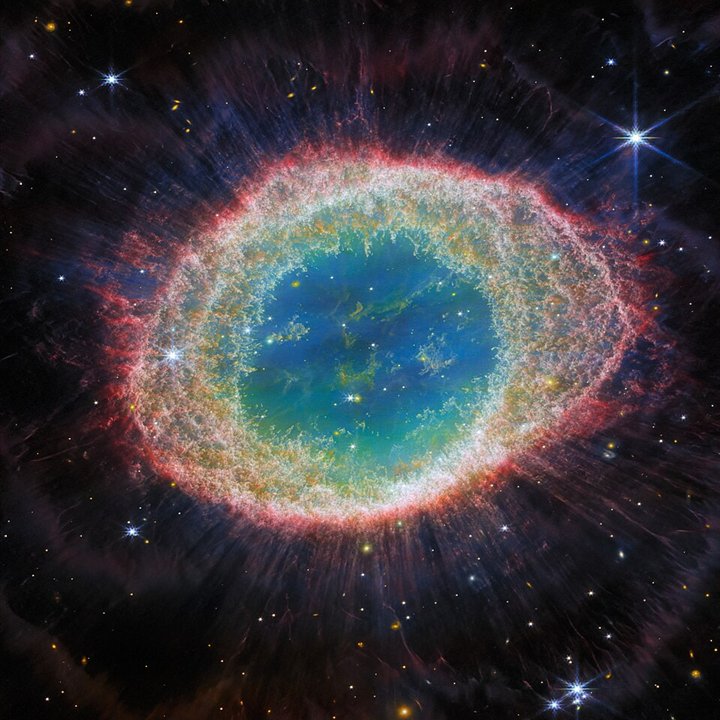
Stars below about eight solar masses end their lives this way, so the Sun will form a similar nebula in several billion years. Webb's 2023 image showed intricate filaments and concentric arcs, details used to study the mass loss history.
Ring Nebula at a Glance
| Property | Value |
|---|---|
| Catalog designation | M57 • NGC 6720 |
| Constellation | Lyra |
| Distance | 2,570 light-years |
| Hubble / morphological type | Bipolar Planetary Nebula |
| Galaxy Guide class | Galactic Nebula & Supernova Remnant (Nebula / SNR) |
| Central star | White dwarf |
| Discoverer | Antoine Darquier, 1779 |
| Image credit (Galaxy Guide) | NASA / ESA / C.R. O'Dell (Vanderbilt University) |
Three-Dimensional Triaxial Barrel Geometry & Ionization Stratification
Pole-On Projection of an Equatorial Torus and Bipolar Lobes
Although visual observers since William Herschel (who coined the term "planetary nebula" in the 1780s) interpreted M57 as either a hollow spherical shell or a flat planar ring, spatially resolved long-slit echelle spectroscopy and Hubble Space Telescope (HST) Wide Field Camera 3 (WFC3) tomography by C. Robert O'Dell and collaborators (2013) proved that the Ring Nebula is a triaxial prolate ellipsoid (open-ended barrel) with a dense equatorial torus viewed within ~25°–30° of its polar symmetry axis.
When integrated along the line of sight, the high emission measure (∫ ne2 d*s*, with ne ≈ 500–2,000 cm−3) through the walls of the dense equatorial waist produces the luminous elliptical ring, whereas the thin polar caps escaping along our line of sight at ±40 to 50 km·s−1 project across the interior hole of the ring. Because the equatorial waist expands radially at vexp ≈ 20–30 km·s−1, its kinematic expansion age is τkin ≈ 4,000 to 6,000 years, placing M57 in a more evolved, radiation-bounded to density-bounded evolutionary stage than the younger Cat's Eye Nebula (NGC 6543).
Classical Ionization Stratification (He II → [O III] → [N II])
M57 is the textbook astrophysical standard for photoionization stratification driven by a short-wavelength ionizing source. Because higher-ionization ions have higher ionization potentials (χ) and larger photoabsorption cross sections near threshold, ultraviolet photons from the central white dwarf are progressively softened as they propagate outward through the equatorial torus:
- The Innermost Cavity (
r< 25 arcseconds): Photons with energies *h*ν > 54.4 eV (the He+ ionization threshold) are absorbed close to the central star, creating the central blue glow of He II λ468.6 nm recombination emission and high-excitation [Ne V] lines. - The Main Green Body (
r≈ 25–38 arcseconds): Photons between 35.1 eV and 54.4 eV doubly ionize oxygen and neon, exciting the turquoise-green forbidden doublets of [O III] (495.9 and 500.7 nm) and [Ne III] (386.9 nm) alongside Balmer Hβ (486.1 nm) at an electron temperature of Te ≈ 10,000–12,000 K. - The Outer Crimson Rim (
r≈ 38–45 arcseconds): Near the hydrogen ionization front (*h*ν = 13.6–14.5 eV), only singly ionized and neutral species survive, producing a sharp red-orange rim of [N II] (654.8/658.3 nm), Hα (656.3 nm), [S II] (671.6/673.1 nm), and neutral [O I] (630.0 nm).
JWST NIRCam & MIRI Anatomy: 20,000 `H2` Globules & Concentric Arcs
High-Resolution James Webb Space Telescope Imaging (2023)
In August 2023, Roger Wesson, Albert Zijlstra, Mike Barlow, and the JWST Ring Nebula Project published 1.62 to 25.5 μm observations of NGC 6720 obtained with the James Webb Space Telescope NIRCam and MIRI instruments. The sub-arcsecond infrared images resolved three physical structures that transform classical models of planetary nebula shaping:
- Approximately 20,000 Dense Molecular Hydrogen (
H2) Globules: Distributed throughout the inner rim and dark radial spokes, each cometary knot has a mass of ~10−5 M☉ (comparable to Earth or Neptune), a core particle density of nH2 ≈ 105–106 cm−3 at T ≈ 30–100 K, and a photoevaporating ionization skin with a dusty radial tail shadowed from the central star's radiation field. Unlike the Crab Nebula, where filaments form via magnetic Rayleigh–Taylor instabilities driven by a pulsar wind, the knots in M57 formed via hydrodynamic Rayleigh–Taylor and photoionization instabilities when the hot ionizing front overran clumpy AGB dust shells. - A Narrow Polycyclic Aromatic Hydrocarbon (PAH) Ring: Located just outside the optical ionization front inside the photodissociation region (PDR), traced by the 3.3, 7.7, and 11.3 μm C–H and C–C vibrational bands of aromatic hydrocarbon macromolecules.
- Ten Concentric Outer Arcs and Polar Spikes: Extending across the petal-like outer H2 halo (R ≈ 45–110 arcseconds) is a sequence of ~10 concentric arcs spaced every ~280 years. Because no single-star pulsation or thermal-pulse mechanism operates on a 280-year timescale, Wesson et al. (2024) demonstrated that these arcs are spiral density wakes carved into the slow AGB outflow by a low-mass binary companion orbiting at a separation of 40 to 60 AU (comparable to Pluto's orbit).
The Central White Dwarf (`WD 1851+329`) & Stellar Evolution Context
At the geometric center of M57 shines the faint (V ≈ +15.75) hydrogen-deficient DAO white dwarf central star (WD 1851+329, HD 175353). Having exhausted all nuclear shell burning at the tip of the asymptotic giant branch and entered the white dwarf cooling track on the Hertzsprung–Russell diagram, the remnant core has a mass of MWD ≈ 0.61–0.62 M☉ (corresponding to an initial main-sequence progenitor mass of Minit ≈ 2.0–2.5 M☉), a radius of RWD ≈ 0.015 R☉ (~1.5 Earth radii), an effective surface temperature of Teff ≈ 120,000–135,000 K, and a declining bolometric luminosity of L ≈ 200–300 L☉. Over the next 20,000 to 50,000 years, the expanding nebular barrel will disperse into the interstellar medium of the Milky Way, enriching future molecular clouds with carbon, nitrogen, and silicate dust while the central white dwarf cools over billions of years.
References
- O'Dell, C. R., Ferland, G. J., Henney, W. J., & Peimbert, M. (2013). "Studies of NGC 6720 with Calibrated HST/WFC3 Emission-line Filter Images. I. Structure and Evolution." The Astronomical Journal, 145(4), 92. doi:10.1088/0004-6256/145/4/92
- Wesson, R., Matsuura, M., Zijlstra, A. A., Volk, K., Kavanagh, P. J., García-Rojas, J., et al. (2024). "JWST observations of the Ring Nebula (NGC 6720): I. Imaging of the intricately structured nebula." Monthly Notices of the Royal Astronomical Society, 528(2), 3392–3416. doi:10.1093/mnras/stad3670
- Kwok, S. (2000). The Origin and Evolution of Planetary Nebulae. Cambridge University Press. doi:10.1017/CBO9780511529504
- Sahai, R., Morris, M. R., Villar, G. G., Young, D., & Contreras, C. S. (2012). "Shocked and Unshocked Molecular Hydrogen in the Ring Nebula." The Astronomical Journal, 144(5), 141. doi:10.1088/0004-6256/144/5/141